Ally and Allie look almost identical on a page, and that single extra letter causes more mix-ups than most people expect. One word describes a relationship, the other is usually someone’s actual name, yet both spellings show up constantly in texts, emails, and social captions.
This guide breaks down what each word means, how they are pronounced, when each spelling is correct, and how naming conventions like Allison and Alexandra connect to Allie. Real examples and a quick comparison table make the difference easy to apply immediately.
Ally vs Allie: What’s the Difference?
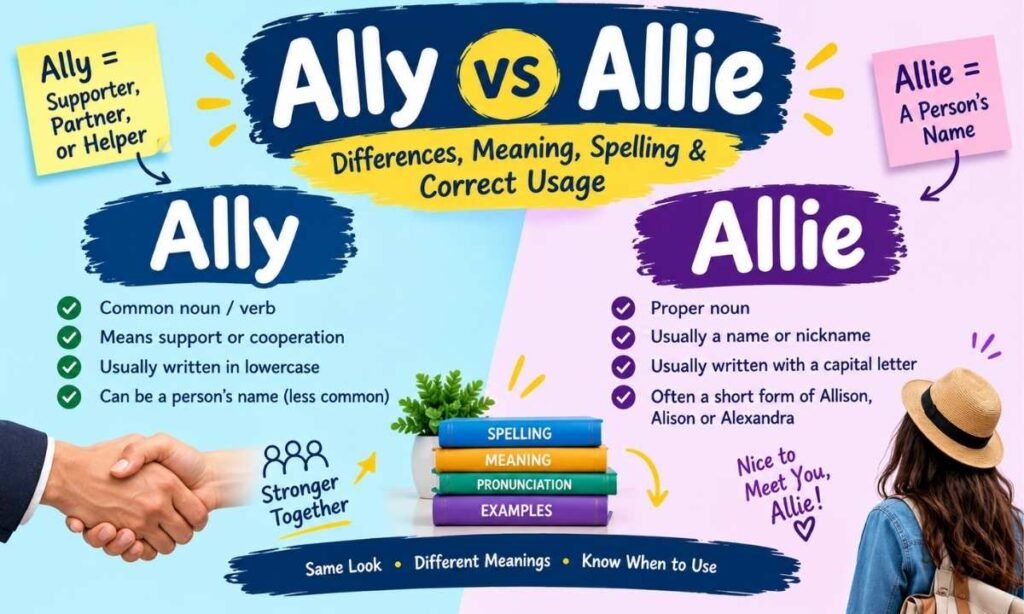
Ally is the standard English word for a supporter, partner, or someone who cooperates with another person or group. Allie is generally a personal name or nickname, most often short for Allison or Alexandra. The two words share a root sound but serve completely different grammatical roles.
Ally Means a Supporter or Partner
As a common noun, ally describes someone who stands with you, whether that is a friend, a coworker, or an entire nation in a political alliance.
Allie Is Usually a Person’s Name
Allie functions as a proper noun, referring to one specific individual rather than a general concept of support or cooperation.
Why Ally and Allie Are Easy to Confuse
Because they sound nearly identical when spoken and differ by only one letter in writing, autocorrect and quick typing frequently swap one for the other.
Ally vs Allie Quick Comparison
| Feature | Ally | Allie |
| Main use | Supporter or partner | Personal name |
| Word type | Common noun or verb | Proper noun |
| Capitalization | Usually lowercase | Usually capitalized |
| Example | She is my ally. | Allie called me. |
| Core meaning | Support and cooperation | A specific person’s name |
What Does “Ally” Mean?
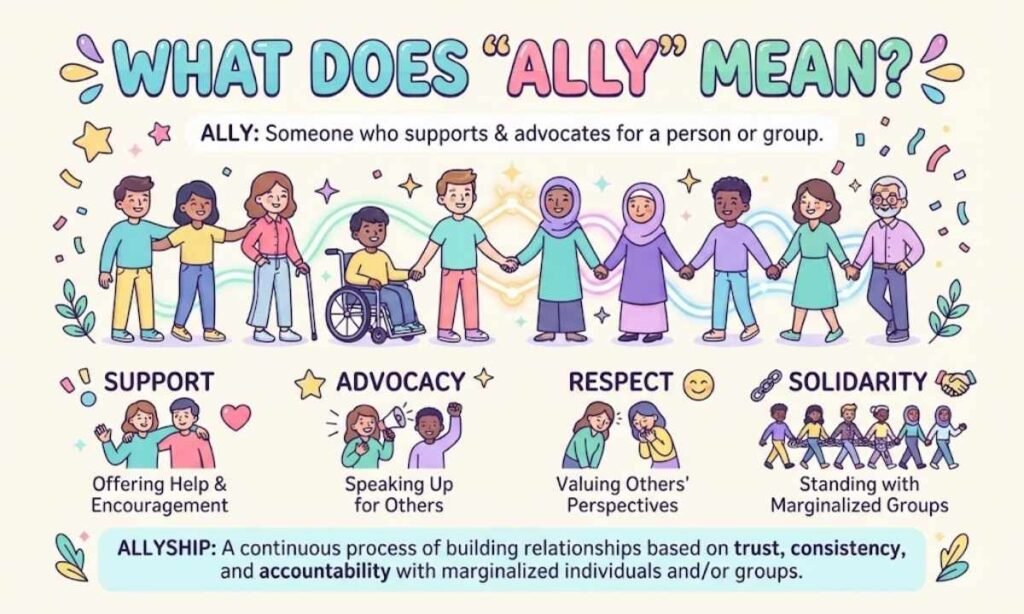
Ally carries a consistent meaning across contexts, even though the setting changes how it is applied.
Ally as a Noun
Used as a noun, ally refers to a person, group, or country that offers help or cooperation, as in “she has always been a loyal ally.”
Ally as a Verb
As a verb, to ally means to form a partnership or join forces, commonly seen in the phrase “ally yourself with” a cause or group.
Ally in Relationships, Business, and Between Countries
In personal relationships, an ally is someone who supports you emotionally. In business, allies cooperate on shared goals or deals. Between nations, allies formally cooperate through treaties or shared defense agreements.
What Does “Allie” Mean?
Allie almost always functions as a given name or an affectionate short form rather than carrying an independent dictionary definition.
Allie as a First Name
Some people are given Allie as their full legal first name rather than as a nickname for something longer.
Allie as a Nickname
More commonly, Allie works as a casual nickname for a longer formal name, used by friends and family in everyday conversation.
Is Allie a Short Form of Allison?
Yes, Allie is frequently used as a diminutive of Allison, one of its most common source names.
Ally vs Allie Pronunciation
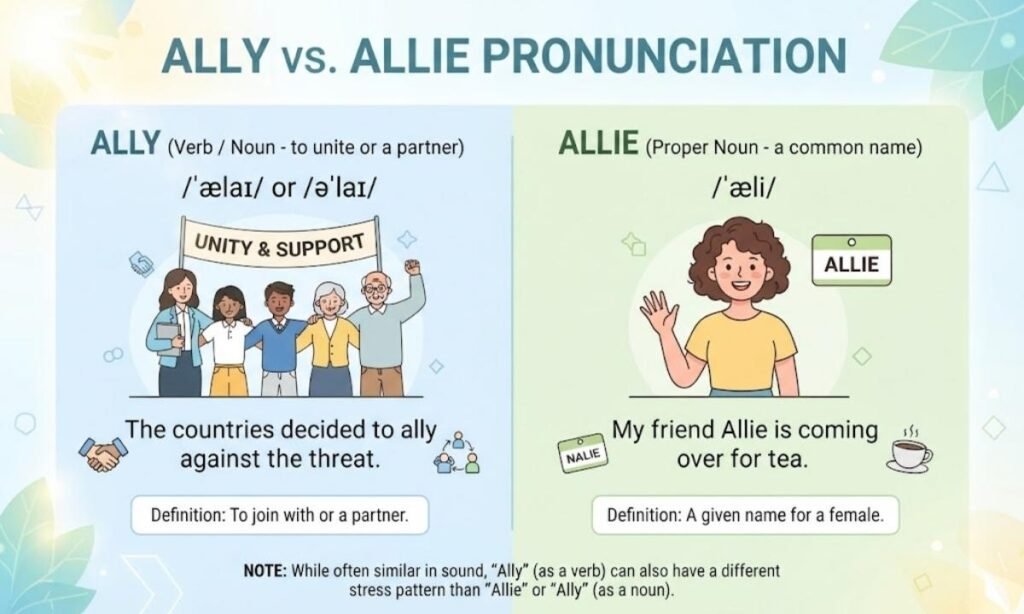
Pronunciation is where a lot of guides oversimplify, since the way these words sound depends partly on how someone chooses to say their own name.
How Do You Pronounce “Ally”?
As a common word, ally is typically pronounced AL-eye, with stress on the first syllable, though a secondary pronunciation closer to uh-LY also appears depending on regional accent.
How Do You Pronounce “Allie”?
As a name, Allie is generally pronounced AL-ee, rhyming with “rally” rather than with “eye.”
Do Ally and Allie Sound the Same?
Not usually. The word ally tends to end on an “eye” sound, while the name Allie tends to end on an “ee” sound, though individual pronunciation can vary by person and region.
Ally or Allie: Which Spelling Is Correct?
Neither spelling is universally “more correct,” since each one is correct for a different purpose.
Use “Ally” When You Mean a Supporter
If the sentence is about cooperation, partnership, or backing someone up, ally is the standard spelling.
Use “Allie” When It Is Someone’s Name
If you are referring to a specific person by name, Allie is correct only if that is how they actually spell it.
Why You Should Never Assume Someone’s Name Spelling?
Names follow the individual’s own preference, and Ally itself is also a documented given name for some people, so context and confirmation matter more than assumption.
Ally vs Allie Examples in Sentences
Seeing both words used naturally makes the distinction easier to remember than a definition alone.
Examples Using “Ally”
She became my closest ally. We need an ally in this project. The two countries remain allies after decades of cooperation.
Examples Using “Allie”
Allie is coming to dinner tonight. I called Allie yesterday about the schedule. Allie sent the email this morning.
Examples Using Both Words Together
Allie became an important ally to the entire team during the project.
Correct and Incorrect Examples
| Correct | Incorrect | Why |
| She is my ally. | She is my Allie. | The sentence describes support, not a name |
| Allie sent the email. | Ally sent the email, if her name is Allie. | Assuming the wrong spelling of her name |
| They became allies. | They became allie. | Ally pluralizes to allies, not allie |
Ally as a Noun vs Ally as a Verb
Ally is unusual among these two words because it functions in more than one grammatical role.
Ally as a Common Noun
Most often, ally names a person or entity, as in “a trusted ally.”
Ally as a Verb
Less commonly, ally works as a verb meaning to join or unite with someone, as in “the two groups chose to ally against a shared threat.”
Allied and Allies as Related Forms
The related forms allied and allies extend the same meaning, describing past cooperation or multiple supporters, and neither form applies to the name Allie.
Should “Ally” and “Allie” Be Capitalized?
Capitalization offers a useful clue, though it is not an absolute rule.
When to Capitalize Allie
Because Allie is a proper noun referring to a specific person, it is capitalized in every standard use.
When to Write Ally in Lowercase
When ally describes a supporter or partner in general terms, it stays lowercase, just like any other common noun.
When Ally Is Someone’s Actual Name
Ally itself is also used as a person’s name or nickname, in which case it is capitalized, so capitalization alone cannot always tell you which meaning is intended without reading the full sentence.
Is Allie a Nickname for Ally, Allison, or Alexandra?
Nickname conventions vary widely, and no single rule applies to every person who uses a shortened name.
Allie is commonly linked to Allison, one of its most frequent full forms. It also appears as a nickname connected to Alison, a slightly different spelling of the same root name. Some people additionally use Allie as a short form of Alexandra, though this pairing is less common than the Allison connection. Because nickname choices are personal, it is best to confirm rather than assume which full name someone’s Allie is shortened from.
Ally vs Allie as Baby Names
Naming data adds a useful, factual layer that separates the everyday word from the personal name entirely.
According to United States Social Security Administration records, Allie has consistently outpaced Ally in total recorded births, with roughly 52,700 babies named Allie historically compared to around 10,100 named Ally. Allie peaked in popularity around 2010 with over 1,600 births that year, while Ally reached its own peak closer to 1998 with about 636 births.
Both names have declined in recent years, but Allie remains the far more common of the two spellings as a standalone given name in the United States.
| Metric | Allie | Ally |
| Approximate total U.S. births | 52,700 | 10,100 |
| Peak year | 2010 | 1998 |
| Peak year births | 1,637 | 636 |
| Recent trend | Declining since 2010 | Declining since 1998 |
Common Mistakes With Ally and Allie
A few recurring errors account for most of the confusion between these two words.
Writing Allie when the sentence actually means a supporter is one frequent slip. Writing Ally instead of someone’s actual name, when they spell it Allie, is another common mistake. Forgetting to capitalize Allie in casual writing happens often in quick texting. Assuming every person who goes by Allie is short for Allison, without confirming, overlooks other possible source names like Alexandra or Alison.
Easy Trick to Remember Ally vs Allie
A simple substitution test makes the distinction almost automatic once you try it a few times.
If you can replace the word with “supporter” and the sentence still makes sense, you need ally. For example, “she is my strongest ally” becomes “she is my strongest supporter,” which still reads naturally. But “Allie called me yesterday” cannot be replaced the same way, since “supporter called me yesterday” loses the intended meaning entirely, confirming that a specific name is meant instead.
Ally and Allie as Usernames and Social Media Handles
Both spellings show up constantly as usernames, which adds another layer of everyday confusion beyond formal writing. Someone using “Allie” as a handle is almost always referencing their own name, while “Ally” as a username can go either way, representing either a person’s chosen name or a conceptual choice tied to the word’s supportive meaning.
When messaging someone by their handle, it is worth checking their profile or bio rather than assuming which meaning they intended.
How to Politely Confirm Someone’s Preferred Spelling
If you are unsure whether someone spells their name Ally or Allie, a quick, direct question avoids repeated mistakes. Simply asking “just to confirm, is it Ally or Allie?” the first time you write their name is far better than guessing and correcting it later.
This is especially useful in professional emails, where getting a colleague or client’s name wrong can look careless even though the two spellings are easy to mix up.
Words That Look Similar to Ally and Allie but Mean Something Else
A few nearby spellings add to the confusion and are worth distinguishing separately. Alley refers to a narrow passage or lane between buildings, and shares no meaning with either ally or Allie despite the close spelling. Alli, without the trailing e, sometimes appears as a shortened username or casual name variant distinct from Allie.
Recognizing these lookalikes helps prevent an entirely unrelated word from being mistaken for either core term.
Frequently Asked Questions
Is Ally or Allie the correct spelling?
Both are correct, depending on meaning: ally for a supporter, Allie for a person’s name.
What is the difference between Ally and Allie?
Ally is a common word for a supporter or partner, while Allie is typically a personal name.
Is Allie a nickname for Allison?
Yes, Allie is one of the most common nicknames used for the name Allison.
Is Ally a name or a word?
Ally is primarily a common word, though it is also used by some people as an actual given name.
Are Ally and Allie pronounced the same?
Not usually; ally often ends on an “eye” sound while Allie typically ends on an “ee” sound.
Can Ally be a person’s name?
Yes, some individuals use Ally as their given name or nickname rather than the general noun.
What is the plural of ally?
The plural of ally is allies, formed by changing the y to ies.
Is Allie more common than Ally as a U.S. name?
Yes, U.S. birth records show significantly more babies named Allie than Ally historically.
Conclusion
Use “ally” when you mean a supporter, partner, or someone who cooperates with you. Use “Allie” when referring to a person whose name is spelled that way.
Since Ally can also be someone’s actual name, always confirm and follow the individual’s own preferred spelling rather than assuming based on the word’s common meaning.