
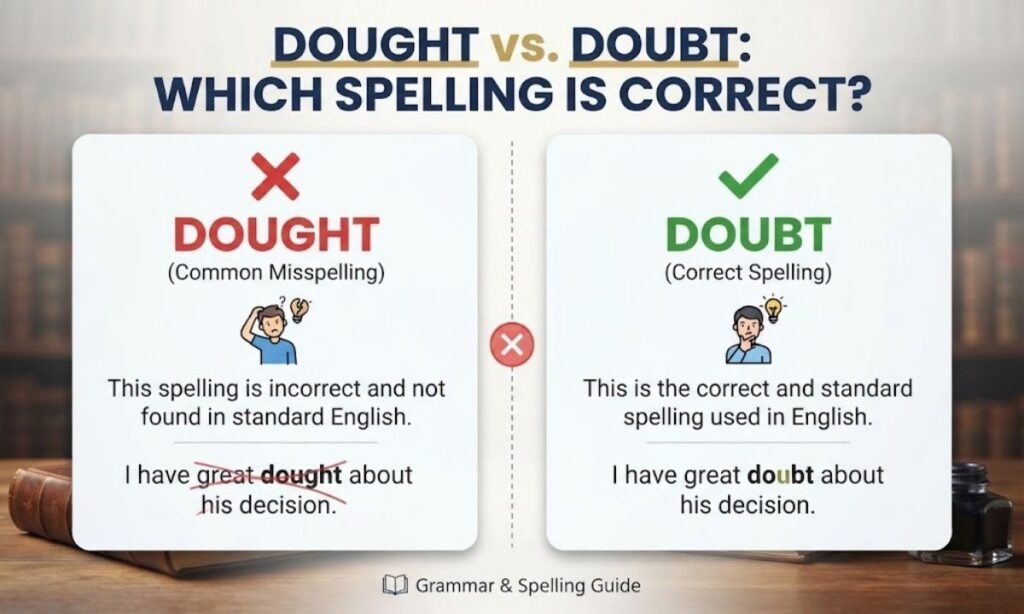
Typing this word by ear leads many people to write dought instead of doubt. The silent B hides in plain sight, and the ending sound suggests a spelling that dictionaries never use for this word. The mistake is common, easy to fix, and worth understanding once.
Whether you write essays, reports, or business emails, one wrong letter can distract readers and weaken trust. This guide gives the direct answer first, then covers meaning, pronunciation, sentence use, and the rare history of dought. You will find two tables, clear examples, memory tricks, and short answers to common questions, so the correct spelling sticks for good and you can write with confidence.
Dought vs Doubt: Quick Answer
Doubt is the correct modern spelling. Dought is not a spelling of doubt. It is a rare dialect word from Scots and northern English with a different meaning, so it never replaces doubt in standard writing.
Is “Dought” or “Doubt” Correct?
Doubt is correct. Use it whenever you mean uncertainty or disbelief.
What Does “Doubt” Mean?
Doubt means a feeling of uncertainty, or to be unsure that something is true or likely.
Is “Dought” a Real Word?
Yes, but only as an obsolete or dialect term. It does not mean doubt.
Dought vs Doubt Meaning and Difference
Meaning of Doubt
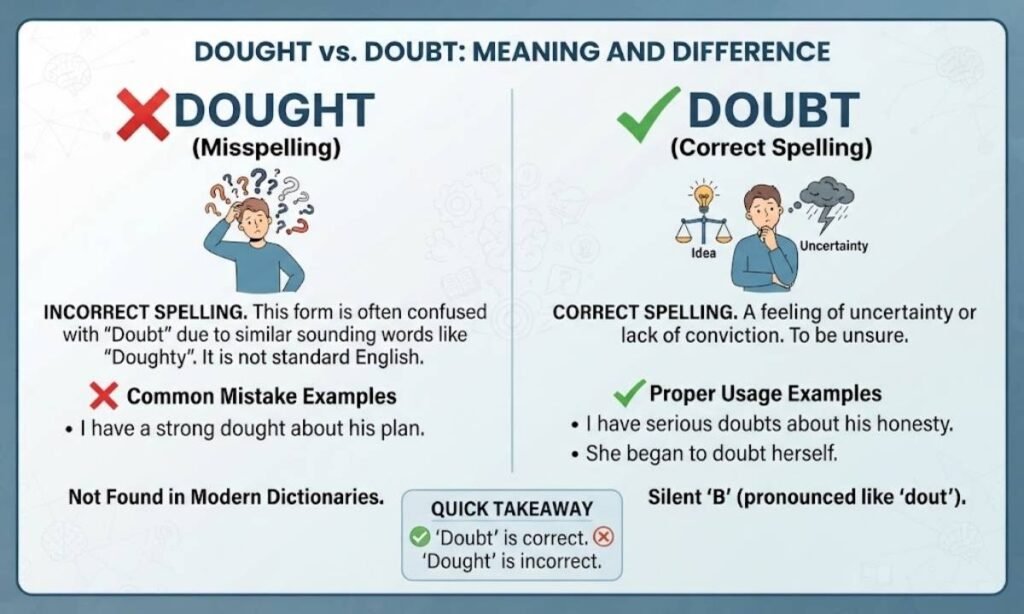
Doubt names uncertainty, disbelief, or lack of trust. As a verb, it means to question or distrust.
Meaning of Dought
Dictionaries record dought as a dialect past tense of dow, meaning to be able. Scots also used it for strength.
Why Dought and Doubt Are Confused
They sound close to many ears, and words like thought and bought set a strong spelling pattern.
Dought vs Doubt: Spelling Comparison
Correct Spelling: Doubt
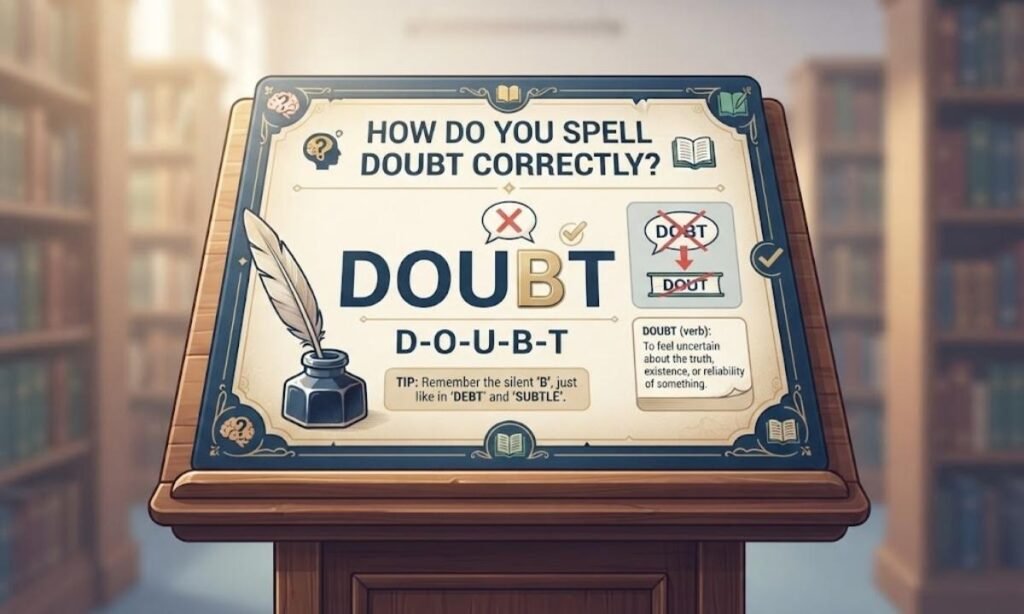
Doubt has five letters: D, O, U, B, T. The B is silent.
Incorrect Modern Spelling: Dought
Dought swaps the B for GH. In modern writing, it counts as an error.
Dought vs Doubt in a Simple Comparison Table
| Feature | Doubt | Dought |
| Modern spelling | Correct | Incorrect |
| Meaning | Uncertainty or distrust | Dialect word meaning was able, or strength |
| Where used | Everyday English | Historical Scots and northern English |
| Should you write it? | Yes | Only in historical quotes |
How Do You Spell Doubt Correctly?
Why Does Doubt Have a Silent B?
Scribes later added the B to echo the Latin root, even though speakers never pronounced it. The letter stayed in the spelling.
How to Remember the Spelling of Doubt
Doubt and debt both hide a silent B before the T. Pair the two words in your mind, and the missing letter becomes easy to spot.
Common Spelling Mistakes With Doubt
• Dought for doubt
• Dout for doubt
• Doutful for doubtful
How Do You Pronounce Doubt?
Doubt Pronunciation in American English
Say it as DOWT, rhyming with out and about. Listeners across the United States use this same sound, with no B and no GH.
Why the B in Doubt Is Silent
The B entered the spelling for etymology, and speakers never voiced it.
Dought vs Doubt Pronunciation
Many people say both as DOWT, which fuels the mix up. Older Scots forms ended with a throat sound.
How to Use Doubt in a Sentence?
Doubt as a Noun
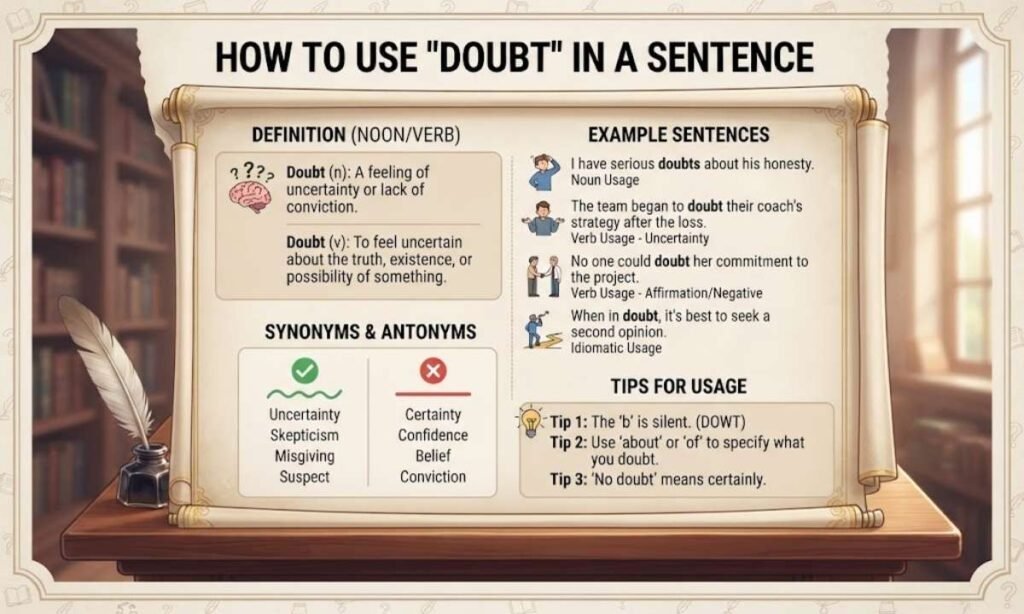
As a noun, it names uncertainty, as in there is no doubt about it.
Doubt as a Verb
As a verb, it means to question, as in I doubt he will arrive on time.
Examples of Doubt in Everyday English
• She had no doubt the bus would be late.
• Don’t doubt yourself.
Examples of Doubt in Formal Writing
• The study leaves little doubt about the trend.
• The committee expressed doubt about the budget.
Dought vs Doubt Example Sentences
Correct Examples With Doubt
• He has no doubt about the answer.
• I doubt the store is open.
Incorrect Examples With Dought
• He has no dought about the answer.
• I dought the store is open.
Correct “Without a Doubt” Examples
• Without a doubt, this is the best option.
• She is without a doubt the top candidate.
“I Doubt” vs “I Have Doubt”
I doubt uses the verb, while I have doubts uses the noun. Both are correct.
Is Dought Ever a Correct Word?
Yes, but only in historical or dialect contexts, and never as a stand in for doubt.
Dought in Historical English
Middle English records show dought as a past form of a verb meaning to avail or be able.
Dought in Scots and Northern English
Scottish dictionaries list dought as a past tense of dow and as a noun meaning power.
Why Historical Dought Is Different From Doubt
Dought comes from an Old English root meaning to be useful. Doubt comes from Latin through French.
Dought vs Doubt in American English
Which Spelling Is Used in the USA?
American writers use doubt, and no regional rule allows dought.
Is Dought an American English Word?
No. It is not part of standard American vocabulary, and spell checkers flag it.
Does British English Spell Doubt Differently?
No. British and American English both spell it doubt.
Why Do People Spell Doubt as Dought?
The Silent B Spelling Problem
A silent letter gives no audio clue, so writers guess a spelling that fits the sound.
The Influence of Words Like Thought and Bought
Words ending in ought are common, so dought feels familiar, though thought rhymes with taught, not out.
How Pronunciation Causes the Mistake
Drought is spelled with GHT yet sounds like doubt, so the pattern looks believable to anyone spelling by sound.
Doubt Synonyms You Can Use
Synonyms for Doubt as a Noun
• Uncertainty
• Skepticism
• Hesitation
• Misgiving
Synonyms for Doubt as a Verb
• Question
• Distrust
• Mistrust
Doubt vs Uncertainty
Uncertainty is neutral, while doubt often leans toward disbelief. A forecast carries uncertainty, but a skeptic voices doubt.
Doubt vs Suspicion
Doubt questions whether something is true. Suspicion senses that something may be wrong.
Doubt Word Forms You Should Know
| Word Form | Part of Speech | Example |
| Doubt | Noun, verb | I doubt it |
| Doubted | Past tense verb | She doubted the claim |
| Doubting | Present participle | He kept doubting himself |
| Doubtful | Adjective | The result is doubtful |
| Undoubtedly | Adverb | It is undoubtedly true |
Origin of the Word Doubt
Doubt entered English from Old French, which drew on the Latin verb dubitare. English later restored the B to match Latin. That scholarly choice explains why the letter shows up in print while speakers leave it silent.
Common Phrases With Doubt
These set phrases appear in news, law, and daily speech, and each one keeps the B.
• No doubt: certainly
• Beyond a reasonable doubt: a legal standard of proof
• Benefit of the doubt: a fair assumption of good faith
• Cast doubt on: make something seem less believable
Quick Checklist Before You Publish
• Search your draft for dought and replace it with doubt.
• Check doubtful and doubting for the B.
• Run a spell check, then reread once.
Frequently Asked Questions
Is Dought a Correct Spelling?
No. Doubt is the only correct modern spelling.
What Is the Correct Spelling, Dought or Doubt?
Doubt. It has a silent B before the T.
What Is the Meaning of Dought?
It is a dialect past tense of dow, meaning to be able.
What Is the Meaning of Doubt?
Doubt means uncertainty, or to feel unsure about something.
How Do You Pronounce Doubt?
Say DOWT, with a silent B.
Can Dought Be Used in Modern English?
Only when quoting or studying historical or dialect texts.
Is Dought an Old English Word?
Its roots reach Old English, but it appears mainly in Middle English and Scots.
Conclusion
Doubt is the spelling you need for modern English. Dought is a separate historical word, not a variant of doubt, so keep the silent B and the correct meaning in mind.