Few spelling pairs cause as much second guessing as mold and mould. You may have seen one on a food label and the other on a hardware store website, and wondered whether one of them is a typo. Neither is. The difference comes down to which version of English you are writing in.
This guide explains which spelling to use in the United States, what British readers expect, and how the change carries into molded, molding, and moldy. You will also find examples, two comparison tables, memory tricks, and quick answers, so you can settle the question in under a minute.
Mold vs Mould: What Is the Difference?
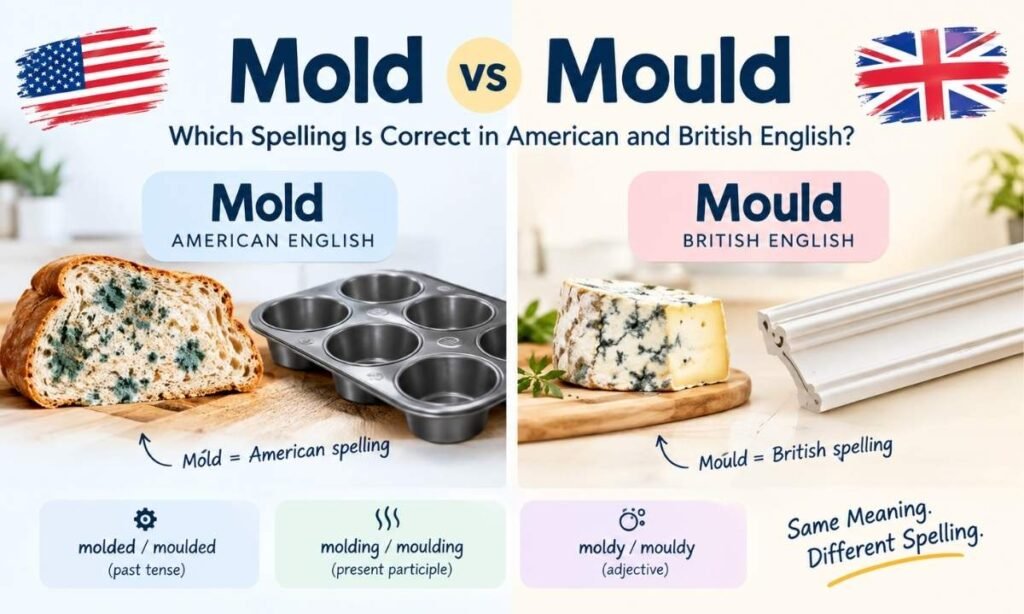
Quick answer: Mold is the standard American English spelling, while mould is the standard British English spelling. Both are correct, and both carry the same core meanings.
Mold Is the American Spelling
U.S. dictionaries list mold as the main form, so American writers should use it in emails, articles, and school papers.
Mould Is the British Spelling
Readers in the United Kingdom, Australia, and New Zealand expect mould in news stories, textbooks, and product labels.
Do Mold and Mould Mean the Same Thing?
Yes. The fungus, the shaping container, and the verb meaning to shape all work the same way in both spellings.
Is Mold or Mould Correct?
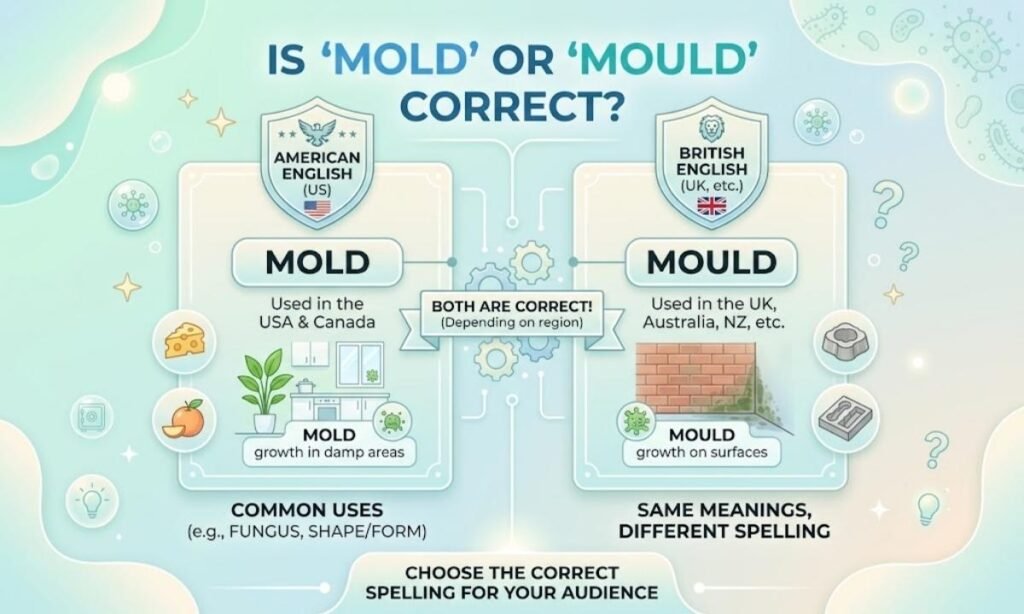
Correctness depends on your audience, not on the word itself. Match the spelling to the region your readers live in.
• Writing for a U.S. audience: use mold.
• Writing for a UK, Australian, or New Zealand audience: use mould.
• Writing for a global audience: pick one form and stay consistent.
An American writer who types mould has not made a mistake, but the word will look foreign to most local readers. Editors also notice the mismatch quickly, so it is worth checking before you hit send or publish.
What Does Mold Mean?
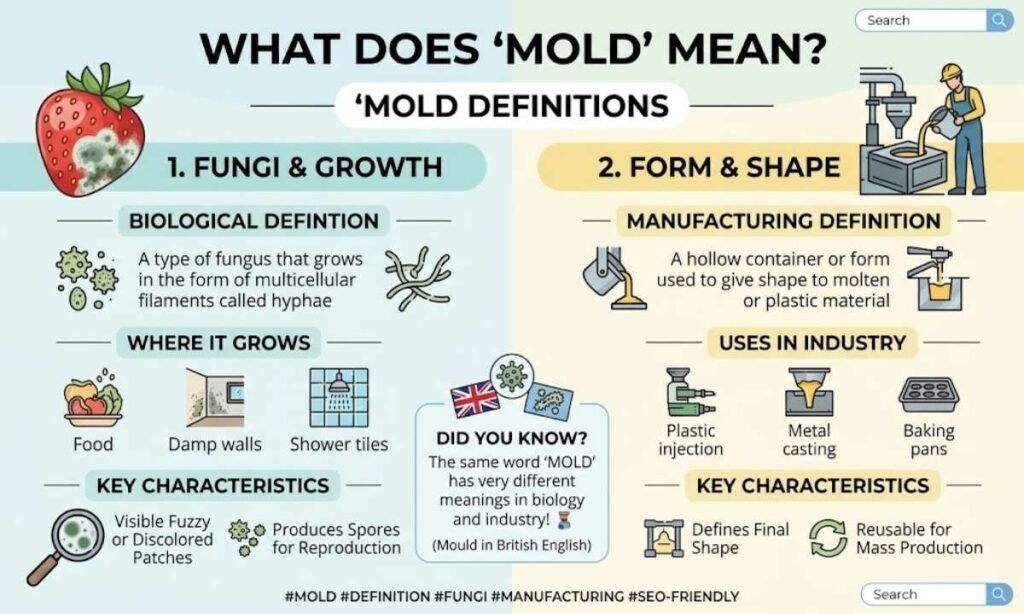
The word has several related senses, and each one exists in both spellings.
Mold as a Fungus
A fuzzy or powdery growth that forms on damp walls, bathroom tile, and old bread.
Mold as a Shaping Container
A hollow form that gives shape to liquid material, such as gelatin, candle wax, or molten metal.
Mold as a Verb
To shape something by hand or by machine, like clay, dough, or a plastic part.
Mold in a Figurative Sense
To influence someone’s character, as when a coach molds a young player into a leader.
Mold vs Mould in American and British English
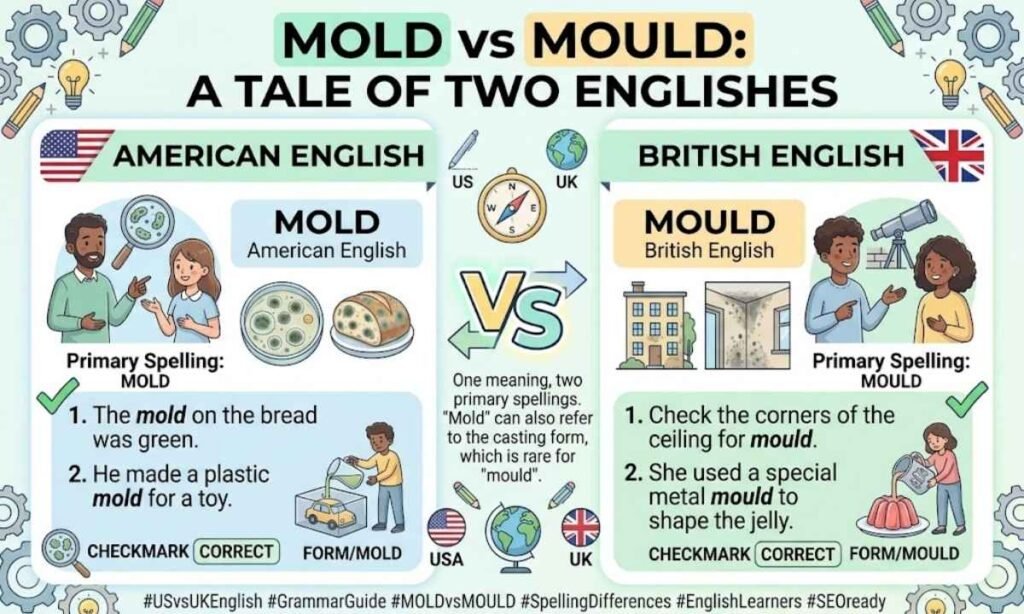
Geography drives the choice more than any grammar rule.
• United States: mold is the standard.
• United Kingdom: mould is the standard.
• Australia and New Zealand: mould is standard, following British habits.
• Canada: both forms appear, so follow the style guide your publisher uses.
Mold vs Mould Examples in Sentences
Short sentence pairs make the difference easy to spot.
| Use | American English | British English |
| Fungus | We found mold behind the fridge. | We found mould behind the fridge. |
| Container | She poured batter into a silicone mold. | She poured batter into a silicone mould. |
| Verb | The sculptor molded the clay by hand. | The sculptor moulded the clay by hand. |
| Adjective | The bread turned moldy overnight. | The bread turned mouldy overnight. |
| Participle | The factory is molding plastic parts. | The factory is moulding plastic parts. |
Molded vs Moulded: Which Is Correct?
Both are right. Molded is the American past tense and past participle, and moulded is the British one. The spelling of the base word simply carries through.
• American: “The artist molded the figure from wet clay.”
• British: “The artist moulded the figure from wet clay.”
Molding vs Moulding and Moldy vs Mouldy
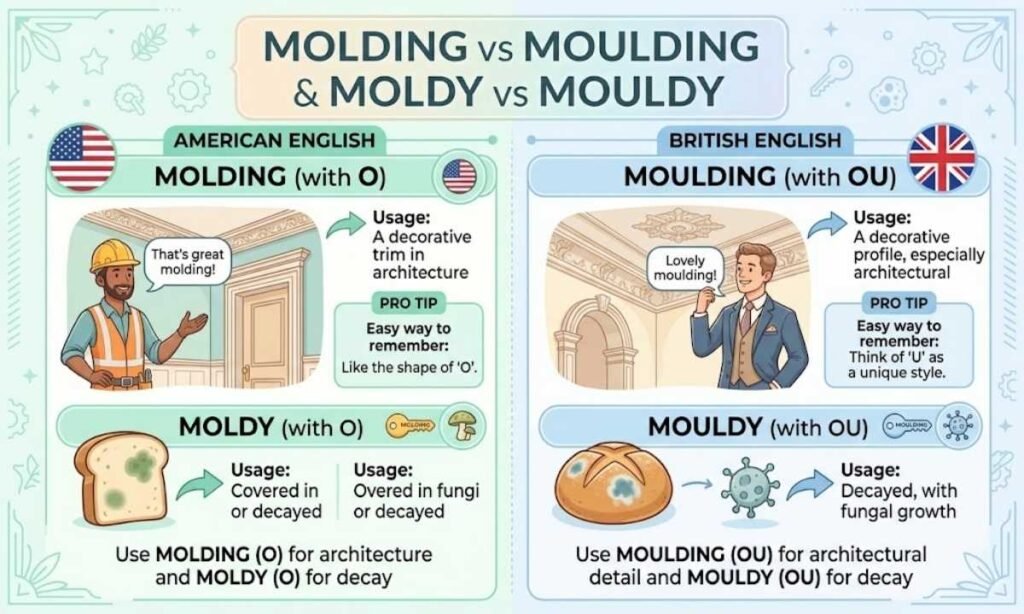
The same pattern applies to every word built from the base form.
• Molding and moulding work as nouns and verbs. Crown molding is the decorative trim where a wall meets the ceiling.
• Injection molding and injection moulding name the same manufacturing process for making plastic parts.
• Moldy and mouldy describe anything covered in fungus. Note that mouldy keeps the extra u.
Mold vs Mould in Different Contexts
The spelling stays tied to region even when the topic changes. Here is how it plays out in common situations.
• Food: Americans discard moldy cheese, while British shoppers throw out mouldy cheese.
• Home: Damp basements and leaky windows invite mold in the U.S. and mould in the UK.
• Manufacturing: A plastic mold or mould shapes parts, and injection molding is a standard factory method.
• Cleaning: Mold removal and mould removal describe the same job, from scrubbing tile to hiring a specialist.
In every case, the meaning does not change. Only the spelling shifts with your audience.
Common Mistakes With Mold and Mould
1. Treating mould as a typo, when it is standard British English.
2. Assuming the two words have different meanings.
3. Mixing spellings in one document, such as mold and moulded together.
4. Forgetting that molded, molding, and moldy must match the base word.
5. Changing an official brand or organization name, which should keep its own spelling.
A quick read through your draft for these five slips catches nearly every spelling problem readers will notice.
How to Remember Mold vs Mould?
• U for UK: if the word keeps the u, think United Kingdom.
• Trim for America: American English drops the extra letter in mold, color, and favorite.
• Pair it with a familiar word: if you write colour in British English, you write mould too.
Mold vs Mould Quick Comparison
| Word Form | American English | British English |
| Main spelling | mold | mould |
| Fungal growth | mold | mould |
| Shaping container | mold | mould |
| Verb | mold | mould |
| Past tense | molded | moulded |
| Present participle | molding | moulding |
| Adjective | moldy | mouldy |
The History Behind the Two Spellings
The words come from several sources, including Old French and Scandinavian languages, and mould was the common English spelling for centuries. In the early 1800s, Noah Webster’s dictionaries helped popularize shorter American spellings. That is why Americans write mold, color, and honor while British writers keep the u.
Related Words That Follow the Same Pattern
Once you know this rule, many other spelling differences become easy to predict.
• color and colour
• favorite and favourite
• neighbor and neighbour
• flavor and flavour
• smolder and smoulder
Mold vs Mould on Signs, Labels, and Product Pages
U.S. home improvement stores sell mold removers, while UK retailers sell mould removers. Health guidance follows the same regional habit. If you run an online store, match product titles to your shopper’s region, and use the local spelling in headings, image descriptions, and page titles.
Spellchecker Settings That Save You Time
Set your word processor to English (United States) or English (United Kingdom) before you start typing. The spellchecker will then flag the wrong form automatically. Give your draft one final proofread with the correct language selected before you publish.
Tips for Writers With a Global Audience
• Follow the style guide your audience uses, such as AP or Chicago in the U.S.
• Use mold in American academic and business writing, and mould in British formal writing.
• Keep one spelling across headings, captions, and metadata.
• Publish separate regional pages if your traffic is truly split.
Frequently Asked Questions
Is mold or mould correct?
Both are correct. Mold is American, and mould is British.
Is mold American or British?
Mold is the standard American spelling. British English uses mould.
Do mold and mould mean the same thing?
Yes. They share the same meanings for fungus, containers, and shaping.
Is mould a misspelling of mold?
No. It is the standard British spelling, not an error.
Which spelling should I use in the USA?
Use mold, along with molded, molding, and moldy.
Is molded or moulded correct?
Both are correct. Molded is American, and moulded is British.
Can I use mould in American English?
You can, but it looks unfamiliar. Use mold unless you are quoting a British source or brand.
Conclusion
Mold and mould are two correct spellings of the same word. Choose mold for American readers and mould for British ones, then carry that choice through molded, molding, and moldy.
Stay consistent, check your spellchecker language, and follow the style guide your audience uses. With those habits, you will never have to wonder which form is right again.