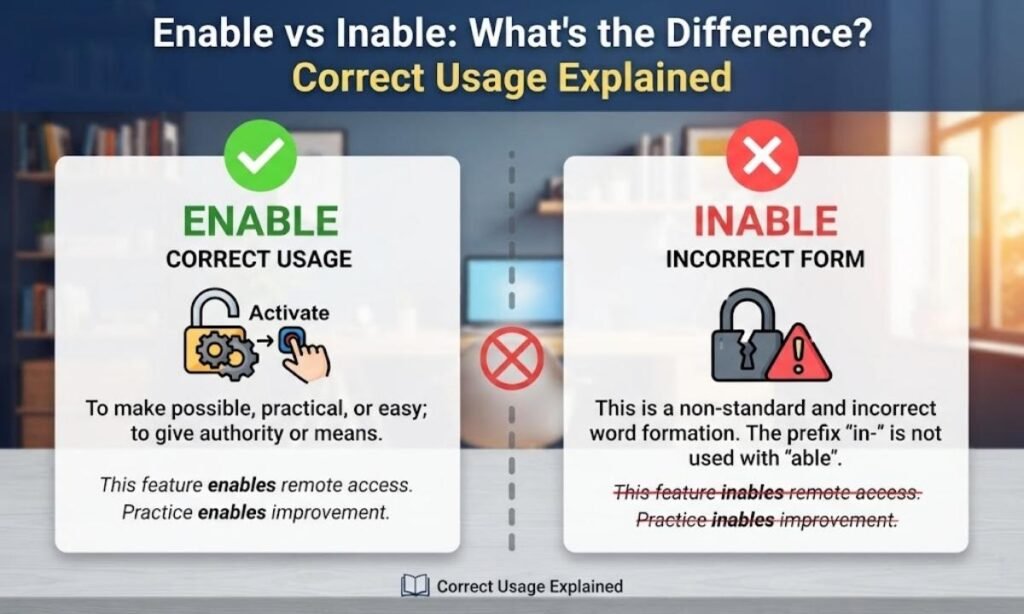
People often type “inable” when they want to say that something makes an action possible, or that someone cannot do something. The mix up is common because English uses the prefix “in” in many words, so it feels natural.
The standard words are enable and unable. This guide explains what each one means, shows the correct grammar patterns, and compares enable, unable, able, and disable. You will find clear examples, two tables, and simple memory tricks for emails, reports, and software settings.
Enable vs Inable: Quick Answer
Is “enable” or “inable” correct?
Enable is correct. It is the standard spelling used in modern dictionaries, news writing, and technical documentation.
Is “inable” a real English word?
Not in standard modern English. It appears only in very old texts as a spelling variant and is considered obsolete today.
What word should you use instead of “inable”?
Use enable to mean “make possible” and unable to mean “not able.” Both are correct and widely understood.
What Does “Enable” Mean?
Enable definition and meaning
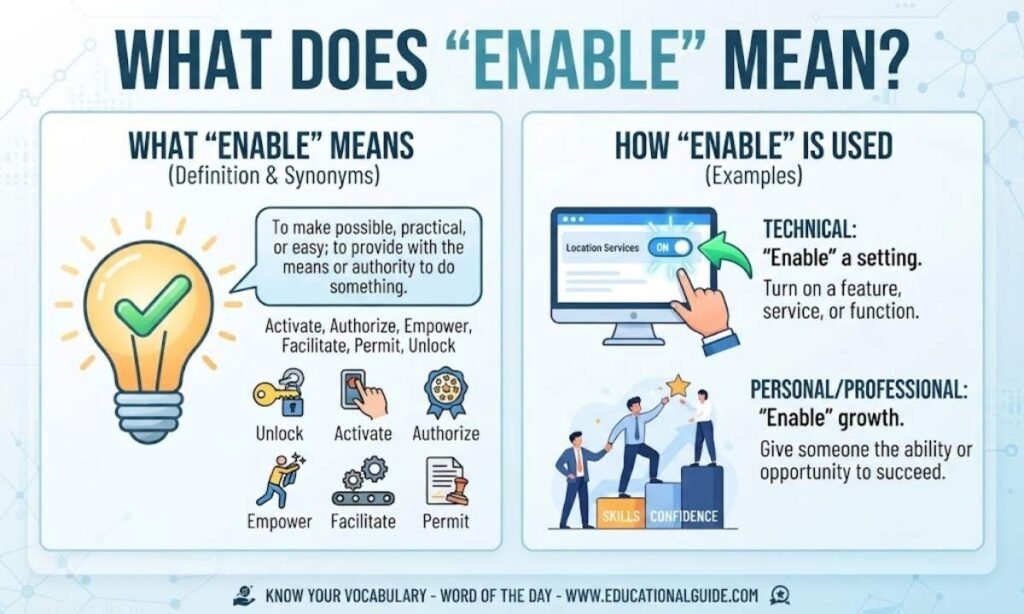
Enable is a verb that means to give someone the means, power, or permission to do something. It can also mean to switch on a feature.
How is “enable” used in a sentence?
It usually follows the pattern enable plus a person or thing, then “to” plus a verb. Example: “Good training enables teams to work faster.”
Enable sentence examples
• The new app enables users to track daily spending.
• A scholarship enabled her to finish college.
• Please enable notifications in your settings.
What Does “Unable” Mean?
Unable definition and meaning
Unable is an adjective that means lacking the ability, skill, or opportunity to do something. It describes a state, not an action.
When should you use “unable”?
Use it when someone or something cannot do a task because of a limit, a rule, or a lack of resources. It sounds more formal than “can’t.”
Unable in a sentence
• I am unable to attend the meeting on Friday.
• The server was unable to process the request.
Enable vs Unable: The Difference That Causes Most Confusion
Enable means “make possible”
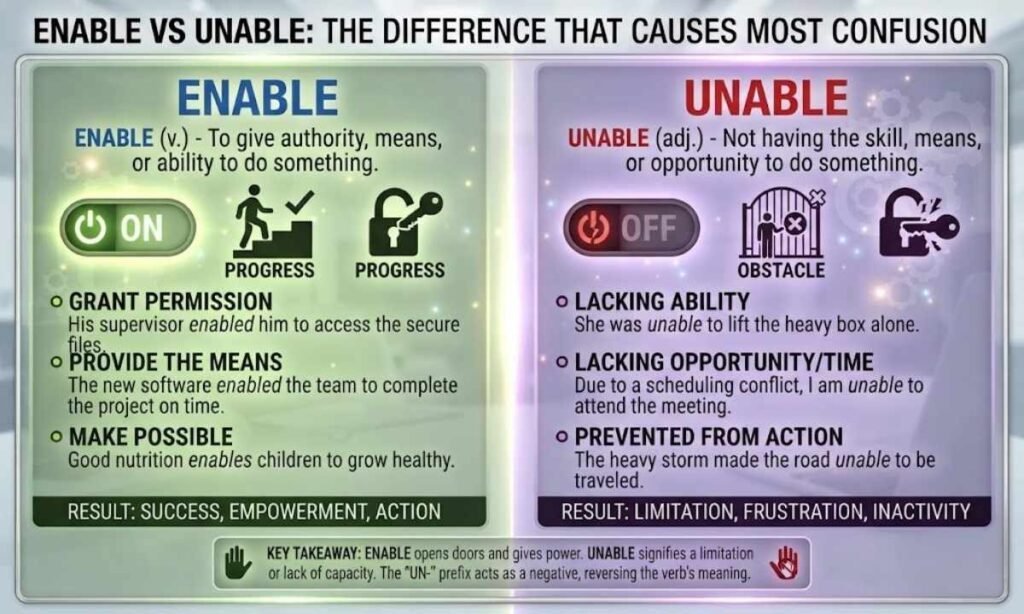
Enable is something you do for another person or thing. It opens a door.
Unable means “not able”
Unable describes a person or thing that cannot do something. It closes the door.
Why they are not exact grammatical opposites
Enable is a verb and unable is an adjective. They sit in different word classes, so they can contrast in meaning but cannot swap places in a sentence.
Why Does “Inable” Look Correct?
The confusion with English prefixes
English has many “in” words, such as inactive, incapable, and inaccurate. Writers assume “in” plus “able” must follow the same rule.
Why “able” becomes “unable,” not “inable”
Over time, English settled on “un” for this word, just as it did for unhappy and unclear. Prefix choice depends on word history, not a single rule.
Common spelling and pronunciation confusion
Enable and inable sound close in fast speech, because the first vowel is weak. That makes typing errors and autocorrect slips more likely.
Was “Inable” Ever a Word?
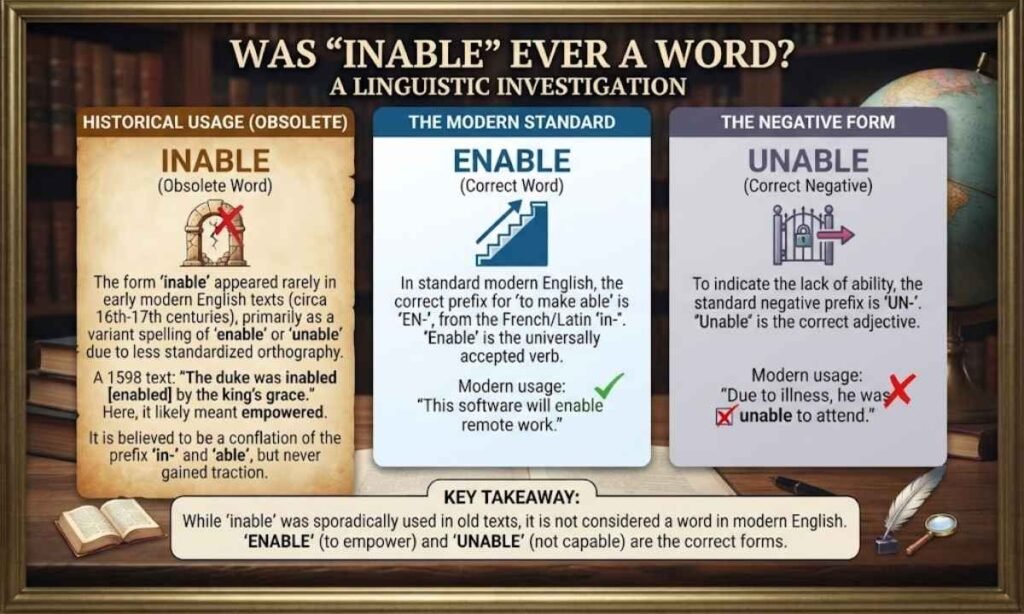
Historical meaning of “inable”
In older English, inable appeared as a variant spelling of enable, and sometimes in forms tied to ability. Spelling was far less fixed in earlier centuries.
Is “inable” obsolete or incorrect?
Modern dictionaries treat it as obsolete. In current writing, it will be read as a mistake.
Why historical usage does not make it standard today
Standard English follows current usage, not old spellings. Editors, search engines, and readers all expect enable or unable.
How to Use “Enable” Correctly
The “enable + someone + to” grammar pattern
The safest structure is enable, then the person or thing, then “to” and a base verb. Example: “The grant enables schools to buy books.”
Enable someone to do something
This pattern shows empowerment. “Mentors enable young writers to find their voice.”
Enable something to happen
This pattern shows cause and result. “Cloud storage enables files to sync instantly.”
Enable as “activate” in technology
In tech, enable means turn on. “Enable two factor login to protect your account.”
Enable Examples in Everyday English
Enable in technology
Developers enable features, permissions, and settings. A user may enable dark mode or location access.
Enable in business
Managers enable growth through better tools and clear goals. Strong systems enable employees to work with less friction.
Enable in education
Teachers enable learning with feedback and practice. Digital tools can enable students to study at their own pace.
Enable in professional writing
Formal documents use enable to show support or capability. “This policy enables faster approvals.”
Enable vs Disable: Are They Opposites?
When “disable” is the correct opposite of “enable”
Disable is the true opposite when you mean turn off or remove the ability. It matches enable as a verb.
Enable and disable in technology
Settings menus use both words as a pair. You enable a feature to turn it on and disable it to turn it off.
Enable vs unable: why they are different
Unable describes inability, while disable is an action. Use disable for switches and unable for people who cannot do something.
Enable vs Able: What’s the Difference?
Able describes ability
Able is an adjective meaning having the power or skill to do something. “She is able to lead.”
Enable describes creating ability
Enable is a verb meaning to give that power to someone else. “Training enables her to lead.”
Examples of able vs enable
• He is able to code in Python.
• The course enables him to code in Python.
Common Mistakes With Enable, Inable, and Unable
“I am inable to…” vs “I am unable to…”
Correct: “I am unable to join the call.” Inable is wrong in this sentence.
“The software will inable…” vs “The software will enable…”
Correct: “The software will enable offline access.” Always spell the verb with an “e.”
“Enable” vs “unable” in technology
Error messages say “unable to connect,” not “enable to connect.” The first describes failure and the second is a common typo.
“Enable” vs “disable” for settings
Use enable to switch something on and disable to switch it off. Do not use unable for settings.
Enable vs Inable vs Unable vs Disable
Quick Comparison of Four Words
| Word | Standard Today | Part of Speech | Meaning | Example |
| Enable | Yes | Verb | Make possible, switch on | Enable the camera. |
| Inable | No | Obsolete variant | Old spelling, not used | Avoid in writing. |
| Unable | Yes | Adjective | Not able to do something | I am unable to attend. |
| Disable | Yes | Verb | Turn off, remove ability | Disable pop ups. |
Which word should you choose?
Choose enable to make something possible, unable to say someone cannot, and disable to turn something off. Skip inable entirely.
Synonyms for Enable and Unable
Synonyms for enable
Common options include allow, permit, empower, equip, facilitate, and activate.
Synonyms for unable
Close options include incapable, powerless, incompetent, and not able. Each carries a slightly different tone.
Which synonym fits the context?
| Context | Best Choice | Example |
| Technology | Activate | Activate the update. |
| Support or growth | Empower | Empower your team. |
| Rules and access | Permit | Permit guest access. |
| Formal inability | Unable | Unable to comply. |
Verb Forms of Enable: Enables, Enabled, and Enabling
Use enables for third person singular, enabled for past tense, and enabling for continuous action. Example: “Enabling cookies enabled the page to load.”
Related Words: Enabler and Enablement
An enabler is someone or something that makes success possible. Enablement refers to the process of giving people tools and skills, a term common in business training.
Pronunciation Tips for Enable and Unable
Enable is pronounced en AY bul, with stress on the second syllable. Unable is pronounced un AY bul, and the matching ending helps explain why people confuse them.
Quick Practice Sentences
Fill in the blank with enable, unable, or disable:
1. Please ____ the update to improve speed.
2. She was ____ to find her keys.
3. ____ the alarm before you leave.
Answers: enable, unable, disable.
Why Correct Word Choice Builds Trust in Writing?
Readers notice small spelling errors, and they can weaken credibility in resumes, proposals, and product pages. Choosing the right word shows care, accuracy, and professionalism.
How to Remember Enable vs Unable
Use the “make possible” test
If you can swap the word with “make possible,” use enable. If not, pause and check.
Use “unable” when someone cannot do something
If the sentence says a person or system cannot act, unable is the right word.
Remember: enable, able, unable
Enable builds ability, able has ability, and unable lacks ability. Inable has no place in this chain.
Frequently Asked Questions
Is “inable” a correct English word?
No. It is an obsolete spelling and not part of standard modern English.
Is it enable or inable?
Enable is correct. Inable is a misspelling in current usage.
Is “inable” the opposite of “able”?
No. The opposite of able is unable.
Is “unable” the opposite of “enable”?
Not exactly. Unable is an adjective, while the verb opposite of enable is disable.
Can I say “I am inable to”?
No. Say “I am unable to” instead.
What is the difference between enable and unable?
Enable means to make something possible. Unable means not able to do something.
What is the difference between able and enable?
Able describes having the ability. Enable means giving someone that ability.
What is the opposite of enable?
Disable is the most common opposite, especially in technology. Prevent can also work in general writing.
What does enable mean in technology?
It means to turn on a feature, setting, or permission. Users enable options in apps and devices.
How do you use enable in a sentence?
“This tool enables teams to share files quickly.” Follow the pattern enable, person or thing, to, verb.
How do you use unable in a sentence?
“The system was unable to save the file.” It describes a failure or limit.
Is “inable” an obsolete word?
Yes. It appears in older texts but is not used in modern standard English.
Conclusion
Enable is the correct word when you mean make possible or switch on. Unable is correct when you mean not able, and disable is correct when you mean turn off.
Inable is not standard English today, so avoid it in professional writing. Keep the simple chain in mind: enable gives ability, able has ability, and unable lacks it.