
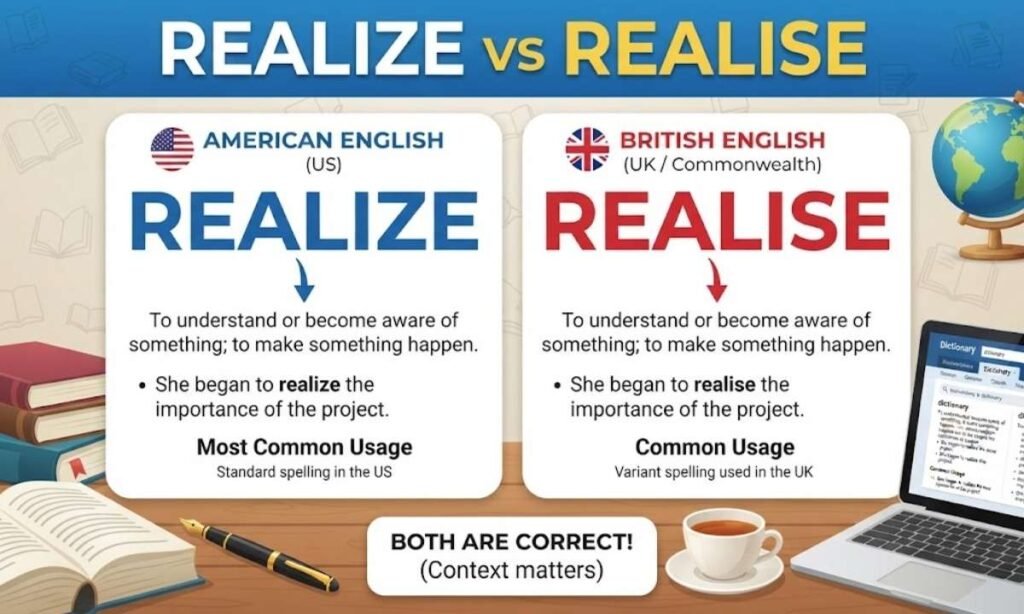
Realize and realise are both correct spellings of the same verb. Neither one is a typo. Realize is the standard choice in American English, while realise is common in British English, Australian English, and New Zealand English. The meaning, grammar, and pronunciation stay the same.
The only real question is which spelling fits your audience. This guide explains realize vs realise, shows how each form works in sentences, and covers related words like realized, realizing, and realization. You will also learn when to follow a style guide, how to stay consistent, and how to avoid common mistakes. Short examples and two quick tables make the choice easy.
Realize vs Realise: The Quick Answer
Both spellings are correct. Use the one that matches your audience and stay consistent.
• Realize is the standard spelling in US English.
• Realise is common in British English.
• British English can also use realize under the -ize spelling convention.
• The meaning does not change.
| Feature | Realize | Realise |
| United States | Standard | Not standard |
| United Kingdom | Used in some house styles | Very common |
| Canada | Commonly used | Less common |
| Australia and New Zealand | Less common | Common |
| Meaning and pronunciation | Same | Same |
What Is the Difference Between Realize and Realise?
The Difference Is Spelling, Not Meaning
Realize and realise are two spellings of one verb. Changing the z to an s does not change the definition, tense, or grammar. It works like color and colour: one idea, two regional spellings.
What Does Realize/Realise Mean?
Dictionaries list two everyday meanings:
• To become aware of something or understand it clearly.
• To achieve something or make it real, such as a plan or a dream.
Are Realize and Realise Pronounced the Same?
Yes. Both are pronounced REE-uh-lyze. Realise is normally spoken with a /z/ sound at the end, even though it is written with an s.
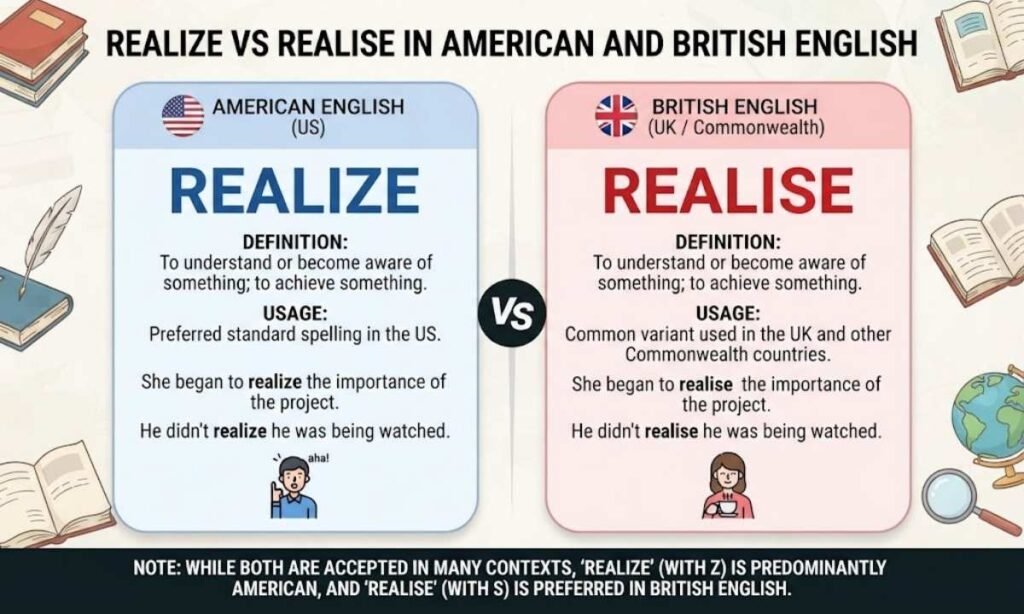
Realize vs Realise in American and British English
When to Use Realize in American English
Choose realize whenever you write for a US audience. It is the expected spelling in:
• US schools and colleges
• US business writing
• American websites and blogs
• Professional emails and reports
• General US writing
When to Use Realise in British English
Realise is the form most readers expect in the United Kingdom. It appears in many British newspapers, websites, and school materials. It is common, but it is not the only acceptable British spelling.
Why You May See Realize in British English
Some British publishers follow the -ize convention, which traces the ending back to its Greek roots. Oxford University Press is a well known example. Because style guides differ, you can find realize in British books and journals, and it is not an error there.
Realize vs Realise Across English-Speaking Countries
United States and Canada
Americans strongly prefer realize. Canadian English also uses realize, although Canadian spelling is not identical to American spelling in every word. The Language Portal of Canada lists realize among common Canadian forms.
United Kingdom, Australia, and New Zealand
These countries often prefer realise. You may still see realize depending on the publication, university, or style guide.
What Should an International Writer Choose?
Pick the spelling system required by your audience, publication, institution, or style guide. Then use it consistently from start to finish.
Realize vs Realise: Related Word Forms
The spelling choice carries into every related form of the word.
| Word Type | US Style | British Style |
| Base verb | realize | realise |
| Past tense | realized | realised |
| Present participle | realizing | realising |
| Noun | realization | realisation |
| Adjective | realizable | realisable |
Realized vs Realised
Both are correct past tense forms. Use realized with realize and realised with realise.
Realizing vs Realising
These are the -ing forms, used in continuous tenses and as gerunds. The only difference is the z or s.
Realization vs Realisation
These nouns name the moment of understanding or the act of achieving something. Match them to your chosen verb spelling.
Realizable vs Realisable
This adjective describes something that can be achieved, such as a realizable goal. The same z and s rule applies.
How to Use Realize and Realise in a Sentence
Examples Meaning “Become Aware”
• I realize my mistake now.
• She realized that the store had already closed.
• We suddenly realize how late it is.
• He did not realize the meeting had moved.
• Do you realize what this means?
Examples Meaning “Achieve or Make Real”
• She worked for years to realize her dream.
• He hopes to realize his ambition of opening a bakery.
• Good coaching helps students realize their potential.
• The team finally realized its goal.
American vs British Examples Side by Side
| American Spelling | British Spelling |
| I realized I forgot my keys. | I realised I forgot my keys. |
| She is realizing her dream. | She is realising her dream. |
| The realization hit him slowly. | The realisation hit him slowly. |
The grammar and meaning stay identical. Only the spelling changes.
Which Spelling Should You Use in Formal Writing?
For US Academic and College Writing
Use realize, since it is the standard in American English.
For UK Academic Writing
Follow your institution’s spelling instructions. Do not assume there is one universal UK rule, because some departments accept -ize and others require -ise.
For Business, Websites, and Professional Writing
Match the English style of your company, publication, or target audience. A US brand should use realize, while a UK brand will usually use realise.
What If a Style Guide Says Something Different?
The style guide wins. If it tells you to use one form, follow it even when your personal habit is different.
Common Realize vs Realise Mistakes
Treating Realise as a Misspelling
Realise is not an error. It is the standard spelling in much of the English-speaking world outside North America.
Assuming Realize Is Always American and Never British
Realize also appears in British English where the -ize convention is used. Calling it purely American oversimplifies the rule.
Mixing -ize and -ise Spellings
Writing realize in one paragraph and realise in the next looks careless. Pick one system and apply it to every word, including organize and recognize.
Changing the Spelling but Also Changing the Grammar
Switching from s to z does not change how the word functions. Tense, subject agreement, and sentence structure remain exactly the same.
Realize vs Realise: Easy Memory Trick
Remember “Z” for Standard US Spelling
Think of the z in realize as a reminder of American style. If you are writing for a US reader, keep the z.
Use Your Document’s Existing Spelling Style
The trick is only a starting point. If your document already uses British spelling, stay with realise so the whole text feels consistent.
Frequently Asked Questions
Is realize or realise the correct spelling?
Both are correct. Realize is standard in the US, and realise is common in British English.
Is realize American or British English?
Realize is the standard American spelling. It is also used in some British styles.
Is realise wrong in American English?
Realise is not standard in the US, so most American editors will change it to realize. It is still correct British spelling.
Can you use realize in British English?
Yes. Some British publishers and style guides prefer the -ize ending, so realize can appear in British writing.
Do realize and realise have the same meaning and pronunciation?
Yes. They share the same definitions and are both pronounced with a final /z/ sound.
Are realized and realised both correct?
Yes. Use realized with realize and realised with realise.
Is realizing or realising the correct spelling?
Both are correct. Choose realizing for US style and realising for British style.
Conclusion
Realize and realise are two correct spellings of the same word, and the difference is regional, not grammatical. Use realize for US audiences and realise for most British, Australian, and New Zealand readers, unless a style guide says otherwise.
Whichever you choose, keep every related word consistent, including realized, realizing, and realization.