
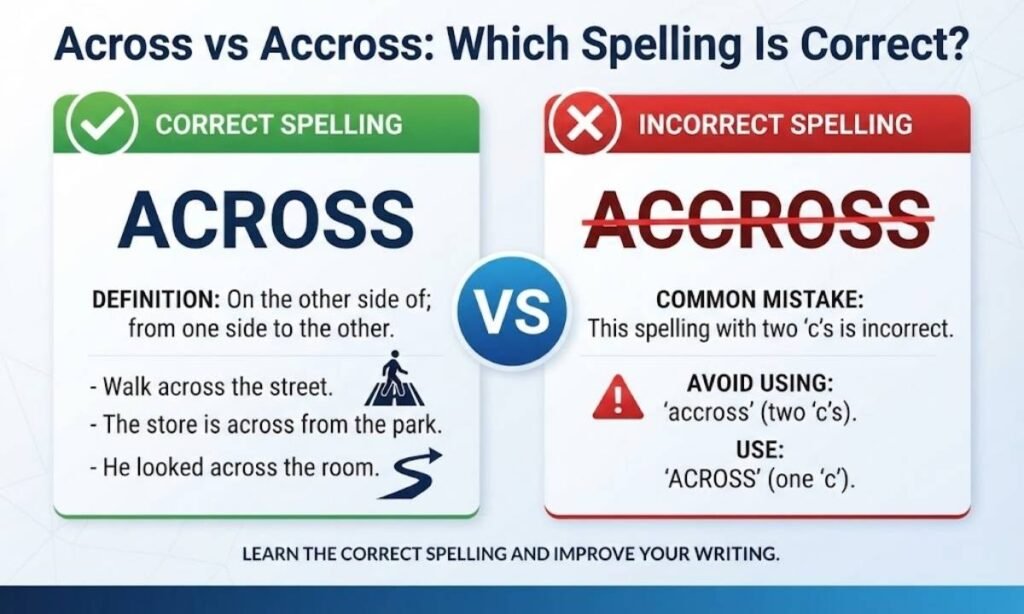
Across is the only correct spelling in standard English, and accross is simply a misspelling that adds an extra letter c by mistake. The word across describes movement from one side of something to the other, a position on the opposite side, or something that spreads throughout an area or group.
This guide explains why the extra c creeps in, breaks down across as both a preposition and an adverb, compares it with similar words like over and through, and gives you simple tricks so the correct spelling sticks for good.
Accross vs Across: Which Is Correct?
| Word | Correct? | Meaning |
| Across | Yes | From one side to another, or throughout an area |
| Accross | No | Common misspelling of across |
Across is spelled with one c and two s letters, following the pattern A C R O S S. Accross adds a second c that does not belong there, and it never appears in any recognized English dictionary as a valid spelling.
What Does Across Mean?
Across generally describes movement from one side of something to the opposite side, a position facing something from the other side, or something spreading throughout a whole area. According to Britannica’s learner dictionary, across can describe crossing a street or river, being seated on the opposite side of a table, or a story that spreads throughout an entire country.
Across as a Preposition
● Walked across the street
● Ran across the field
● Drove across the country
● The bridge stretches across the river
Across as an Adverb
● Come across
● Looked across
● The river is a mile across
Why Is Accross Spelled Incorrectly?
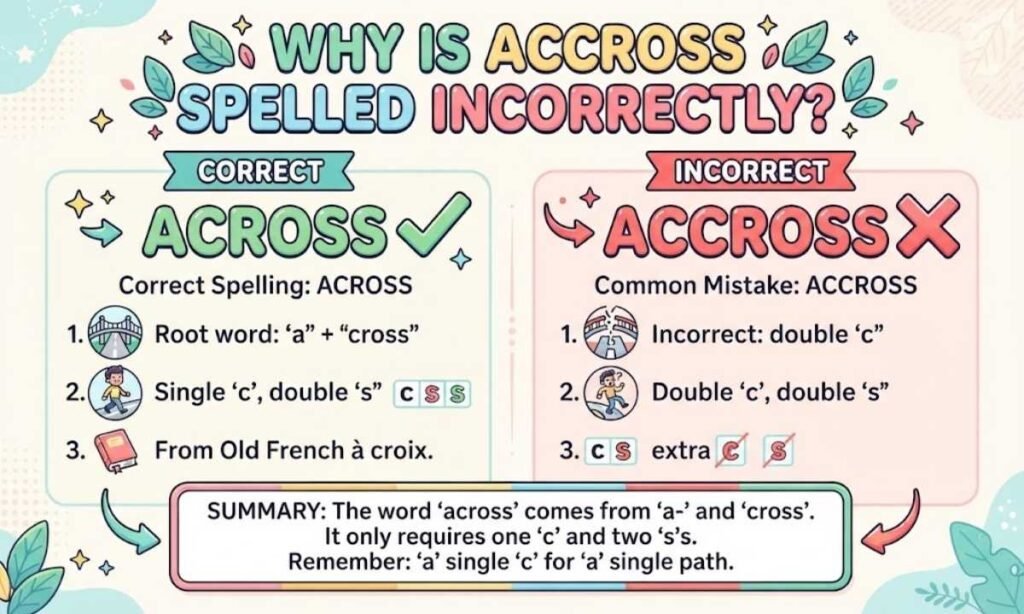
Many writers add the extra c because English has several words that double a consonant right before adding a suffix, so the pattern feels familiar even though it does not apply here. Across only ever takes one c, no matter how the word is used in a sentence.
The Easy Way to Remember Across
A simple memory trick is A plus CROSS equals ACROSS. Since the word cross itself only has one c, adding the letter A to the front keeps that single c intact.
How Do You Spell Across Correctly?
The correct spelling, letter by letter, is A C R O S S. The incorrect version, accross, wrongly doubles the c to read A C C R O S S. Saying the phrase a cross out loud before writing across helps many people remember there is only one c.
Accross vs Across Examples
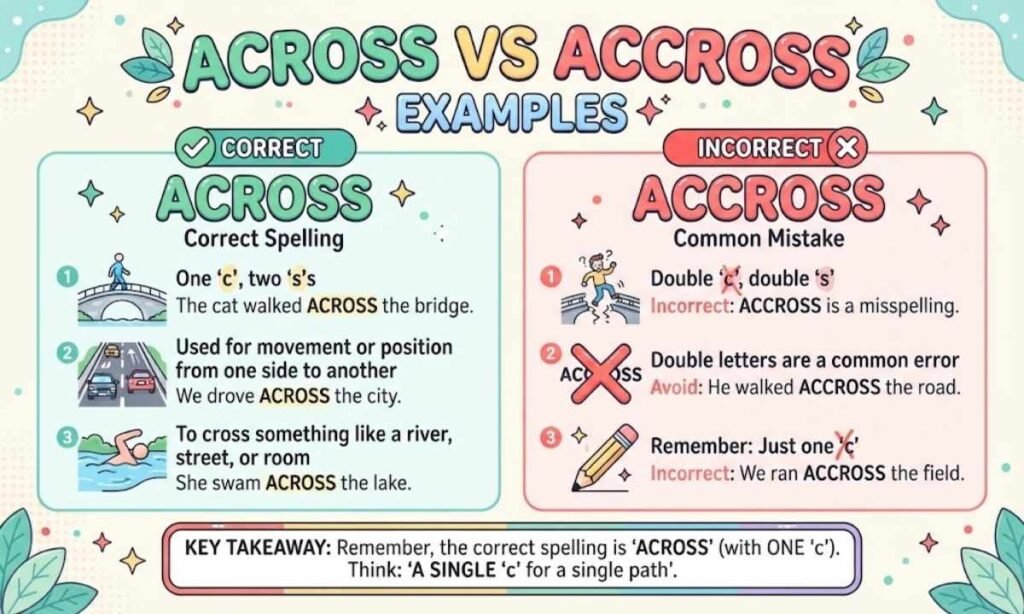
Correct examples:
● She walked across the street.
● We drove across the country.
● The news spread across the city.
● He ran across the field.
Incorrect examples corrected:
● She walked accross the street becomes she walked across the street.
● We traveled accross the country becomes we traveled across the country.
Across appears constantly in everyday writing, from emails and school assignments to social media captions and workplace messages, so getting the spelling right matters in nearly every kind of communication.
How to Use Across in a Sentence?
● For movement: She walked across the room.
● For location: The store is across the street.
● For distribution: The company has offices across the country.
● For distance or width: The river is two miles across.
That last use for measuring width is documented specifically in learner dictionaries, where across describes how wide something is from one edge to the other.
Is Accross a Word?
Accross is not a standard English word. It shows up occasionally in casual typing, social media posts and quick messages, but its appearance online does not make it correct. Whenever you mean the standard term, across is always the spelling to use.
Across Grammar Rules You Should Know
Across works as a preposition when it connects a verb to a noun, such as across the bridge, and as an adverb when it stands on its own to modify a verb, such as she looked across. Both roles rely on the same one c spelling.
Across, Over or Through
| Word | Core Meaning | Example |
| Across | From one side to the other of a surface | She walked across the field |
| Over | Movement above or spanning something | The plane flew over the mountains |
| Through | Movement within or inside something | He walked through the forest |
These three words often get mixed up because they all describe motion, yet each one specifies a different kind of path relative to the surface or space involved.
Across vs Cross: What Is the Difference?
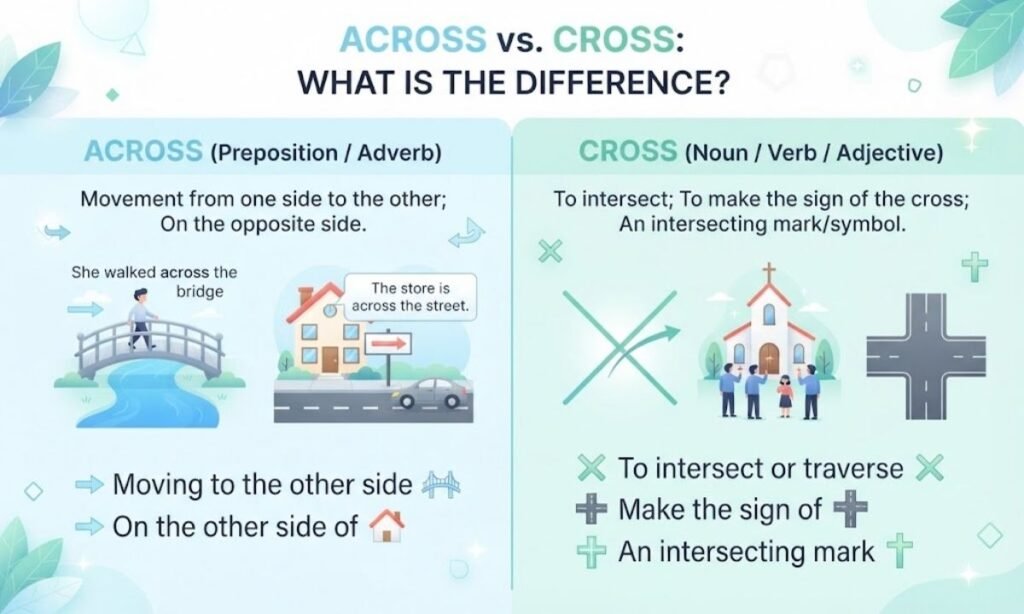
Across functions as a preposition or adverb, while cross is usually a verb describing the action of moving from one side to the other, as in cross the road or cross the bridge. You can say she walked across the road or she will cross the road, but the two words are not interchangeable in every sentence because across never acts as a standalone action verb.
Etymology and Origin of the Word Across
According to Wiktionary, across traces back to Middle English acros, which developed from an earlier phrase meaning in the form of a cross, combining the prefix a with the word cross. This origin explains why the memory trick A plus CROSS equals ACROSS works so naturally, since the word was quite literally built from those two pieces centuries ago.
Across in American vs British English
The spelling across stays exactly the same in American and British English, with no regional variation in the letters. The only difference is a slight shift in pronunciation, since British speakers often say it closer to uh KROSS while American speakers lean toward uh KRAWS, though both pronunciations point to the same correctly spelled word.
Across in Idioms and Common Phrases
Across appears in several fixed expressions that go beyond its literal meaning.
● Across the board, meaning applying to everyone or everything equally
● Come across, meaning to find something by chance or to give an impression
● Get across, meaning to successfully communicate an idea
Learning these phrases naturally reinforces the correct spelling since they all rely on the same single c pattern.
Across in Academic and Professional Writing
In research papers, across often describes patterns that hold true throughout multiple groups, such as results were consistent across all age groups.
In business writing, phrases like operations across several countries or teams working across departments are extremely common, so a misspelling like accross can stand out as a careless mistake in otherwise polished writing.
Common Spelling Mistakes Similar to Accross
● Acros, which drops a letter instead of adding one
● Accros, which mixes both errors together
● Confusing across with cross, which changes the part of speech entirely
Across Synonyms: What Words Can Replace It
Depending on context, across can sometimes be replaced with over, throughout, opposite or on the other side, though these words are not always interchangeable.
Over usually works only for movement, throughout fits distribution better than direct crossing, and opposite describes position rather than motion, so context should always guide the choice.
Quick Tips to Never Misspell Across Again
● Remember the phrase A plus CROSS equals ACROSS
● Say the word slowly while typing to avoid adding a second c
● Recall that cross itself only has one c, and across simply builds on it
● Double check longer sentences where autocorrect might not catch the error
Frequently Asked Questions
Is it across or accross?
Across is correct. Accross is a common misspelling with no dictionary entry.
How do you spell across?
It is spelled A C R O S S, with one c and two s letters.
Is accross a real word?
No, accross is not a recognized word in standard English.
What does across mean?
It means from one side to another, on the opposite side, or throughout an area.
Is across a preposition or adverb?
It can function as either, depending on how it is used in a sentence.
What is an example of across?
She walked across the street is a simple, correct example.
Is across the same as cross?
No, across is a preposition or adverb, while cross is usually a verb.
Conclusion
Across is correct, and accross is incorrect. The spelling is A C R O S S, with just one c and two s letters, and the simplest way to remember it is that across was literally built from A plus CROSS.
A final example to keep in mind is she walked across the bridge, a clean and correct use of the word in everyday English.