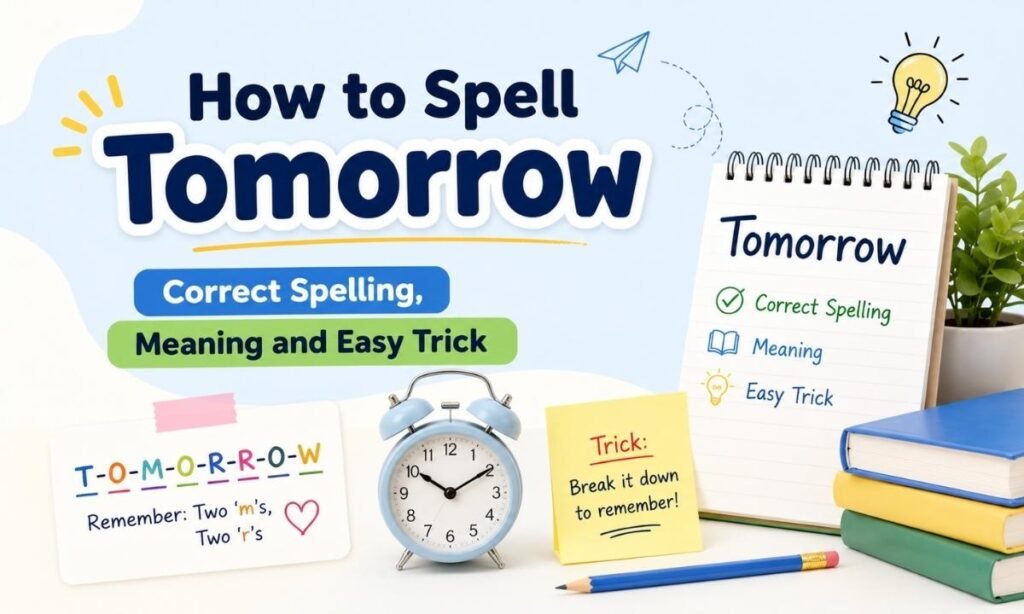
The correct spelling is tomorrow — T-O-M-O-R-R-O-W. It has one M and two R’s, and it is one of the most frequently misspelled words in everyday English writing, texting, and emails.
If you have typed tommorow, tomorow, or tomarrow and paused to double-check yourself, you are not alone. This guide breaks down the exact spelling, the meaning, the pronunciation, and a simple trick that makes the word impossible to forget again.
The Correct Spelling of Tomorrow
Tomorrow refers to the day that follows today. It is spelled with three parts that are easy to separate once you know the pattern:
- T-O-M
- O-R-R
- O-W
Notice the double R in the middle. That single detail is where almost every spelling mistake happens, so keeping it in mind solves most of the confusion instantly.
Tomorrow vs Tommorow: Which One Is Right
| Spelling | Correct or Incorrect | Reason |
| Tomorrow | Correct | Standard dictionary spelling with one M and two R’s |
| Tommorow | Incorrect | Adds an extra M that does not belong in the word |
| Tomorow | Incorrect | Missing the second R |
| Tomarrow | Incorrect | Replaces the second O with an A |
| Tommorrow | Incorrect | Combines both the extra M and extra R errors |
Tommorow is one of the most searched misspellings online, largely because the word sounds like it could carry a double M when spoken quickly. Tomorow, on the other hand, usually happens when someone drops a letter while typing fast on a phone keyboard.
Why People Misspell Tomorrow So Often?
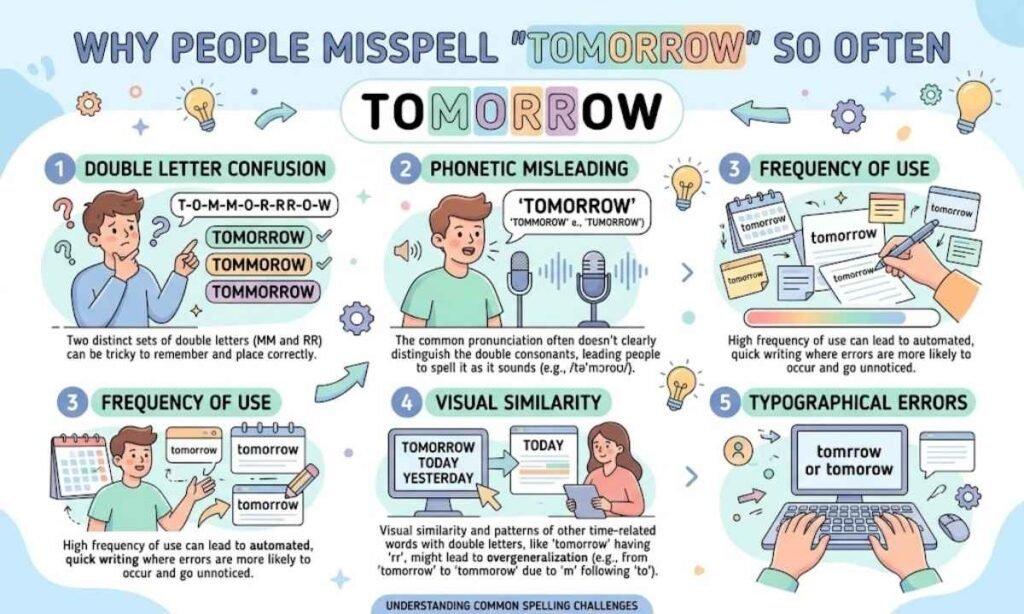
English speakers tend to spell words the way they sound, and tomorrow is a word where sound and spelling do not line up neatly. A few reasons explain the confusion:
- The word is pronounced with a soft, blended middle section, making it hard to hear the exact letter count.
- Autocorrect on some devices does not always catch tomorrow-related typos.
- The double R is silent to the ear but essential in writing.
- Similar-sounding words with double letters elsewhere create habit-based errors.
Understanding the root cause makes the correct spelling easier to lock in permanently.
How Many M’s and R’s Are in Tomorrow
This is one of the most common quick-answer searches related to the word.
| Letter | Count in Tomorrow |
| M | 1 |
| R | 2 |
| O | 3 |
| W | 1 |
A simple rule to remember: one M, two R’s. Once that phrase is memorized, the spelling becomes automatic.
What Does Tomorrow Mean?
Tomorrow has two related meanings depending on context.
- It most commonly refers to the day right after today, such as “The meeting is tomorrow.”
- It can also refer to the near future in a broader sense, such as “The choices we make today shape tomorrow.”
Both uses are grammatically correct, and the word functions as either a noun or an adverb depending on the sentence.
Tomorrow as a Noun and an Adverb
As a noun, tomorrow acts like a specific point in time: “Tomorrow is going to be busy.” As an adverb, it describes when an action happens: “I will call you tomorrow.” Recognizing this dual role helps with sentence structure and avoids awkward phrasing in formal writing.
How to Pronounce Tomorrow in American English?
The American pronunciation is written phonetically as tuh-MOR-oh. The stress falls on the second syllable, and the final syllable is softened rather than emphasized. British English pronunciation is very similar, with only a slight difference in vowel tone, so the spelling remains identical across both varieties of English.
Common Misspellings of Tomorrow
The following incorrect forms appear frequently in search queries and casual writing:
- Tommorow
- Tomorow
- Tomarrow
- Tommorrow
- Tomorro
Each version breaks one of the three core rules of the word: one M, two R’s, and three O’s in the correct positions.
The Easy Spelling Trick: One M, Two R’s
A reliable memory method is to break the word into a short rhythm rather than trying to memorize it as one long block of letters.
Say it as: TOM — ORR — OW
This mirrors how the word is naturally spoken and reinforces the double R visually and audibly at the same time. Writing the word slowly a few times using this three-part break tends to fix the spelling permanently in memory.
Tomorrow in a Sentence
Here are a few natural examples showing correct usage in different sentence positions.
- “I’ll finish the report tomorrow.”
- “Tomorrow will be the busiest day of the week.”
- “See you tomorrow morning.”
- “Tomorrow’s schedule includes three client calls.”
- “We are launching the new product tomorrow.”
Tomorrow vs Today vs Yesterday
| Word | Meaning |
| Yesterday | The day before today |
| Today | The current day |
| Tomorrow | The day after today |
| Day after tomorrow | Two days after today |
Keeping these time references straight is especially useful for scheduling, emails, and everyday conversation where precision matters.
Tomorrow Morning, Afternoon, or Night
Time-of-day phrases pair naturally with tomorrow without needing an apostrophe:
- Tomorrow morning
- Tomorrow afternoon
- Tomorrow evening
- Tomorrow night
These phrases describe a general time period rather than possession, which is why no apostrophe is required.
Tomorrow or Tomorrow’s: What Is the Difference
Use tomorrow when referring to the day itself, and use tomorrow’s when referring to something that belongs to that day.
- “Tomorrow is a public holiday.” (the day itself)
- “Tomorrow’s holiday schedule has been shared.” (something belonging to the day)
This distinction is small but frequently misused in professional writing and email communication.
Is Tomorrow One Word or Two?
Tomorrow is written as a single word in modern English. Historically, the phrase existed as two separate words, “to morrow,” but it merged into one word over centuries of common use. Writing it as two words today is considered outdated and incorrect in standard English.
Quick Examples of Correct vs Incorrect Spelling
Correct:
- “I’ll call you tomorrow.”
- “We have a meeting tomorrow.”
- “Tomorrow will be a busy day.”
Incorrect:
- “I’ll call you tommorow.”
- “See you tomorow.”
- “I’ll call you tomarrow.”
Quick Answer Summary
Tomorrow is spelled T-O-M-O-R-R-O-W. It has one M and two R’s. The most common mistakes are adding an extra M or dropping the second R, both of which are avoided easily once the three-part breakdown is memorized.
Frequently Asked Questions
How do you spell tomorrow?
Tomorrow is spelled T-O-M-O-R-R-O-W, with one M and two R’s.
Is it tomorrow or tommorow?
Tomorrow is correct; tommorow is a common misspelling with an extra M.
Is tomorow a correct spelling?
No, tomorow is missing the second R and is not correct.
How many R’s are in tomorrow?
Tomorrow has two R’s, located in the middle of the word.
Does tomorrow have one M or two?
Tomorrow has only one M, despite how it sometimes sounds when spoken.
What does tomorrow mean?
Tomorrow means the day that comes right after today.
How do you pronounce tomorrow in American English?
It is pronounced tuh-MOR-oh, with stress on the second syllable.
Is tomorrow one word or two?
Tomorrow is one word in modern English, though it was once written as two.
What is the difference between tomorrow and tomorrow’s?
Tomorrow refers to the day itself; tomorrow’s refers to something belonging to that day.
What is the day after tomorrow called?
It is simply called “the day after tomorrow,” with no single-word equivalent in English.
Conclusion
Tomorrow is spelled T-O-M-O-R-R-O-W, with one M and two R’s forming the core of the word. The most common errors, tommorow and tomorow, both come from misplacing those two letters.
Using the simple TOM-ORR-OW breakdown makes the correct spelling easy to remember for good, whether writing a quick text or a formal email about tomorrow’s plans.