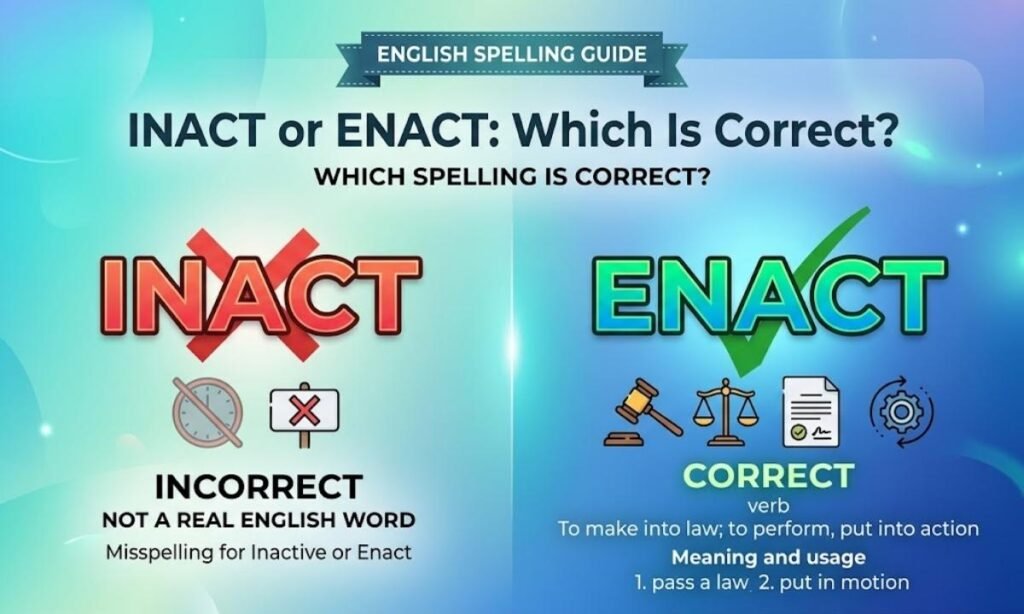
Mixing up “inact” or “enact” is one of the most common word confusions in professional and academic writing. The two look similar on the page, yet only one of them is a standard, dictionary recognized verb used to describe passing a law, adopting a policy, or putting a plan into practice.
Enact is the correct word to use whenever you mean to make something official or bring it into effect. Inact is not treated as a standard modern word, even though it often gets typed by mistake in place of enact, inactive, or inaction.
Quick Answer: Enact Is the Standard Word
What the Dictionaries Say
Enact is the recognized verb meaning to pass into law or put into practice. Inact does not appear as a standard entry in major dictionaries.
Why People Still Type Inact?
Writers often blend enact with inactive or inaction, creating a spelling that looks plausible but is not standard usage.
What Enact Actually Means?
Enact carries several related meanings depending on context. Understanding each sense helps you use the word with confidence rather than guessing.
- To pass a bill or law through a legislative body
- To officially put a rule, policy, or plan into effect
- To perform or act out a role, scene, or event
- To bring an idea from theory into real practice
Why Inact and Enact Get Confused?
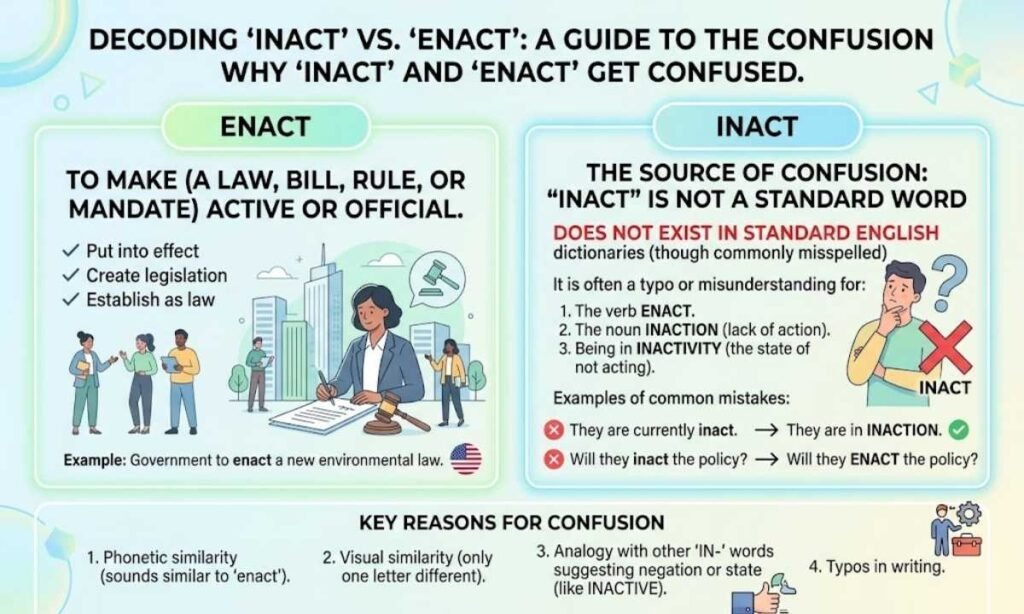
The confusion is not random. It usually comes from three overlapping sources of interference in the writer’s mind.
- Visual similarity between the prefixes “en” and “in”
- Frequent exposure to the word “inactive,” which starts the same way
- Autocorrect and spellcheck tools sometimes failing to flag “inact” in casual typing
Enact vs Inact: Quick Comparison
| Word | Standard Usage | Typical Meaning |
| Enact | Yes | Pass a law, put a plan into effect, perform |
| Inact | No | Not a recognized modern word |
| Inactive | Yes | Not currently active or in use |
| Inaction | Yes | Failure to act or lack of activity |
| Inactivate | Yes | To make something inactive or disable it |
How to Use Enact in a Sentence?
Enact works naturally across legal, business, and everyday contexts. Below are examples that show its range.
Legal and Government Context
Lawmakers plan to enact the new tax reform before the end of the year.
Business Context
The company decided to enact a stricter refund policy starting next month.
Everyday Context
She wanted to enact real change in her community through volunteer work.
What Should You Use Instead of Inact?
If your intended meaning is the opposite of enact, the word you actually need depends on the situation. None of them is “inact.”
- Repeal a law that has already been passed
- Revoke an official decision, license, or approval
- Rescind a policy or formal agreement
- Deactivate a system, account, or feature
- Invalidate a contract or legal document
- Disable a function that was previously switched on
Enact vs Implement: Understanding the Difference
These two words are often used together but are not perfectly interchangeable.
| Term | Primary Focus | Example Use |
| Enact | Officially establishing something into law or effect | Congress will enact the new bill |
| Implement | Carrying out or executing a plan already approved | The team will implement the new policy |
A law is usually enacted first, then implemented through departments and procedures that carry it out in practice.
Enacted or Inacted: Which Past Tense Is Correct?
The Correct Form
Enacted is the accepted past tense and past participle of enact, used in phrases like “the law was enacted in 2020.”
Why Inacted Is Avoided
Inacted follows the same non-standard pattern as inact and is generally treated as a typo rather than a real word.
Enactment or Inactment: Which Noun Is Correct?
Enactment is the standard noun form, referring to the act of making something law or putting it into force. Inactment is not a recognized word and should be avoided in formal writing, legal documents, and academic papers.
Common Mistakes Writers Make With Enact
- Typing inact instead of enact in formal documents
- Confusing enact with implement when describing execution of a plan
- Using enact when the intended meaning is closer to activate
- Mixing up enactment with inactment in legal writing
- Assuming inact is simply the informal version of enact
Enact Synonyms and When to Use Them
| Synonym | Best Used When |
| Pass | Referring specifically to legislation moving through a vote |
| Establish | Creating a new rule, system, or institution |
| Adopt | Formally accepting a policy or proposal |
| Approve | Giving official consent to a plan or document |
| Perform | Acting out a role, scene, or ceremony |
Is Enact Used Differently in American and British English
Enact is treated as standard in both American and British English, with no regional spelling split like color versus colour. Inact is not accepted as a correct spelling in either variety, which sets this pair apart from true regional differences.
How Grammar Checkers Handle Inact
Most modern grammar and spellcheck tools flag inact as an error and suggest enact, inactive, or inaction as replacements. Relying on these tools during editing is a simple way to catch the mistake before publishing a document, email, or report.
Inact and Enact in Search Behavior
People frequently search phrases like “inact or enact” and “is inact a word” because the visual similarity creates genuine doubt while typing. Recognizing this pattern helps writers understand that the confusion is common rather than a sign of poor language skills.
Enact in Academic and Research Writing
Academic papers frequently use enact when describing policy changes, historical legislation, or theoretical frameworks being put into practice. Precision matters here, since reviewers and editors expect standard vocabulary rather than invented forms like inact.
The Historical Background Behind Enact
Enact traces back to Latin roots combined with the prefix “en,” meaning to put into a certain state or condition. Over centuries, English absorbed this structure to describe formally establishing laws, rules, and practices, which is why the word still centers on the idea of bringing something into force.
Simple Ways to Remember the Correct Spelling
- Connect enact with “put into effect” to lock in the correct meaning
- Remember that enactment and enacted both start with “en,” matching enact
- Avoid building new words from inactive, since inact is not a standalone term
Frequently Asked Questions
Is inact or enact correct?
Enact is correct. Inact is not a standard modern English word.
Is inact a real word?
No, inact is not recognized in standard dictionaries.
What does enact mean?
Enact means to pass a law or officially put something into effect.
Is inact the opposite of enact?
No, correct opposites include repeal, revoke, or rescind.
How do you spell enact correctly?
Spell it e-n-a-c-t, with no double letters or variations.
Is enacted or inacted correct?
Enacted is correct. Inacted is treated as a spelling error.
Is enactment or inactment the correct noun?
Enactment is correct. Inactment is not a recognized word.
Conclusion
Enact is the standard, dictionary recognized word for making a law, policy, or plan official, while inact is not accepted as correct modern English despite how often it appears by mistake.
Choosing the right word around enact, whether that means enacted, enactment, repeal, or implement, comes down to matching the term to the exact meaning you intend. Keep this guide handy the next time you draft a policy, report, or legal document and the correct choice will become second nature.