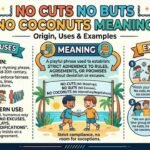
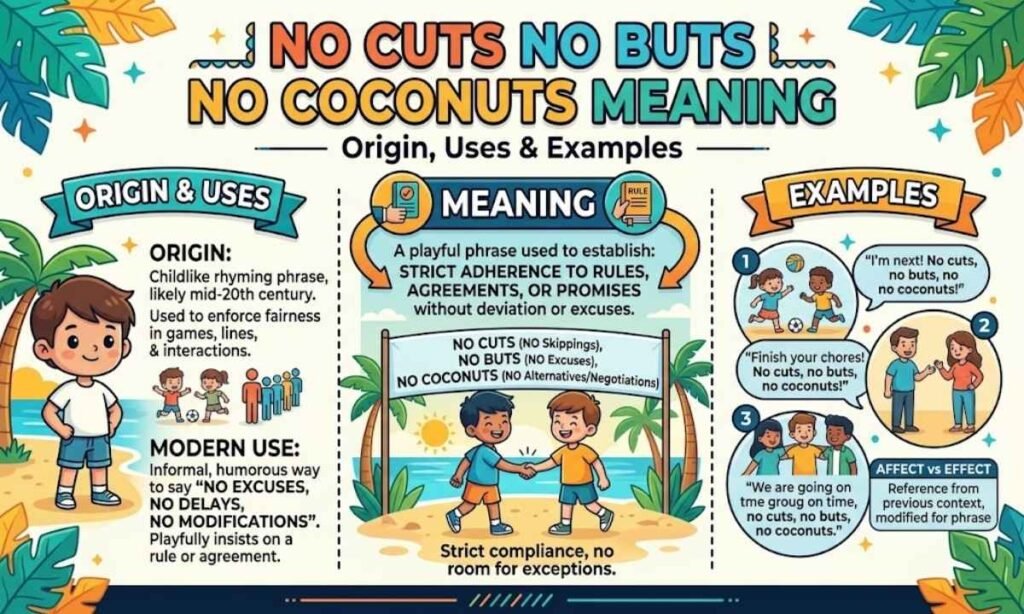
“No cuts no buts no coconuts” is a playful English rhyme that means no line jumping, no excuses, and no arguments. People use it to keep things fair or to end a debate with a smile. Kids love it, and adults borrow it too, often without thinking twice about where it came from. It is short, catchy, and instantly clear.
This guide explains, step by step, the meaning, origin, movie references, and real examples of the phrase. You will also find similar sayings, spelling variations, and quick answers to the questions people ask most, so you can use the rhyme with confidence and explain its background to anyone who asks.
What Does No Cuts No Buts No Coconuts Mean?
The phrase means follow the rule, skip the excuses, and do not argue. Each part does a different job:
• No cuts: do not jump ahead of others in a line
• No buts: do not interrupt or answer back with excuses
• No coconuts: a silly rhyming add on with no literal meaning
The literal words mention fruit and interruptions. The real message is fairness and firmness. It works as informal slang, closer to a playground chant than a formal idiom.
Origin of No Cuts No Buts No Coconuts
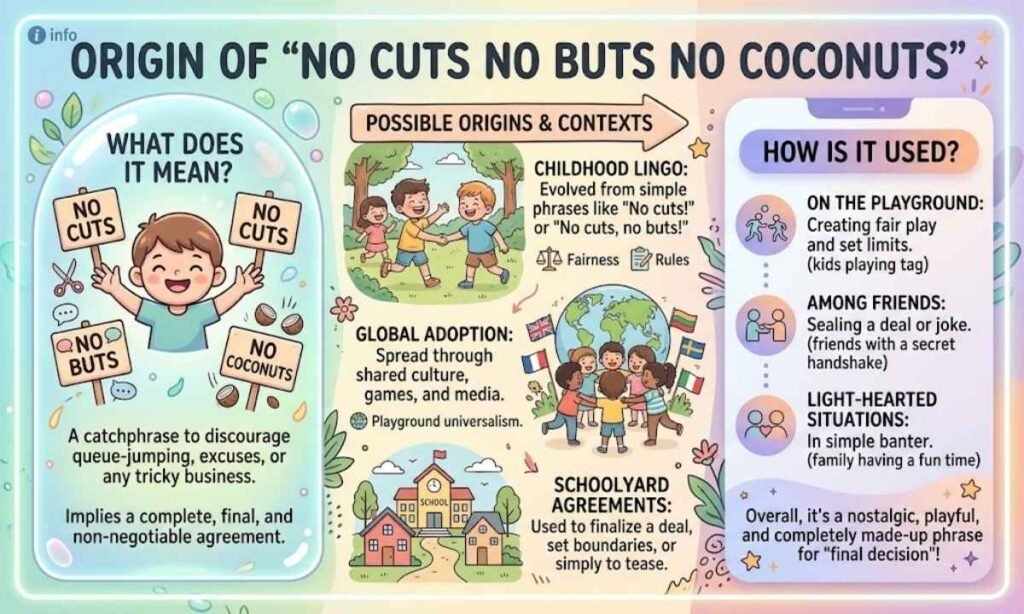
Nobody can name the exact inventor, which is normal for playground rhymes. The most common explanation points to school lunch lines in the United States. Kids yelled “no cuts” at anyone who slid in ahead of friends, and “buts” hinted at butting in.
Written traces help date it. Language researcher Barry Popik lists a Hey Arnold! episode from 1997 as an early example. A punk album from 1999 by Death by Stereo includes a song with the same name. Etiquette for Dummies also mentioned the chant in 2007.
Because the rhyme spread by word of mouth, wording and spelling changed from school to school. That is why researchers lean on printed and broadcast examples instead of one official record. Treat any claim of a single confirmed inventor with caution.
Line Etiquette Behind the Rhyme
Queue etiquette explains why the rhyme feels so natural. Everyone waits their turn, and a cutter breaks that unwritten deal. The chant gives children a quick, friendly way to protect fairness without waiting for a teacher. You will hear it in places like:
• School lunchrooms and cafeteria queues
• Water fountains and playground slides
• Bus stops and ticket counters
No Cuts No Buts No Coconuts in Movies and TV
Pop culture made the phrase easy to recognize. Here are the best known examples:
• Hey Arnold!: the “Hall Monitor” episode, where Phoebe learns to enforce hallway rules
• Wreck It Ralph (2012): Ralph offers the rhyme as a guess when Sergeant Calhoun asks about the first rule of Hero’s Duty
• The Big Bang Theory: the line appears in the episode titled “The Line Substitution Solution”
• American Dad!: an early episode uses the variation “no ifs, no buts, no coconuts”
So the movie did not create the phrase. It simply introduced it to a much bigger audience.
Examples of No Cuts No Buts No Coconuts
Classroom and Kids Examples
• “Line up for recess. No cuts, no buts, no coconuts.”
• “Turn in your reading log today. No cuts, no buts, no coconuts.”
Family and Friends Examples
• “Dishes before dessert. No cuts, no buts, no coconuts.”
• “Everyone pays for their own snacks tonight. No cuts, no buts, no coconuts.”
• “Bedtime is at nine. No cuts, no buts, no coconuts.”
Social Media and Funny Examples
• “My diet starts Monday. No cuts, no buts, no coconuts. Yes, even the cake.”
When Should You Use No Cuts No Buts No Coconuts?
Use it when the mood is light and the people know you. It fits these situations well:
• Casual chats with friends and family
• Parenting moments that need a smile instead of a lecture
• Classroom games, queues, and group activities
• Playful rules for team events and family game nights
Skip it in business emails, legal documents, academic writing, and serious conflicts. In those places, the joke can sound dismissive.
How to Say It Without Sounding Rude?
Tone decides whether the phrase feels funny or bossy. Keep these steps in mind:
1. Smile or use a light voice so the joke is clear.
2. Say it to people who already know your sense of humor.
3. Explain the reason right after, especially with children.
4. Drop the rhyme if the situation turns serious.
Similar Phrases and Expressions
Several sayings carry the same message. This table shows how they compare:
| Phrase | Meaning | Tone |
| No ifs, ands or buts | No arguments or conditions | Common and firm |
| No excuses | Take responsibility | Direct |
| End of discussion | The topic is closed | Serious |
| No shortcuts | Do it the proper way | Practical |
| If ifs and buts were candy and nuts | Excuses change nothing | Playful and older |
No Cuts No Buts No Coconuts Meaning in Different Languages
• Hindi: koi bahana nahi, koi bahas nahi (कोई बहाना नहीं, कोई बहस नहीं)
• Spanish: sin excusas y sin peros
• Simple English: no line jumping, no excuses
Translations capture the message, not the rhyme. That is why the coconut part usually disappears.
Common Misunderstandings About the Phrase
• Coconuts have no hidden meaning. The word exists only for rhythm and humor. In other settings “coconut” can be a hurtful label, but that has nothing to do with this rhyme.
• It is not formal. Treat it as a playground rhyme rather than an official idiom.
• It did not start in Wreck It Ralph. The film used an existing chant.
• It does not always mean the same thing. In a queue it targets cutters, while in a debate it targets excuses.
Spelling Variations: Cuts, Butts, and Ifs
You will see several versions online, and each one has a logic:
• No cuts, no buts, no coconuts: the most common spelling
• No cuts, no butts, no coconuts: the queue version, where “butts” means butting in
• No ifs, no buts, no coconuts: the excuse version, where “buts” means objections
No Cuts No Buts No Coconuts vs No Ifs No Buts
| Feature | No cuts no buts no coconuts | No ifs no buts |
| Main idea | Fairness plus no excuses | No excuses or conditions |
| Common setting | Schools, games, humor | Parents, managers, daily speech |
| Tone | Playful | Firm |
| Best for | Kids, friends, jokes | Clear instructions |
“No ifs, ands or buts” is the older, more general expression. The coconut version feels more like childhood nostalgia and internet humor. Use the first when you mean business and the second when you want a laugh.
Why Rhymes Like This Stick in Memory?
Playground rhymes survive because they are easy to repeat. Three things help this one:
• A steady three beat pattern that is easy to chant
• The repeated word “no” that builds rhythm
• A surprise ending word that makes people laugh
Fun Facts About No Cuts No Buts No Coconuts
• A 2008 children’s book uses the rhyme in its title
• The phrase shows up on mugs, posters, and memes
• Short video creators keep it alive with idiom explainers and Wreck It Ralph clips
• Adults often remember it from elementary school lunch lines
• The shorter form, no cuts no buts, carries the same message without the joke
Key Takeaways
• It means no cutting in, no excuses, and no arguments
• The exact origin is unknown, but school lines are the usual source
• Coconuts is there only for the rhyme
• It is informal, so keep it for friendly moments
Frequently Asked Questions
What does no cuts no buts no coconuts mean?
It means no line jumping, no excuses, and no arguments. It is a playful way to say the rule is final.
Is no cuts no buts no coconuts an idiom?
Not officially. It is an informal rhyme, closer to a playground chant than a dictionary idiom.
Where did the phrase come from?
The exact source is unknown. Most explanations point to American school lunch lines.
Is it used in Wreck It Ralph?
Yes. Ralph says it as a guess when asked about the first rule of Hero’s Duty.
Why does it include coconuts?
Only for rhyme and humor. The word has no hidden meaning here.
Is it formal or informal?
It is informal. Save it for casual and friendly conversations.
Can adults use this phrase?
Yes, especially in jokes or light situations. Avoid it in serious or professional settings.
Conclusion
No cuts no buts no coconuts is a small rhyme with a clear job. It asks for fairness, blocks excuses, and does it with a grin. Its roots sit in school lunch lines, and pop culture kept it alive for a new generation.
Use it with friends, family, and kids when the mood is light. Keep it out of formal writing, and you will get the laugh without the eye roll.