If you have ever paused mid sentence wondering whether to write “totalling” or “totaling,” you are not alone. This single letter difference confuses writers, students, and professionals across the world. The good news is that the answer is simple once you understand where each spelling comes from.
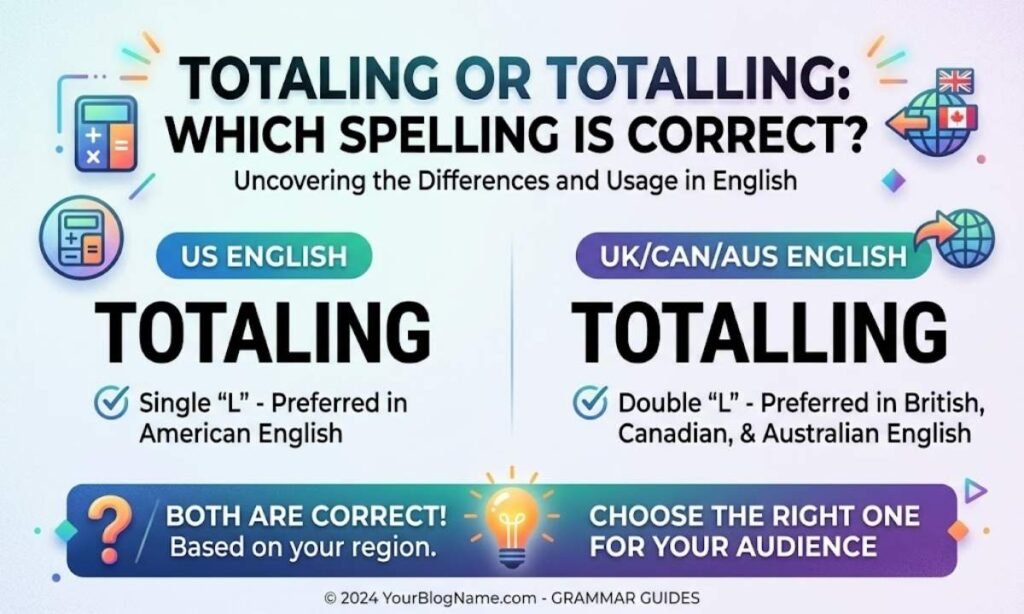
In short, “totaling” is the standard American English spelling, while “totalling” is the standard British English spelling. Both words carry the same meaning and function the same way in a sentence. The only real difference is regional preference, and once you know which audience you are writing for, choosing the correct form becomes effortless.
Understanding the Difference Between Totaling and Totalling
Both words come from the base verb “total,” meaning to add up or reach a sum. When you attach the suffix “ing” to create the present participle, American and British English follow slightly different spelling conventions.
- Totaling uses one “l”
- Totalling uses two “l”s
- Both describe the act of adding numbers together or reaching a final amount
- Neither spelling changes the pronunciation of the word
This pattern is not unique to “total.” Many verbs ending in a single vowel followed by “l” behave the same way, which is why the confusion extends beyond this one word.
Totaling Is the Standard Spelling in American English
American English generally does not double the final consonant when adding “ing” to a word that ends in a single “l,” unless the stress falls on the last syllable. Since “total” is stressed on the first syllable, American style guides keep it as “totaling.”
You will see this spelling in:
- News articles from U.S. publications
- American business and financial reports
- U.S. school textbooks and academic writing
- Legal and government documents within the United States
Example sentences
The store reported sales totaling twelve thousand dollars this week. Her expenses were totaling more than expected by the end of the month. The committee reviewed donations totaling several thousand dollars.
Totalling Is the Standard Spelling in British English
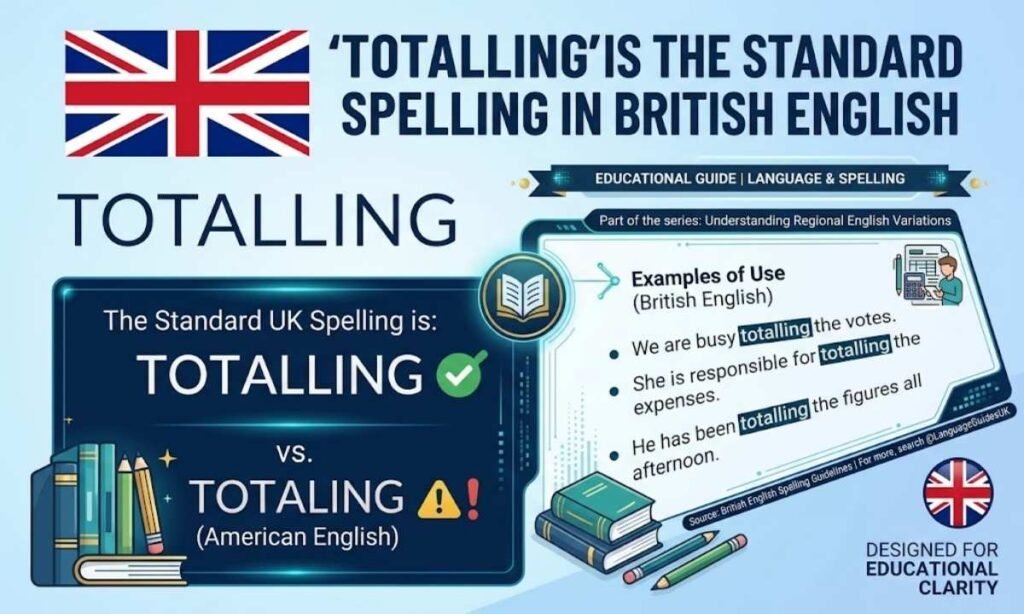
British English tends to double the final consonant more often when adding suffixes, even when the stress does not fall on the final syllable. This is a long standing pattern in UK spelling rules and applies to similar words such as “traveling” versus “travelling” or “modeling” versus “modelling.”
You will typically find “totalling” in:
- UK newspapers and magazines
- British academic writing
- Government and legal documents in the United Kingdom
- Writing produced in Australia, Canada, and other Commonwealth regions that follow British conventions
Example sentences
The invoice showed charges totalling three hundred pounds. Damages totalling a significant sum were reported after the storm. The fund raised donations totalling well over the initial goal.
Totalling vs Totaling at a Glance
| Feature | American English | British English |
| Present participle | Totaling | Totalling |
| Number of “l”s | One | Two |
| Past tense | Totaled | Totalled |
| Meaning | Add up or reach a sum | Add up or reach a sum |
| Common regions | United States | UK, Australia, Canada |
| Pronunciation | Same | Same |
How to Use Totalling or Totaling in a Sentence?
Both words function as verbs describing an ongoing action of adding numbers or reaching a total. They often appear right before a specific figure or amount.
Common sentence patterns
- Subject plus totaling or totalling plus amount (Sales totaling five thousand units)
- Totaling or totalling used after a noun to describe a running sum (Costs totalling the entire budget)
- Used in formal reports to summarize financial or statistical data
In professional writing, it is common to see phrases like “expenses totaling” or “revenue totalling” followed directly by a number, which makes the sentence easy to scan for readers looking at financial summaries.
Totaled or Totalled: The Past Tense Debate
Just like the present participle, the past tense form follows the same regional split.
- American English uses totaled with one “l”
- British English uses totalled with two “l”s
Example usage
The final bill totaled two hundred dollars (American). The final bill totalled two hundred pounds (British).
If you are writing for a mixed or international audience, the safest approach is to pick one regional style and apply it consistently throughout your document.
Why English Has Two Spellings for the Same Word?
The split between American and British spelling did not happen by accident. Much of it traces back to early dictionary makers who intentionally simplified certain spelling patterns for American readers. Words with a single vowel before a final “l” were often standardized without the doubled consonant in the United States, while British English retained the older doubling convention. Over time, this created two parallel but equally valid spelling systems that both remain in active use today.
Totaling and Totalling in Business and Financial Writing
Financial documents rely heavily on this word because totals and sums are central to reports, invoices, and statements. Getting the spelling right adds a layer of professionalism and consistency.
- U.S. based companies should use totaling and totaled in reports, invoices, and internal memos
- UK based companies should use totalling and totalled for the same purposes
- International companies often choose American spelling for global communication since it tends to have wider digital reach
Consistency matters more than which spelling you choose. Switching between the two within the same document can look like a careless error rather than a stylistic choice.
Common Errors Writers Make With Totaling and Totalling
- Mixing American and British spelling within the same piece of writing
- Assuming one spelling is objectively more correct than the other
- Confusing totaling with tallying, which is a related but different concept
- Forgetting to match the spelling of the participle with the spelling of the past tense form
- Using totalling in formal American documents intended for a U.S. audience
Totaling vs Tallying: Are They the Same Thing
These two words are often used in similar contexts but are not identical. Tallying usually refers to counting individual items one at a time, while totaling refers to combining numbers into a final sum. You might tally votes one by one, then total the final count to announce a winner. Understanding this distinction helps avoid awkward or imprecise phrasing in reports and everyday writing.
Regional Spelling Variations Across the English-Speaking World
| Region | Preferred Spelling |
| United States | Totaling / Totaled |
| United Kingdom | Totalling / Totalled |
| Canada | Totalling / Totalled (British influenced) |
| Australia | Totalling / Totalled |
| India | Totalling / Totalled (British influenced) |
How Style Guides Treat Totaling and Totalling?
Major style guides reinforce this regional divide rather than contradict it. The Associated Press Stylebook and Chicago Manual of Style, both widely used in the United States, favor the single “l” form.
The Oxford Style Manual and most UK publishing houses favor the doubled “l” form. Writers working with a specific style guide should default to whatever convention that guide follows rather than personal preference.
Totaling and Totalling in Digital and SEO Content
Search engines treat both spellings as related terms, so content creators do not need to publish separate versions for each region unless they are running fully localized websites. For most blogs and business sites, choosing the spelling that matches the primary audience’s location is sufficient for both readability and search visibility.
Tips for Choosing the Right Spelling for Your Audience
- If your readers are mostly American, choose totaling and totaled
- If your readers are mostly British, Australian, or Canadian, choose totalling and totalled
- For a global or mixed audience, American spelling is often the safer default due to its broader use online
- Always check your organization’s existing style guide if one exists
- Use a single spelling convention throughout an entire document or website for consistency
Frequently Asked Questions
Is totaling or totalling correct?
Both are correct. Totaling is American English and totalling is British English.
Is totaling American or British English?
Totaling is the standard spelling used in American English.
Is totalling American or British English?
Totalling is the standard spelling used in British English.
Does totaling have one l or two?
Totaling has one “l” in American English.
How do you spell totaling correctly?
Spell it with one “l” for American English: totaling.
How do you spell totalling correctly?
Spell it with two “l”s for British English: totalling.
Are totaling and totalling the same word?
Yes, they share the same meaning and simply follow different regional spelling rules.
Is totaled or totalled the correct past tense?
Totaled is American English and totalled is British English, both are correct in their regions.
Is tallying the same as totaling?
No, tallying means counting items individually, while totaling means adding numbers to reach a final sum.
Conclusion
Totaling and totalling are two correct spellings of the same word, separated only by regional convention. Totaling belongs to American English, while totalling belongs to British English, and neither version is more accurate than the other.
What matters most is consistency within your writing and matching your spelling choice to your intended audience. Once you understand this simple regional rule, you will never have to second guess which version to use again.