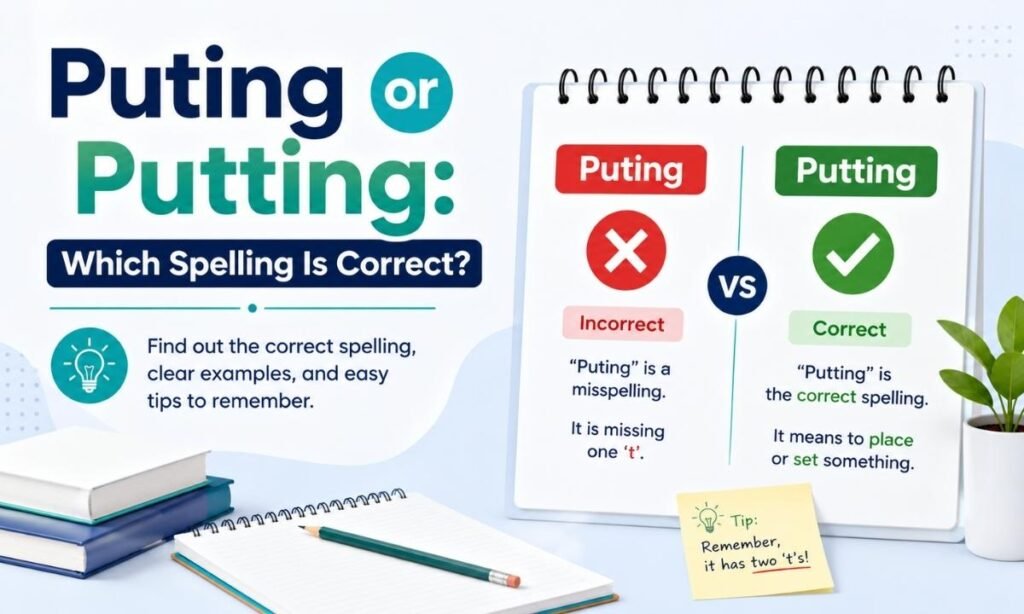
Putting is the correct spelling. Puting is a common misspelling that drops one of the required letters. The base verb put becomes putting by adding a t before ing, following a simple English spelling rule.
This guide breaks down exactly why putting two t’s, how the word works in grammar, its meaning in everyday sentences and golf, plus the mistakes people make most often. By the end, you will never second guess this spelling again.
Puting or Putting: Which One Is Correct?
Is Putting the Correct Spelling?
Yes, putting is the only correct spelling recognized in standard English dictionaries, used consistently in grammar, writing and everyday speech.
Is Puting a Word?
No, puting is not a recognized English word. It is simply a misspelling of putting that appears often due to typing speed or unfamiliarity with the doubling rule.
Why Do People Write Puting Instead of Putting?
Many writers assume the ing ending attaches directly to put without changes, similar to simpler words, which leads to the common puting error.
Why Is Putting Spelled With Two T’s?
The Simple Rule Behind Put Plus ing
English spelling follows a pattern where certain short verbs double their final consonant before adding ing, and put falls directly into that category.
Why the Final T Is Doubled
Doubling the t preserves the short vowel sound in put. Without the second t, the word would visually suggest a different pronunciation.
Does the CVC Rule Apply to Put?
Yes, put follows the consonant vowel consonant pattern, which signals that the final consonant should double before adding a vowel suffix like ing.
What Does Putting Mean?
Putting Meaning in English
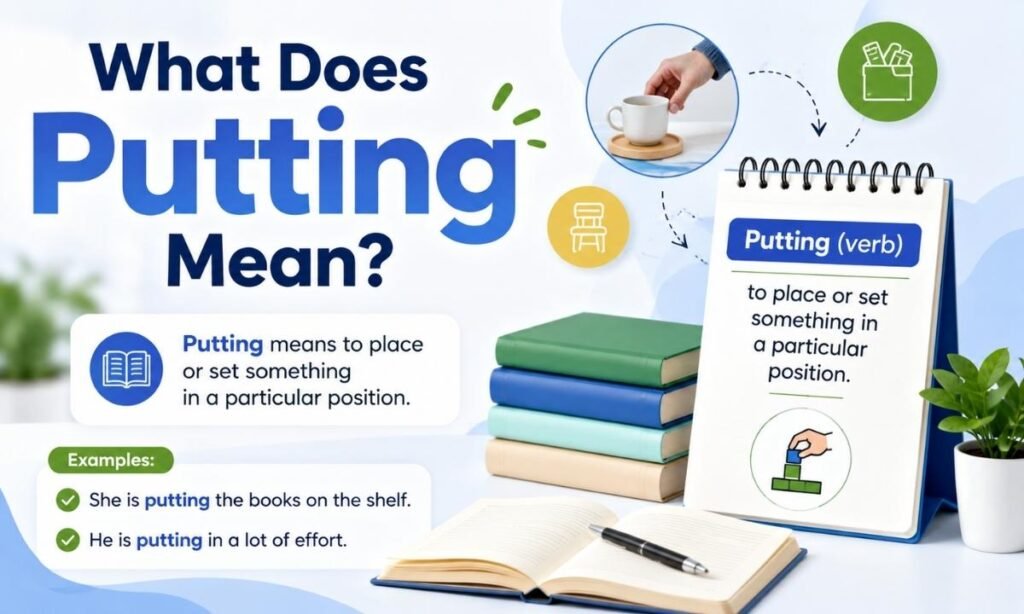
Putting refers to the act of placing, positioning or moving something into a specific location or state.
Putting as the ing Form of Put
Putting is simply the present participle and gerund form of the base verb put, used to describe an ongoing or continuous action.
Putting Meaning in Everyday Sentences
People use putting constantly in daily conversation, such as putting away groceries, putting on shoes or putting effort into a task.
How Do You Spell Putting Correctly?
Put Plus ing or Put Plus t Plus ing?
The correct construction is put plus t plus ing, not a direct attachment of ing to put.
Correct Spelling: Putting
Putting is the only version accepted in formal writing, professional communication and educational materials.
Incorrect Spelling: Puting
Puting should always be avoided, since it is not listed in any standard English dictionary.
Quick spelling formula: PUT plus T plus ING equals PUTTING.
Putting vs Puting: What Is the Difference?
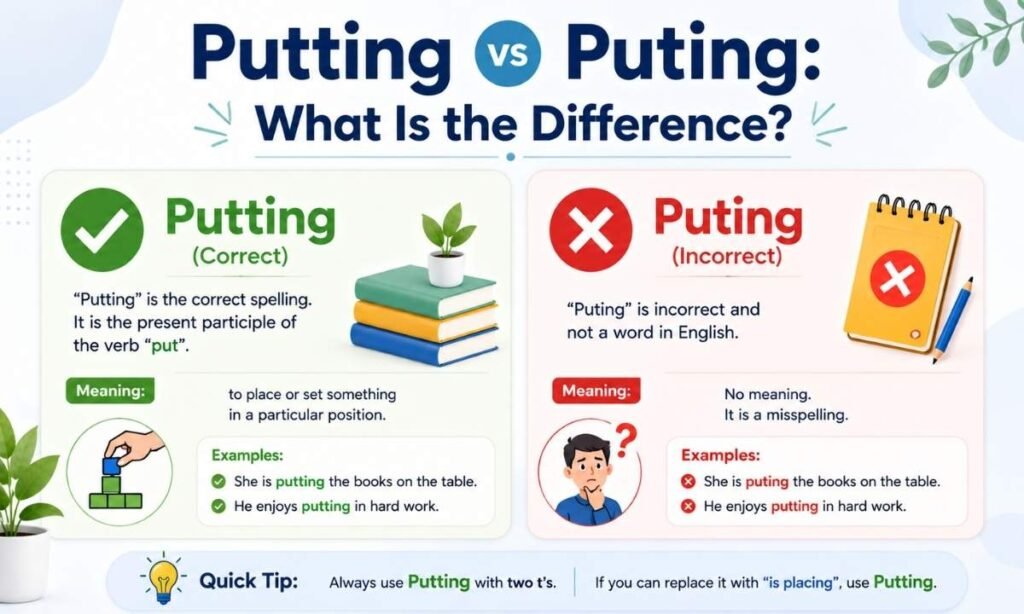
Putting Is Correct
Putting reflects proper English spelling and is safe to use in any writing context.
Puting Is a Common Misspelling
Puting is widely recognized as an error rather than an alternate or informal spelling.
Does the Extra T Change the Meaning?
No, the meaning stays identical. The extra t only corrects the spelling and does not alter the definition in any way.
| Spelling | Status | Meaning |
| Putting | Correct | ing form of put |
| Puting | Incorrect | Common misspelling |
Examples of Putting in a Sentence
Putting Something in a Place
She is putting the keys on the table before leaving the house.
Putting Something Away
He spent the evening putting away the winter clothes.
Putting Something Together
They are putting together a presentation for tomorrow’s meeting.
Putting Something on or Into Something
I am putting sugar into my coffee this morning.
Putting in Everyday Conversation
We keep putting off the trip because of work schedules.
Putting in Different Grammar Forms
Put as the Base Verb
Put functions as the root form used in simple present and imperative sentences.
Putting as a Present Participle
Putting describes an action happening right now, often paired with a form of the verb be.
Putting as a Gerund
When used as a noun, putting can represent the action itself, such as putting things off leads to stress.
Put in the Past Tense
Put remains unchanged in the past tense, making it an irregular verb.
Put, Puts, Putting, and Put: The Complete Pattern
This four form pattern covers present, third person singular, continuous and past tense usage of the verb.
Is Putting Used in American and British English?
Putting in American English
American English uses putting exactly as described, with no regional spelling variation.
Putting in British English
British English follows the identical spelling rule, keeping the double t before ing.
Is the spelling different in the UK and US?
No, putting remains the standard spelling in both American and British English without exception.
What Does Putting Mean in Golf?
Putting in Golf Explained
In golf, putting refers to a gentle stroke used to roll the ball across the green and into the hole.
What Is a Putting Stroke?
A putting stroke is a controlled, low speed swing designed for accuracy rather than distance.
What Is a Putting Green?
The putting green is the smooth, short grass area surrounding the hole where players complete each round.
Putting vs Putt: What Is the Difference?
Putt refers to the specific stroke or shot, while putting describes the broader ongoing action or skill involved.
Putting vs Putt: Are They the Same?
What Does Putt Mean?
Putt is a noun and verb describing a single golf stroke made on the green.
What Does Putting Mean in Golf?
Putting represents the overall technique or continuous action of making putts throughout a game.
How Putt Becomes Putting?
Putt follows the same doubling pattern as put, adding an extra t before ing to form putting.
Common Mistakes With Putting
Puting Instead of Putting
This is the most frequent error, caused by skipping the required consonant doubling.
Puttng Instead of Putting
This mistake usually comes from fast typing, accidentally dropping the vowel i.
Puttin in Informal Writing
Puttin appears in casual texting and song lyrics to mimic relaxed pronunciation, but it is not standard spelling.
Confusing Put With Putting
Writers sometimes use put where putting is grammatically required, especially in continuous tense sentences.
Putting vs Similar ing Words
Run Becomes Running
Run doubles its final consonant, following the same short vowel pattern as put.
Sit Becomes Sitting
Sit also doubles the t before ing for identical phonetic reasons.
Cut Becomes Cutting
Cut follows the same rule, doubling its ending consonant before the suffix.
Put Becomes Putting
Put fits neatly into this same short, one syllable verb category.
Why These Words Double the Final Consonant
Each of these verbs is one syllable, ends in a single consonant and follows a single short vowel, which triggers the doubling rule.
When Should You Use Putting?
Putting in School Writing
Students should always use putting in essays, reports and grammar assignments.
Putting in Emails
Professional emails require the correct spelling to maintain a polished, credible tone.
Putting in Professional Writing
Business documents, proposals and reports should never contain the puting error.
Putting in Text Messages and Social Media
Even in casual writing, putting remains the preferred spelling for clarity and consistency.
Why Is Puting Such a Common Spelling Mistake?
The Pronunciation Can Cause Confusion
Spoken English does not always make the double consonant obvious, leading some writers to skip it.
The Verb Put Looks Too Simple
Because put is short and familiar, writers often assume it follows the simplest possible rule.
People Forget the Consonant Doubling Rule
Many English learners are never taught the CVC pattern clearly, making this mistake extremely common.
Fast Typing Can Lead to Puting
Quick typing on phones or keyboards often skips the second t entirely by accident.
Easy Trick to Remember Putting
Remember Put Has a Double T Before ing
Picture the word visually as put plus an extra t before adding ing.
Think Put Plus T Plus ing
Breaking the word into three simple parts makes the spelling easy to recall every time.
Compare Put to Putting With Run to Running
Since running already feels natural, applying the same logic to putting reinforces the pattern.
Puting or Putting in Real Life Examples
Correct Examples With Putting
She is putting her notes in order before the exam.
Incorrect Examples With Puting
He is puting his shoes on the wrong way. This example is grammatically incorrect.
Putting in Questions
Are you putting the documents in the folder?
Putting in Negative Sentences
I am not putting this off any longer.
Putting Synonyms and Related Words
Placing
Placing works well when describing careful or deliberate positioning.
Setting
Setting fits naturally when arranging objects in a fixed spot.
Positioning
Positioning suits more technical or precise contexts.
Moving
Moving applies when the action involves relocating something entirely.
Adding
Adding works when putting refers to including an extra item or element.
How Spelling Checkers and Dictionaries Treat Puting?
Most spelling and grammar tools automatically flag puting as an error and suggest putting as the correction. Standard English dictionaries do not list puting as an alternate spelling, informal variant or regional form. This consistency across digital tools and printed references confirms that putting is the only version worth using in any serious writing.
How Teachers Explain the Putting Rule to Students?
English teachers often introduce the doubling rule using simple word families like put, run, sit and cut to help students recognize the pattern quickly. Visual breakdowns, such as separating put plus t plus ing, tend to help learners retain the rule better than memorization alone. Repetition through sentence practice remains one of the most effective ways students master this spelling permanently.
Putting in Idioms and Common Expressions
English contains several everyday idioms built around putting, including putting your foot down, putting two and two together and putting yourself in someone else’s shoes. These expressions rely on the correct spelling to remain instantly recognizable in writing. Misspelling within an idiom can make otherwise natural, native sounding phrases look careless or unpolished.
Putting in Business and Formal Communication
In professional settings, putting frequently appears in phrases like putting together a proposal, putting a plan into action or putting priorities in order. Because business writing is often judged quickly, small spelling mistakes like puting can undermine credibility even when the underlying message is strong. Careful proofreading remains essential whenever putting appears in reports, emails or client facing documents.
How Search Engines Treat Puting as a Misspelling?
Search engines typically recognize puting as a misspelling and automatically redirect results toward putting, since search intent almost always points to the correct word. This behavior reflects how strongly established putting is as the accepted spelling across dictionaries and everyday usage. Content creators benefit from using the correct spelling consistently, since it aligns naturally with both reader expectations and search engine understanding.
Frequently Asked Questions
Is it puting or putting?
Putting is correct. Puting is a common misspelling.
How do you spell putting?
Putting is spelled p u t t i n g, with two t’s.
Why does putting have two t’s?
The final consonant doubles to preserve the short vowel sound in put.
Is puting a correct word?
No, puting is not recognized in standard English dictionaries.
What does putting mean?
Putting means placing, positioning or moving something into a specific spot or state.
Is putting correct in American English?
Yes, putting is the standard spelling in American English.
Is putting correct in British English?
Yes, putting follows the same spelling rule in British English as well.
What is the past tense of put?
Put remains the same in the past tense, since it is an irregular verb.
What is putting in golf?
In golf, putting refers to the stroke used to roll the ball into the hole on the green.
Is putt related to putting?
Yes, putt is the base golf term, and putting is its continuous or descriptive form.
Conclusion
Putting is the correct spelling in standard English. Puting is a misspelling that should always be avoided. When the verb put takes the ing ending, the final t is doubled, giving you put plus t plus ing equals putting.