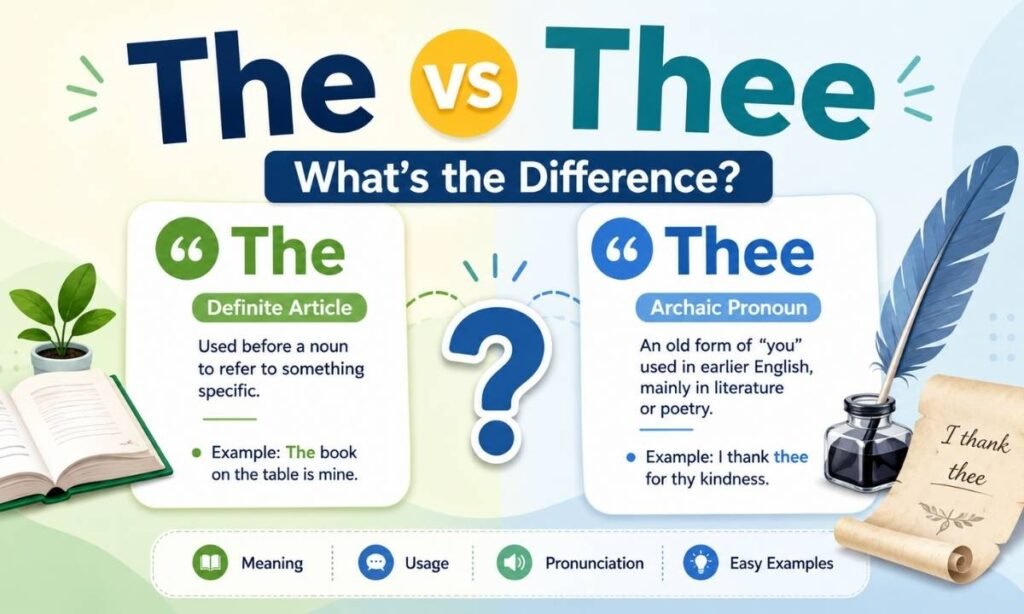
Many English learners get confused the moment they hear “the” pronounced like “thee” in fast speech, and they start wondering if the two words are somehow related. They are not. The is a small but essential definite article that every English sentence relies on, while thee is a much older pronoun that most people only meet in poetry, prayer, or classic literature.
This guide breaks down the meaning, grammar, and pronunciation of both words in plain English. By the end, you will know exactly when to use the, when thee might appear in older texts, and why the two are so often mixed up in casual conversation.
The vs Thee at First Glance
The core difference is simple once you see it stated clearly.
- The is a definite article. Its job is to point to a specific noun that both the speaker and listener already know about.
- Thee is an old object pronoun. It means “you” and comes from a much earlier stage of English grammar.
They belong to two completely different word classes, so they are never interchangeable in a sentence, even though they can sound alike when spoken quickly.
| Word | Word Class | Core Meaning | Everyday Use |
| The | Definite article | Points to a specific noun | Extremely common, used in almost every sentence |
| Thee | Object pronoun | Means “you” (singular) | Rare, found mainly in old literature and religious texts |
What Does The Mean in Everyday English?
The definite article the identifies a particular person, place, thing, or idea that has already been mentioned, is unique, or is obvious from context. English speakers use it dozens of times a day without ever thinking about it.
You typically reach for the when:
- The noun has already come up earlier in the conversation.
- There is only one of something, such as the sun or the internet.
- You are talking about a specific group, institution, or landmark, such as the United Nations or the Eiffel Tower.
- Context makes it obvious which item you mean, such as asking someone to “close the door” in a room with one door.
Common examples include the car, the teacher, the weather, and the news. On the other hand, English usually skips the with general ideas, most personal names, most cities, language names, meal names, and sports, which is why native speakers say “I play football” rather than “I play the football.”
What Does Thee Actually Mean?
Thee is the objective, or object, form of the pronoun thou, and thou was simply the informal way of saying “you” to one person in earlier English. When you needed that same “you” as the object of a verb or preposition, English speakers switched to thee instead.
So in a sentence like “I thank thee,” thee is playing the same role that “you” plays in modern English. Dictionaries including Dictionary.com and Collins describe thee as archaic outside of elevated, poetic, or religious prose, and note that some Quaker communities historically used it in ordinary speech as well.
Where Thee Still Shows Up?
You are most likely to encounter thee in these places today:
- Shakespearean plays and other Early Modern English literature
- The King James Bible and traditional prayers
- Hymns and liturgical language in some churches
- Historical fiction written to sound old fashioned
- A handful of English dialects, including parts of Yorkshire, where thee and thou survive in everyday speech
Why Is The Sometimes Pronounced Thee?
This is where most of the confusion actually starts, and it has nothing to do with the pronoun thee. It is purely a pronunciation pattern.
In relaxed speech, the definite article the usually gets a short, quiet sound close to “thuh.” But right before a word that starts with a vowel sound, native speakers naturally shift to a longer “thee” sound so the words flow together more smoothly.
| Example Phrase | How Most Speakers Say It | Reason |
| the book | thuh book | Next word starts with a consonant sound |
| the apple | thee apple | Next word starts with a vowel sound |
| the hour | thee hour | The h is silent, so the vowel sound comes first |
| the university | thuh university | The u sounds like a y consonant, not a vowel |
Notice that the rule depends on sound, not spelling. That is why the hour takes “thee” even though hour starts with a consonant letter, and the university takes “thuh” even though university starts with a vowel letter. Speakers also use the “thee” pronunciation when they want to add emphasis, as in “that was the movie of the year.”
Thee, Thou, Thy, and Thine Explained
Thee did not travel alone. It belonged to a whole family of second person singular pronouns that modern English eventually dropped in favor of one all purpose word, “you.”
| Old English Form | Grammatical Role | Modern Equivalent |
| Thou | Subject pronoun | You |
| Thee | Object pronoun | You |
| Thy | Possessive adjective | Your |
| Thine | Possessive pronoun | Yours |
So thou art (you are) uses thou as the subject, while I love thee uses thee as the object, and thy kingdom or thine own show the possessive forms in action.
How English Lost Its Informal You?
Older English actually had two separate pronouns for “you,” much like French still distinguishes tu from vous. Thou, thee, thy, and thine were the informal, singular set used with close friends, family, children, or people of lower social rank, while ye and you were originally the plural and more formal set.
Over the 1600s and 1700s, English speakers gradually stopped bothering with the distinction and settled on you for everyone, in every situation. That shift is exactly why thee now reads as old fashioned, poetic, or overly formal to modern ears, even though it started out as the more casual, familiar option.
Thee vs You: Are They the Same Word?
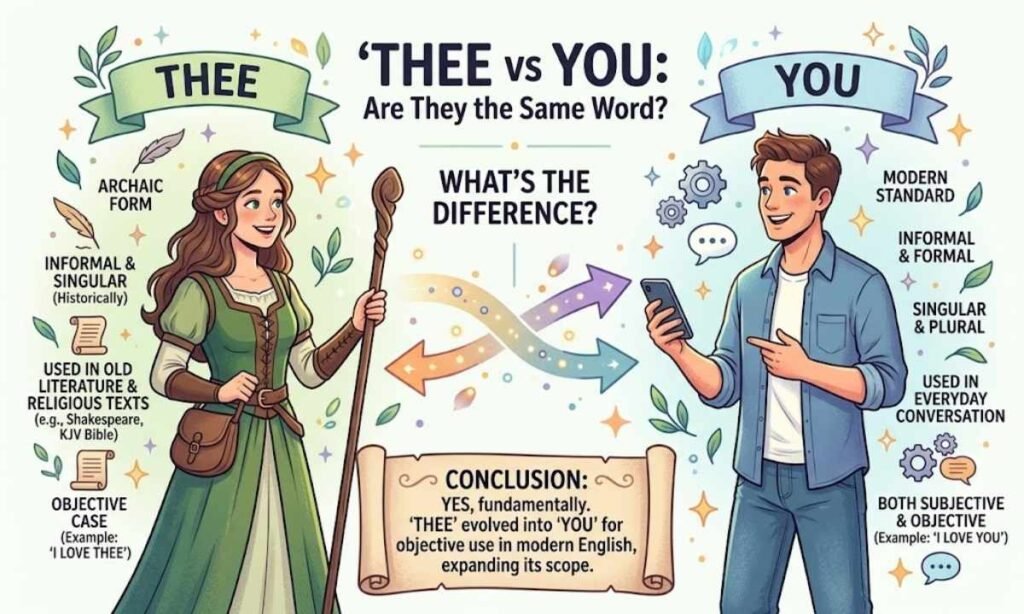
Functionally, yes. Thee simply is an older form of you used as an object. It is not a fancier or more polite version of you, and using it in a normal conversation today will sound theatrical rather than respectful.
If you are ever unsure whether thee fits a sentence, try swapping it for you. If the sentence still makes sense, thee is very likely doing the same job.
- I thank thee becomes I thank you.
- We beseech thee becomes We beseech you.
- To thee I give my word becomes To you I give my word.
Common Mistakes People Make With The and Thee
A few mix ups come up again and again, so it helps to name them directly.
- Writing “thee book” when the writer actually means the article “the.” These two words are never spelled or used the same way.
- Using thee as a subject, as in “thee art kind.” Thee only works as an object; thou would be the correct subject form in archaic English.
- Assuming thee is a formal, upscale version of you rather than an old, informal pronoun.
- Confusing the archaic pronoun thee with the everyday pronunciation of the article the, which can also sound like “thee” before a vowel sound.
A Simple Test to Tell Them Apart
Whenever you are unsure which word belongs in a sentence, ask two quick questions.
- Is the word sitting directly in front of a noun, identifying which one you mean? If yes, you need the article the.
- Can the word be replaced with you without changing the sentence’s meaning? If yes, you are almost certainly looking at the pronoun thee.
This two question test resolves nearly every case you will run into, whether you are reading old poetry or simply double checking your own writing.
The vs Thee Side by Side Examples
Seeing both words used in context makes the distinction stick.
Using the:
- Please pass the salt.
- She is reading the newspaper.
- He is the best player on the team.
Using thee:
- I give thee this ring.
- Blessed art thou among women, and blessed is the fruit of thy womb.
- With this ring, I thee wed.
Each thee example above can be swapped for you without losing meaning, while each the example is simply pointing to a specific, identifiable noun.
How Other Languages Handle This Same Idea?
English is not unusual in separating “pointing at a specific noun” from “addressing a person.” Spanish, French, and German all have definite articles similar to the, such as el, la, le, and der, and many of those languages still keep a formal and informal version of “you,” the way English once did with thou and you. Comparing English to these languages is a useful reminder that thee was never a strange exception; it was simply the informal “you” that English eventually retired.
Tips for Using Thee Correctly in Creative Writing
If you are writing poetry, a period piece, a wedding vow, or dialogue meant to sound old fashioned, a few guidelines will keep your archaic English accurate.
- Use thou only as the subject of a sentence, never as the object.
- Use thee only as the object of a verb or preposition.
- Match the old verb endings when you can, such as thou art, thou hast, and thou dost, since mixing modern verbs with thou or thee tends to look inconsistent.
- Reserve thee and thou for a clearly intentional archaic or poetic tone rather than everyday narration, since overusing them can distract readers.
Quick Reference Guide
Use the whenever you are pointing to a specific, identifiable noun. Use thee only when you are writing or quoting older English in which it functions as the object form of you. Remember that the can sound like “thee” in speech before a vowel sound, but that pronunciation quirk has nothing to do with the archaic pronoun.
Frequently Asked Questions
What is the difference between the and thee?
The is a definite article used before a specific noun, while thee is an archaic pronoun meaning you, used as an object.
Is thee the same word as the?
No. They are spelled similarly but belong to completely different word classes with different jobs in a sentence.
Does thee mean you?
Yes, thee is simply the old object form of you, used mainly in older English texts and prayers.
Why is the sometimes pronounced thee?
Speakers naturally lengthen the sound of the to “thee” before a word that starts with a vowel sound, purely for smoother pronunciation.
Is thee still used in modern English?
Rarely. It survives mainly in classic literature, religious language, poetry, and a few regional dialects.
Is thee more formal than you?
No. Thee was historically the informal, familiar pronoun, not a more polite or formal one.
What is the difference between thou and thee?
Thou is the subject form of the old pronoun, as in thou art, while thee is the object form, as in I see thee.
Conclusion
The is the modern definite article every English speaker uses constantly, while thee is a retired pronoun that once meant you and now lives on mainly in old books, hymns, and prayers.
They sound related because of how the gets pronounced before vowel sounds, but their meanings, grammar, and everyday relevance could not be more different.