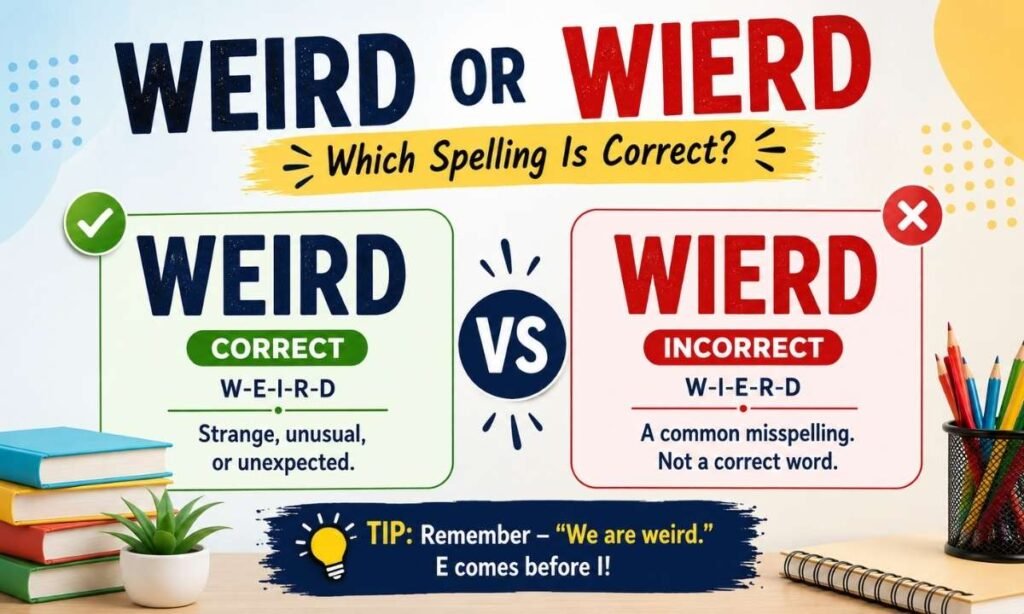
Weird is the correct spelling, while wierd is a common misspelling that many people type without even noticing. The word follows an unusual pattern in English because it places E before I, which goes against the familiar spelling rule most of us learned in school.
This confusion happens to writers, students, and even native speakers because the word sounds like it should follow the standard rule. Below, you will find the correct spelling of Wierd or Weird, the reason behind the confusion, simple memory tricks, real usage examples, and answers to the most common questions people search for online.
Wierd or Weird: Which One Is Correct
The only accepted spelling in modern English is weird. Wierd is not listed as a standard word in any major dictionary, including Merriam-Webster, Cambridge, and Oxford. It is simply a spelling error caused by the way the word sounds when spoken aloud.
- Correct spelling: weird
- Letter order: W-E-I-R-D
- Meaning: strange, unusual, or hard to explain
- Incorrect spelling: wierd
Weird vs Wierd at a Glance
| Word | Correct Spelling | Meaning |
| weird | Yes | Strange, unusual, or unexpected |
| wierd | No | Common misspelling of weird |
How Do You Spell Weird Correctly?
The correct order is W plus E plus I plus R plus D, which together forms weird. Many people instinctively swap the E and I because of how the word is pronounced, but the written form always keeps E ahead of I.
Weird uses the letter combination “ei,” not “ie.” This single detail is the root of almost every spelling mistake connected to this word. If you remember that weird breaks the usual pattern, you are far less likely to write it incorrectly again.
Some older or regional sources, including certain dictionaries of Scots language, list wierd as an alternate historical form. In standard modern English writing, however, only weird is considered correct.
Why Do People Spell Weird as Wierd?
Most spelling confusion around this word traces back to a classroom rule that does not actually apply here.
- The “I before E except after C” rule is taught early in school
- Weird does not contain a C, so writers assume the rule applies
- The word is actually a well-known exception to that rule
- Pronunciation does not clearly signal which vowel comes first
Because the rule fails for this specific word, many capable writers still misspell it as adults. Recognizing weird as an exception, rather than trying to force it into the rule, is the fastest way to fix the habit permanently.
Easy Tricks to Remember the Spelling of Weird
A few simple memory tools make this spelling stick for good.
- Break it down as WE plus IRD to form WEIRD
- Use the sentence “We are weird” as a quick mental cue
- Remember that WEI is correct while WIE is not
- Picture the letters E and I standing side by side, with E always first
Repeating one of these tricks a few times is usually enough to permanently correct the habit of writing wierd.
What Does Weird Mean?
Weird describes something strange, unusual, unexpected, or difficult to explain using ordinary logic. It can apply to a person, an object, a feeling, or an entire situation.
The word functions mainly as an adjective in everyday English. It commonly appears in phrases such as:
- A weird person
- Weird behavior
- A weird feeling
- A weird situation
- A weird sound
- A weird experience
Depending on tone, weird can sound playful, curious, or slightly negative, so context always shapes how the word lands in conversation.
How to Use Weird in a Sentence?
Weird appears comfortably in casual speech, everyday writing, and text conversations.
Everyday examples:
- That noise coming from the attic was really weird.
- It felt weird walking into my old school again.
- She has a weird sense of humor that grows on you.
In more formal writing, alternatives such as unusual, peculiar, or unexpected often fit better than weird, since the word carries a casual tone. In texting and informal chat, weird is used freely and often shortened emotionally rather than grammatically, though the spelling itself never changes.
Weird Word Forms You Should Know
Understanding related forms helps writers use the word correctly across different sentence structures.
| Word Form | Example Sentence |
| Weirdly | He weirdly avoided answering the simple question. |
| Weirdness | There was a strange weirdness to the empty house. |
| Weirder | This plot twist is even weirder than the last one. |
| Weirdest | That was the weirdest dream I have had all year. |
Weird vs Wired: Don’t Confuse These Words
Weird and wired look somewhat similar but carry completely different meanings.
- Weird means strange or unusual
- Wired means connected, or full of restless energy
Example comparison:
- That movie was weird.
- My laptop is wired to the router in the office.
Mixing these two words up is a separate mistake from writing wierd, but it happens often enough to deserve a quick mention here.
Weird Synonyms Worth Knowing
Choosing a synonym can help writers avoid repeating weird too many times in one piece of writing.
- Strange
- Unusual
- Odd
- Bizarre
- Peculiar
- Uncanny
Each synonym carries a slightly different shade of meaning, so it helps to match the tone of the sentence rather than swapping words at random.
Common Weird Spelling Mistakes
Several misspellings show up repeatedly across search queries and everyday writing.
- Wierd, the most frequent error
- Weerd, a phonetic guess based on pronunciation
- Weard, a less common vowel-order mistake
- Wired, a completely different real word that is often confused with weird
Knowing these patterns makes it easier to catch mistakes before hitting publish or send.
Is Weird an Exception to I Before E?
The traditional rule states that I comes before E, except immediately after the letter C. Weird has no C anywhere in it, yet it still breaks the pattern by placing E before I. This makes weird one of the clearest examples of an exception that English teachers often highlight in class.
Other words that break the same rule include:
- Their
- Height
- Seize
- Foreign
Seeing weird alongside these familiar exceptions helps the spelling feel less random and easier to remember long-term.
Weird Across English Dialects: US vs UK Usage
American and British English agree on the correct spelling of weird, which keeps this word simpler than many other transatlantic spelling differences.
- Both American and British dictionaries list weird as standard
- Pronunciation shifts slightly between regions, but spelling stays fixed
- No regional variant spells the word with ie instead of ei
Because there is no split between US and UK spelling here, learners do not need to memorize two different versions, unlike words such as color and colour.
How Kids and New English Learners Learn to Spell Weird?
Teachers and language programs often flag weird early because it appears so often in reading materials aimed at children and new learners.
- Flashcards pairing weird with other rule-breaking words
- Repetition drills using the “we are weird” mnemonic
- Sentence-writing practice to reinforce muscle memory
- Grouping weird with similar exception words during spelling lessons
Early repeated exposure is one of the main reasons fluent adult speakers eventually stop misspelling the word altogether.
Weird on Social Media and in Everyday Digital Writing
The word shows up constantly across captions, comments, and casual online writing, which keeps the misspelling wierd alive despite spellcheck tools.
- Frequently used in reaction comments and casual captions
- Often typed quickly without a spelling check
- Autocorrect on most platforms corrects wierd automatically
- Still appears as a search term because people want quick confirmation
Because so much writing today happens quickly on phones, checking the spelling before posting remains a useful habit.
Tools and Habits That Help You Stop Misspelling Weird
A few practical habits make this mistake disappear for good.
- Turn on browser or app spellcheck for everyday typing
- Read the word slowly, letter by letter, when unsure
- Keep a short mental list of personal trouble words, including weird
- Practice the word in a few sentences until it feels automatic
Small, consistent habits like these tend to outperform simply memorizing a rule once and forgetting it later.
Weird or Wierd: Quick Answer Summary
- Correct: weird
- Incorrect: wierd
- Spelling order: W-E-I-R-D
- Meaning: strange, unusual, or unexpected
- Memory tip: E always comes before I in this word
Frequently Asked Questions
Is it weird or wierd?
Weird is the correct spelling. Wierd is a common misspelling with no standard dictionary entry.
Is wierd a real word?
No, wierd is not a standard English word. It is a frequent misspelling of weird.
How do you spell weird?
Weird is spelled W-E-I-R-D, with the E placed before the I.
Why is weird spelled with EI?
English spelling has many exceptions, and weird is one of the clearest cases where E comes before I.
Is weird an exception to i before e?
Yes, weird breaks the “I before E except after C” rule despite having no C in the word.
What does weird mean?
Weird means strange, unusual, or difficult to explain through ordinary logic.
What is another word for weird?
Common alternatives include strange, unusual, odd, bizarre, and peculiar.
Conclusion
Weird is the standard spelling recognized by every major English dictionary, while wierd remains a widespread but incorrect variation caused by pronunciation and a misapplied spelling rule. Remembering that E comes before I, along with a simple mnemonic like “we are weird,” is usually enough to fix the habit for good.
Once the correct order becomes automatic, this small but persistent spelling mistake tends to disappear from everyday writing entirely.