Most people learned this spelling saying in grade school, yet almost nobody remembers it correctly as adults. The full version taught by language experts is longer than the catchy rhyme, and it explains why words like believe, receive, weird, and science all behave so differently on paper.
This guide breaks the rule into plain, usable steps. You will see the standard pattern, the common exceptions, a side by side comparison table, memory tricks, and a short practice quiz you can use right away to test your own spelling.
What Does I Before E Except After C Mean?
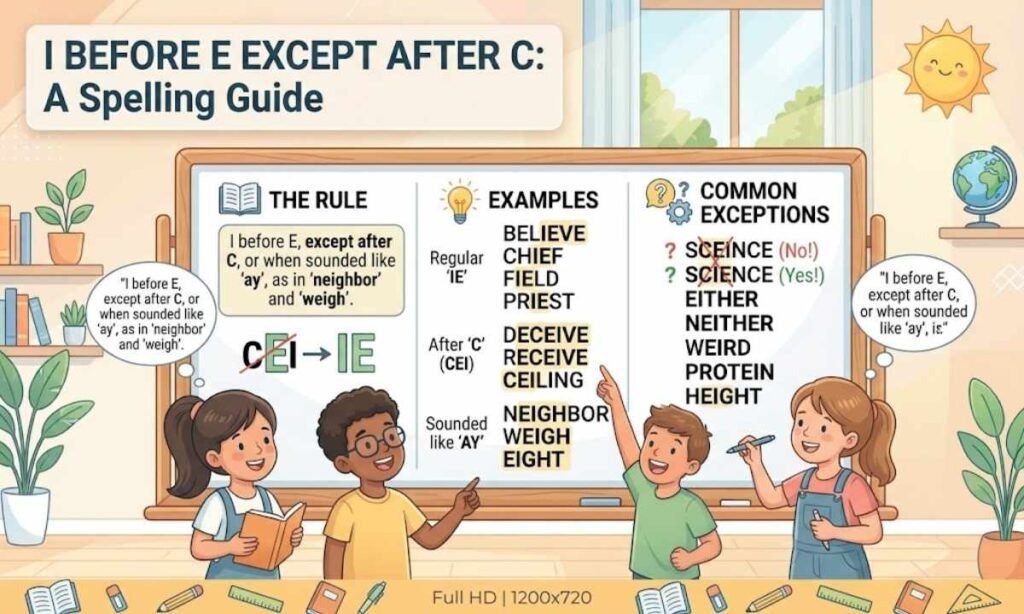
The phrase is a spelling mnemonic, not a strict grammar law. It tells writers that when the letters I and E sit together and make a long E sound, I usually comes first, unless the letter C comes right before them, in which case E comes first.
- IE pattern: believe, chief, field, piece, relief, achieve
- EI after C: receive, deceive, conceive, perceive, receipt, ceiling
That short version works for many everyday words, which is exactly why it survived generations of classroom teaching, even though linguists have pointed out for decades that it is far from complete.
The Sound Matters More Than the Letter Order
Language researchers agree that the rule only reliably applies when IE or EI creates a long E sound, the same sound heard in see or bee. Once the sound changes, the rule quietly falls apart, which is the real reason so many people misspell common words.
- Long E sound, IE pattern: field, niece, thief
- Long E sound, EI after C: receive, conceit, deceit
- Different vowel sound: the rule no longer reliably applies
Understanding this single detail solves more spelling confusion than memorizing endless word lists ever will.
A Complete List of IE and EI Words to Know
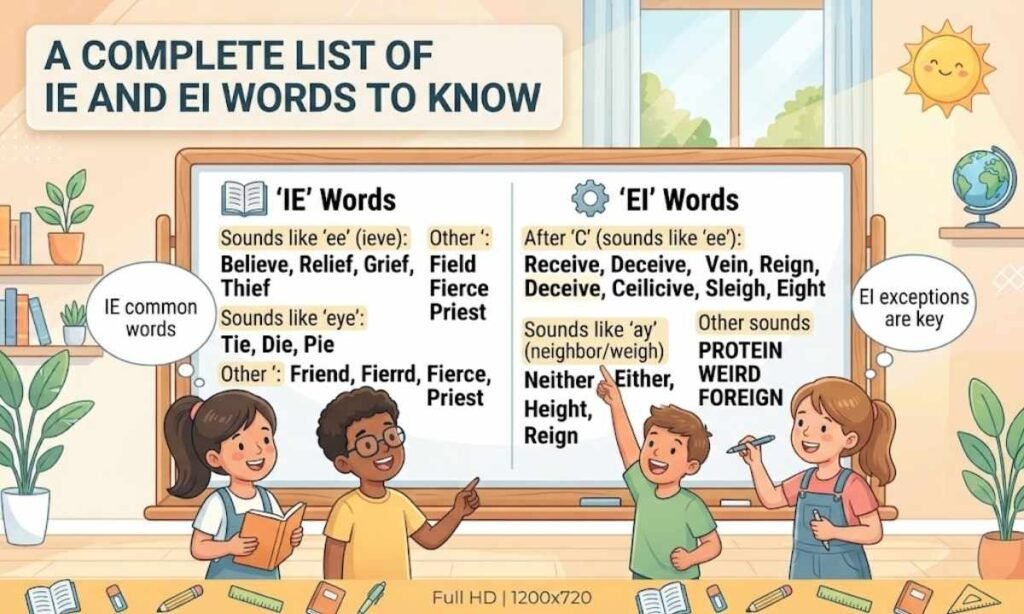
| IE Words (Standard Pattern) | EI Words (After C) |
| believe | receive |
| achieve | deceive |
| chief | conceive |
| field | perceive |
| piece | receipt |
| niece | ceiling |
| relief | conceit |
| thief | deceit |
Keeping a reference table like this nearby is one of the simplest study tools for students, teachers, and anyone preparing for a spelling test or writing exam.
Common Exceptions That Break the Simple Rule
English pulled vocabulary from French, Latin, Germanic languages, and Old English, so a single rhyme could never cover every borrowed spelling pattern.
- EI words that sound like A: eight, weight, freight, neighbor, weigh, vein, reign
- EI words that sound like the long I: height, heist, either, neither, feisty
- EI words with other sounds: foreign, forfeit, leisure, their
- Frequently cited outlier: seize, which keeps EI even though it carries a long E sound
Many of these exceptions were formalized in an extended version of the rhyme, first traced back to Ebenezer Cobham Brewer in 1880, which added the line about words sounded as A, as in neighbor and weigh.
IE Words That Follow the Letter C
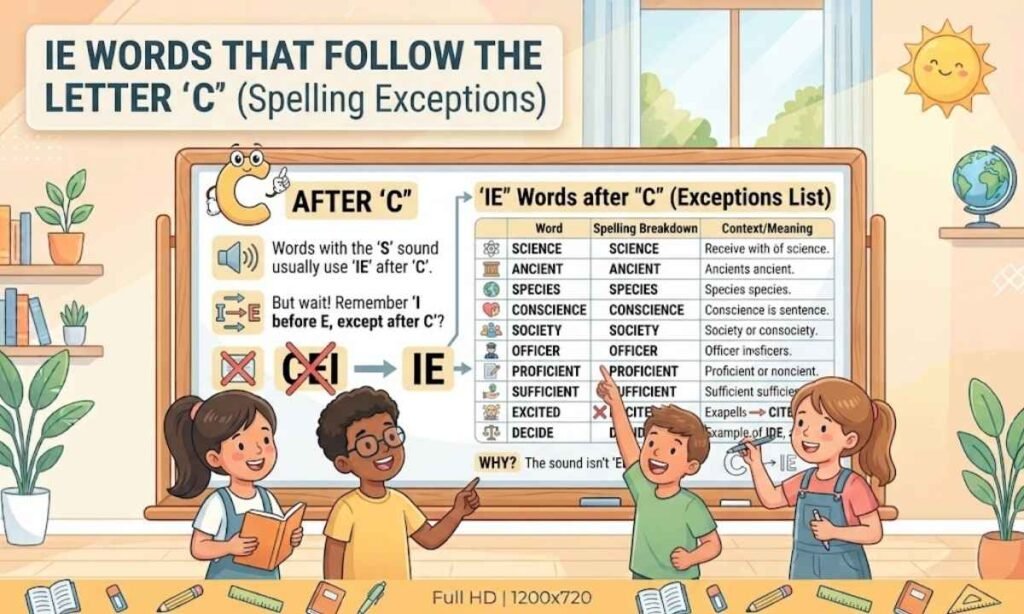
This group confuses learners the most, since it seems to directly contradict the second half of the original phrase.
- science
- species
- sufficient
- efficient
- conscience
- deficient
Language experts explain that in these words the C makes a soft SH sound rather than a hard K sound, so the IE combination is not functioning as one simple long E vowel unit, which places these words outside the scope the rule was ever meant to cover.
Why the Rule Has So Many Exceptions?
The mnemonic was never designed as a complete grammar law. It was a teaching shortcut created for classrooms, meant to help young students remember one common pattern rather than describe the entire English spelling system.
- English absorbed spelling habits from multiple source languages
- Pronunciation of IE and EI shifted differently across word origins
- Some so called exceptions, like science, are not true exceptions once the sound and the role of C are properly analyzed
Merriam Webster itself now presents an expanded version of the rhyme that accounts for sounds like A and SH, admitting the short version was always an oversimplification.
The History Behind This Famous Spelling Rhyme
The earliest documented form of this mnemonic appeared in nineteenth century English spelling guides, well before it became a fixture in American classrooms. Writers and grammar reference editors have revised the phrase multiple times across the last century, each time trying to patch a new batch of exceptions into the rhyme without making it too clumsy to remember.
How the Rule Is Still Taught in Classrooms Today?
Elementary teachers still introduce the short rhyme early because it gives students an easy entry point into English spelling patterns. Many lesson plans now pair the rhyme with sound based sorting activities, asking students to group words by their vowel sound rather than by letter order alone, which better matches how linguists actually explain the pattern.
British English Versus American English Spelling Habits
Both varieties of English generally follow the same core IE and EI pattern, but pronunciation differences can shift how a learner hears certain words. Some British teaching materials attach the rule specifically to the long E sound from the start, which naturally filters out a few of the exceptions that trip up American students who learn only the short rhyme.
Spell Check Tools and Their Limits With This Rule
Modern word processors catch most IE and EI mistakes automatically, yet they still miss context specific errors, especially when a misspelled word happens to form another valid English word. Relying only on autocorrect without understanding the underlying sound pattern can leave gaps in a writer’s independent spelling skills.
IE vs EI After C: Quick Comparison Table
| Pattern | Example Words |
| IE (standard) | believe, piece, field |
| EI after C | receive, deceive, receipt |
| EI without C | weird, seize, foreign |
| IE after C | science, species, sufficient |
This table format is a fast reference for essays, spelling tests, and quick classroom review sessions.
Commonly Misspelled IE and EI Words
- Believe, not beleive
- Receive, not recieve
- Deceive, not decieve
- Weird, not wierd
- Their, not thier
- Height, not hieght
Dictionary and grammar reference sites consistently list these same six words among the most searched spelling corrections in English, which shows how persistent this confusion remains even among confident writers.
Fun Facts About English Spelling Exceptions
English has thousands of documented exceptions across its grammar and spelling system, and the IE versus EI pattern is often cited as one of the clearest classroom examples of why rigid spelling rhymes struggle against a language built from so many borrowed roots. Some linguists have even argued the rule causes more mistakes than it prevents once every documented exception is counted.
Simple Tricks to Remember IE and EI
- Listen for the long E sound first
- Check whether the letter C comes directly before the vowel pair
- Default to IE if there is no C
- Switch to EI if C comes first and the sound is still long E
- Memorize exception groups by sound instead of as one giant list
Anchoring the rule to memory words like believe for IE and receive for EI gives most learners a fast mental shortcut that holds up in everyday writing.
Quick Practice to Test Your Spelling
Try filling in the missing letters, then check your answers below.
- bel__ve
- rec__ve
- w__rd
- dec__ve
- h__ght
Answer key: believe, receive, weird, deceive, height
Frequently Asked Questions
What is the I before E except after C rule?
It is a spelling mnemonic stating that I comes before E, except when the pair follows the letter C, mainly for words with a long E sound.
Does the I before E rule always work?
No, it only reliably applies to words with a long E sound, and even then it has several well known exceptions.
What are the most common I before E exceptions?
Common exceptions include weird, seize, height, foreign, and science, which do not follow the basic letter order pattern.
Is it I before E or E before I?
It depends on the word and the sound it makes, since both orders are correct in different, well documented cases.
Why is receive spelled with EI?
Receive follows C and carries a long E sound, which places it directly inside the standard EI after C pattern.
Why is weird an exception?
Weird has a long E sound but no preceding C, so by the classic rhyme it should use EI, breaking the simple pattern entirely.
Is science an exception to I before E?
Yes, because the C in science makes a soft sound rather than a hard K sound, placing it outside the rule the rhyme was built for.
Conclusion
The I before E except after C rule works best as a starting point, not a final answer. Use IE for the standard long E sound, switch to EI after C when that same sound continues, and treat every other case as part of a learnable exception group rather than a random accident.
With the tables and tricks above, spelling these tricky words correctly becomes far easier to remember for good.