
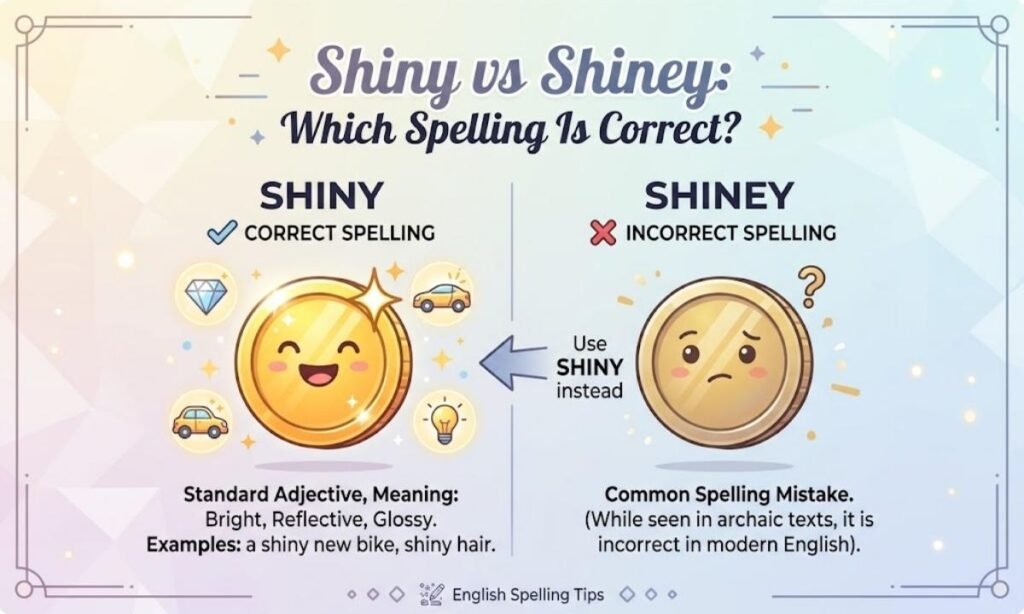
Shiny is the word you want when you’re describing something bright, glossy, polished, or reflective, like a new car, a clean floor, or freshly washed hair. Shiney shows up often in casual typing, but it isn’t the accepted spelling of this adjective in dictionaries or edited writing.
This confusion is common because the base word “shine” already ends in a silent e, so it feels natural to keep that e when adding the “y” ending. If you’re wondering about Shiny vs Shiney, the correct form is straightforward once you understand the spelling rule. Below, we’ll break down the spelling rule, the word’s history, correct usage, related forms, and the most common mistakes people make with it.
Shiny or Shiney: Which Is Correct?
Shiny is correct. It’s the standard adjective form recognized by Merriam-Webster, Dictionary.com, and Collins, and it’s the spelling used in books, news articles, and professional writing. Shiney appears occasionally online, but style guides and dictionaries treat it as a misspelling of shiny.
For example: “The freshly waxed floor looked shiny” is correct. “The freshly waxed floor looked shiney” is not.
What Does Shiny Mean?
Shiny Definition in Simple English
Shiny describes a surface that reflects light because it’s smooth, bright, or polished. Merriam-Webster defines it as having a smooth, glossy surface, and Collins describes it as glossy or polished and bright. It’s also used more loosely to mean filled with light, as in a shiny, sunlit morning.
Examples of Shiny in a Sentence
• Her shoes were shiny after a fresh polish.
• The new phone has a shiny glass back.
• He drives a shiny black pickup truck.
• The countertop stayed shiny even after months of use.
• Their hair looked shiny and healthy after the salon visit.
Where Does the Word “Shiny” Come From?
Shiny comes from the verb “shine,” combined with the adjectival suffix “y,” which is used to turn nouns or verbs into descriptive words (compare rain to rainy, or wind to windy). Merriam-Webster traces the earliest known use of shiny to the 16th century, and Dictionary.com records its first appearance between 1580 and 1590. The spelling has stayed consistent for centuries: shine plus y, with no extra e.
Why Is It Shiny and Not Shiney?
The Shine to Shiny Spelling Pattern
English has a general pattern for adjectives built from a verb or noun ending in a silent e: drop the e, then add the ending.
• shine becomes shiny
• grime becomes grimy
• haze becomes hazy
• spice becomes spicy
Following this same pattern, shine drops its e and takes the y, giving you shiny, not shiney.
Why Does the Extra “E” Cause Confusion?
People see “shine” and instinctively want to preserve the full root word before adding a suffix, so they type “shine” plus “y” as shiney instead of dropping the silent e first. This is one of the most frequently cited reasons across grammar and spelling resources for why the mistake happens so often, and it explains the error without implying that shiney is a recognized alternative.
How Autocorrect and Typing Habits Create the Shiney Mistake?
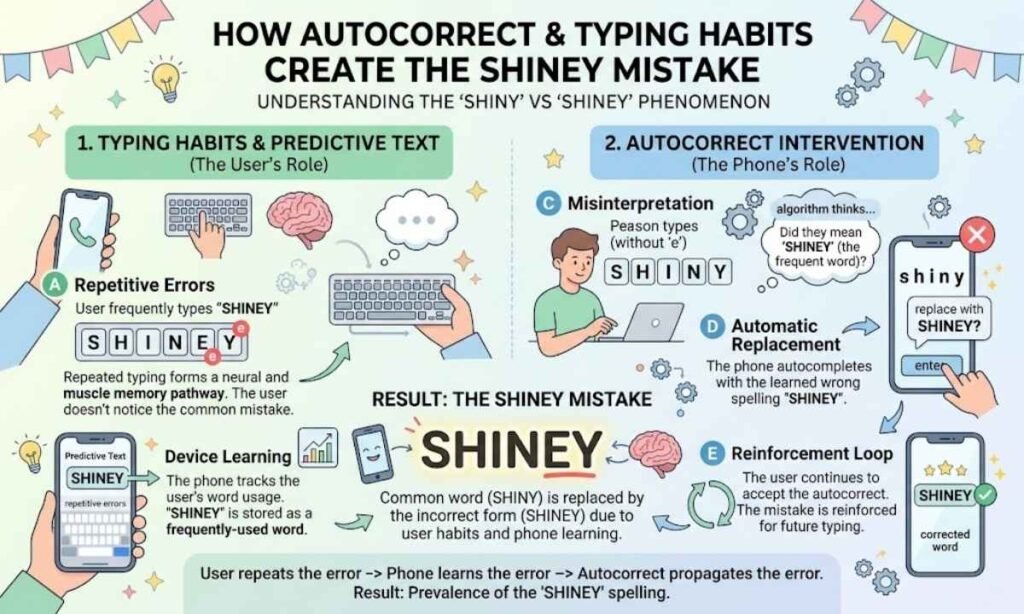
Fast typing and muscle memory also play a role. Many people type common “-y” adjectives like “funny,” “sunny,” or “honey,” and the visual pattern of “e” followed by “y” bleeds into words like shiny.
Because shiney isn’t flagged as an error on every keyboard or app, the mistake can slip through unnoticed, especially in texts, captions, and social media posts where spellcheck is inconsistent.
Shiny vs Shiney: What’s the Difference?
| Word | Standard Spelling? | Meaning |
| Shiny | Yes | Bright, glossy, polished, or reflective |
| Shiney | No, as an adjective | Usually a misspelling of shiny |
Is Shiney a Word?
Shiney is not the standard spelling of the adjective meaning bright or glossy. However, the letter sequence “shiney” does appear intentionally in other contexts, including:
• Surnames (Shiney as a family name in some regions)
• Usernames and gamer tags
• Brand names or product names
• Character names in fiction, games, or entertainment
So while shiney isn’t wrong in every possible context, it’s incorrect whenever you’re using it to mean bright, glossy, or reflective.
How Do You Use Shiny Correctly?
Shiny Before a Noun
• a shiny car
• shiny shoes
• a shiny surface
• shiny wrapping paper
Shiny After a Linking Verb
• The floor looks shiny.
• Her shoes are shiny.
• The metal became shiny after polishing.
• His forehead was shiny with sweat.
Shiny vs Shining: Are They the Same?
| Word | Main Use | Example |
| Shiny | Describes an appearance or quality | The car is shiny. |
| Shining | Describes an ongoing action of giving off light | The sun is shining. |
Shiny and shining are related but not interchangeable in every sentence. Shiny is typically an adjective describing a surface, while shining is often the present participle of the verb “shine,” describing an active process of emitting or reflecting light.
Shiny, Shinier, and Shiniest
What Is the Comparative Form of Shiny?
Shinier. Example: This table is shinier than the old one.
What Is the Superlative Form of Shiny?
Shiniest. Example: That is the shiniest car in the showroom.
What About Shininess?
Shininess is the noun form of shiny, referring to the quality or degree of being shiny. Example: The polish improved the shininess of the wood floor.
Shiny vs Glossy, Polished, and Reflective
Shiny vs Glossy
Glossy often emphasizes a smooth, coated surface with a noticeable sheen, such as glossy paper or glossy paint, and is commonly used in printing and photography.
Shiny vs Polished
Polished suggests a surface has been actively treated, buffed, or smoothed to achieve its brightness, implying effort rather than just appearance.
Shiny vs Reflective
Reflective focuses specifically on a surface’s ability to bounce back light, which is useful in technical or safety contexts like reflective tape or reflective glass.
Shiny vs Matte: What’s the Difference?
• Shiny: reflects noticeable light and often looks glossy or wet
• Matte: has a flat, low-glare finish with minimal reflection
This distinction matters across several industries:
• Paint and home finishes
• Photography and printing
• Cosmetics, especially skin and lip products
• Furniture and flooring
• Electronics and device casings
Common Mistakes With Shiny
Writing Shiney Instead of Shiny
Incorrect: The car is shiney. Correct: The car is shiny.
Writing Shineyer Instead of Shinier
Incorrect: This one is shineyer. Correct: This one is shinier.
Writing Shineyest Instead of Shiniest
Incorrect: It is the shineyest one. Correct: It is the shiniest one.
Confusing Shiny With Shining
Incorrect: The floor was shining after mopping, so I left shiny footprints. Correct: The floor was shiny after mopping, and the sun was shining through the window.
Shiny vs Shiney in American English
American English uses shiny as the standard adjective for something bright, glossy, or reflective. Merriam-Webster, an American dictionary, lists only shiny, with shinier and shiniest as its inflected forms, and does not list shiney as an accepted variant.
Is Shiney a US Spelling?
No. Shiney is not recognized as a standard American English spelling of the adjective in any major dictionary.
Correct and Incorrect Examples of Shiny
| Incorrect | Correct |
| shiney shoes | shiny shoes |
| shiney car | shiny car |
| shiney hair | shiny hair |
| shiney surface | shiny surface |
| shineyer | shinier |
| shineyest | shiniest |
Quick Spelling Checklist You Can Save
Before you publish or send anything, run through this short list:
1. Drop the silent e from “shine” before adding “y.”
2. Double check comparative and superlative forms: shinier, shiniest, not shineyer or shineyest.
3. Remember shininess is the correct noun form.
4. Treat “shiney” as acceptable only in proper names, never as the adjective.
5. Run a spellcheck, since many tools now flag shiney automatically.
Shiny in Everyday Pop Culture
The word shiny shows up often outside strict dictionary use. In some fandoms and video games, “shiny” refers informally to a rare or desirable collectible version of an item, and in casual slang it can describe something exciting or new, as in a “shiny new phone.”
These informal uses still rely on the correct base spelling, shiny, even when the meaning stretches beyond “reflects light.”
Easy Memory Trick for Shiny vs Shiney
Use this simple rule: shine loses its e when y joins in, so shine becomes shiny.
You can also anchor the whole word family together: shiny, shinier, shiniest, shininess, all spelled without the extra e.
Frequently Asked Questions
Is shiny or shiney correct?
Shiny is correct. Shiney is a common misspelling of the adjective meaning bright or glossy.
Is “shiney” a real word?
Not as a standard adjective, though it can appear as a surname, username, or brand name.
Why is shiny spelled without an e?
Because shine drops its silent e before adding the “y” suffix, following a common English spelling pattern.
Is shiny the correct spelling in American English?
Yes, American dictionaries like Merriam-Webster list only shiny, not shiney.
What is a related form of shiny?
Shininess is the noun form, and shinier and shiniest are the comparative and superlative forms.
Is it shinier or shineyer?
Shinier is correct. Shineyer is not a recognized word.
What is another word for shiny?
Common synonyms include glossy, gleaming, polished, lustrous, and sparkling.
Conclusion
Shiny is the standard spelling when you mean bright, glossy, polished, or reflective.
Shiney is generally a misspelling of that adjective, though it can still appear correctly as a name or brand. Keep the word family in mind: shine becomes shiny, shinier, shiniest, and shininess, all without the extra e.