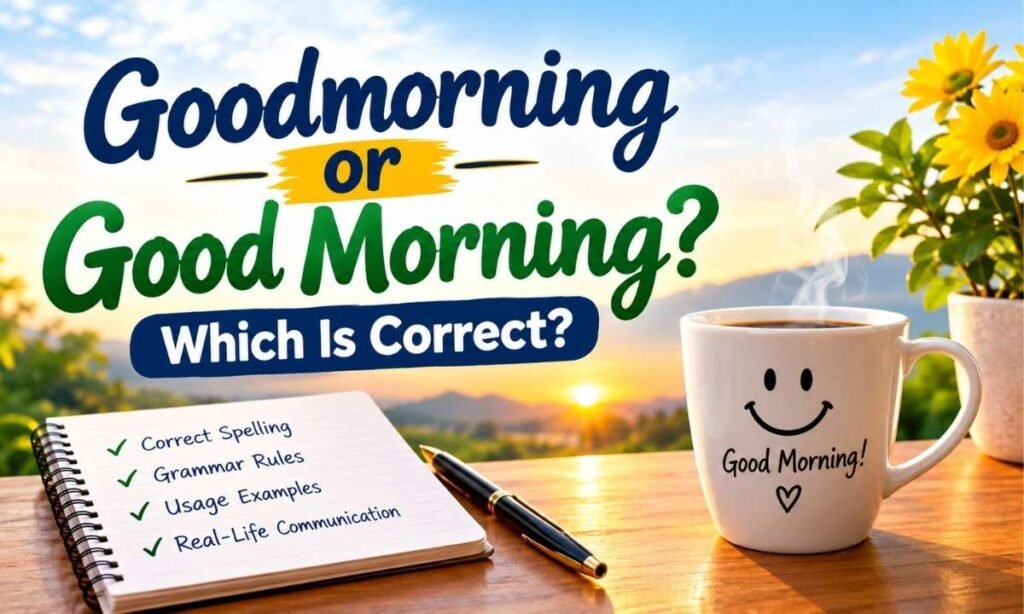
Many people wonder whether “goodmorning” or “good morning” is the right way to write this common greeting. The confusion is understandable, since English has several compound words that begin with “good,” such as goodbye and goodnight, and it is easy to assume this phrase follows the same pattern.
The short answer is that “good morning” is always written as two separate words. “Goodmorning” is considered a spelling mistake in standard English, even though it appears often online. This guide breaks down the grammar, punctuation, and usage rules behind this everyday phrase, drawing on leading dictionaries and language resources.
Goodmorning or Good Morning — The Quick Answer
Good Morning Is the Correct Spelling
“Good morning” is the standard English spelling used to greet someone in the morning. It works as an interjection or a short exclamatory phrase rather than a compound noun, so it keeps its two-word form in every setting, from casual conversation to formal business writing.
Why Goodmorning Is Not Standard
Writing “goodmorning” as one word does not follow accepted English spelling conventions. Major dictionaries, including Merriam-Webster, Cambridge, and Collins, list only the two-word version. The one-word form still shows up in casual texts, usernames, or brand names, but it is not treated as correct in formal or professional writing.
Is Goodmorning Ever Acceptable to Use?
Although “goodmorning” is not standard grammar, the one-word form is sometimes used deliberately as a stylistic choice. Brands, usernames, app names, and creative writing occasionally merge the words for visual impact or trademark purposes.
This kind of usage is a proper-name exception rather than a grammar rule, so it should never be treated as a model for everyday writing, emails, or articles aimed at a general audience.
Is Good Morning One Word or Two Words?
Good Morning Is Always Two Words
Unlike words such as “goodbye” or “goodwill,” which merged into single compound words over centuries of use, “good morning” has never made that shift. Dictionaries and style guides consistently separate “good” and “morning” as an adjective and noun working together as a greeting.
Why Compound Words Cause Confusion
English includes many “good” compounds, including goodwill, goodbye, and goodness. Because these words evolved into single terms, many writers assume “good morning” followed the same path. Language data and dictionary entries show it did not, and the phrase still appears strictly as two words in every recognized source.
What Do Dictionaries and Style Guides Say?
Definitions From Leading Dictionaries
Merriam-Webster defines “good morning” as an interjection used to greet someone or say hello in the morning. Cambridge and Collins describe it in a similar way, as a polite exclamation used when meeting or seeing someone earlier in the day.
Good Morning as a Greeting vs a Noun Phrase
“Good morning” can stand alone as a greeting, or it can work inside a sentence as a noun phrase, such as “It was a good morning at the office.” In both roles, the two words remain separate, and the meaning shifts with context rather than spelling.
Capitalization Rules for Good Morning
At the Start of a Sentence
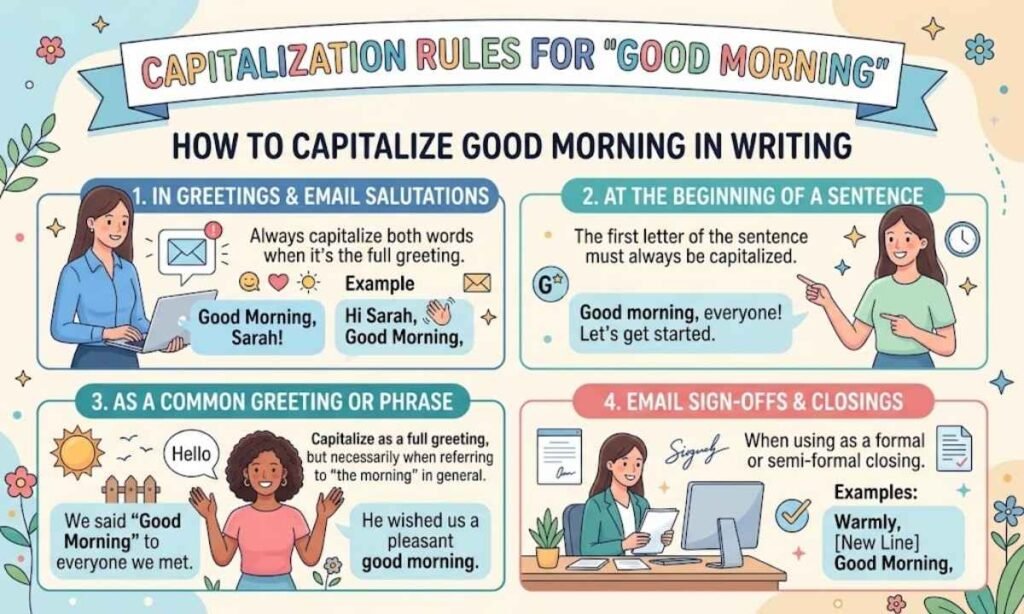
“Good morning” follows normal sentence-case rules: only the first letter is capitalized, and the rest stays lowercase, unless the phrase appears in a heading, title, or after another sentence-ending punctuation mark.
In Headings, Titles, and Email Greetings
In titles or headings, writers often capitalize both words for style, such as “Good Morning: A New Beginning.” In an email greeting, only the first word usually needs a capital letter, followed by the recipient’s name and a comma.
Do You Need a Comma After Good Morning?
Good Morning, Name — Direct Address
A comma is required when “good morning” is followed directly by a person’s name, title, or group being addressed, since the name functions as direct address. Examples include “Good morning, Sarah” and “Good morning, everyone.”
When No Comma Is Needed
If “good morning” stands alone as a complete greeting with nothing following it, no comma is needed. A comma only becomes necessary once a name, title, or addressed group is added right after the phrase.
Good Morning vs Goodnight — Why the Spelling Rules Differ
Many writers assume that if “goodnight” can sometimes appear as one word informally, “goodmorning” should follow the same rule. Dictionaries treat the two greetings differently. “Goodnight” has partly shifted into an accepted informal one-word sign-off in some style guides, while “good morning” has not undergone the same change and remains two words in every recognized dictionary. This distinction is one of the more common sources of confusion for English learners and native speakers alike.
Good Morning in American English vs British English
Both American and British English spell and punctuate “good morning” the same way. The real difference lies in tone and frequency. American English tends to use the phrase casually across almost every setting, including workplaces, schools, and customer service. British English sometimes favors the shorter “morning” in informal contexts, saving the full phrase for slightly more polite situations. Regardless of dialect, the two-word spelling stays standard.
Good Morning Etiquette in Professional and Digital Communication
In professional emails, “Good morning” is a common, polite opening line, typically followed by a comma and the recipient’s name or a general greeting like “everyone.” In workplace chat tools and text messages, the phrase is often shortened to “Morning” or written in lowercase for a more relaxed tone.
On social media, capitalization and punctuation rules loosen further, but grammar checkers and professional style guides still recommend the standard two-word, comma-inclusive form for formal communication and customer-facing messages.
Customer service teams and schools also rely heavily on this greeting. A support agent opening a chat with “Good morning, how can I help you today?” signals politeness and attentiveness, while teachers greeting a class with “Good morning, everyone” sets a welcoming tone for the day.
In every one of these settings, the two-word spelling and correct comma placement remain the expected standard.
Common Alternatives to Good Morning
Writers who want to vary their morning greetings have several accepted options depending on the level of formality. “Rise and shine,” “top of the morning,” and a simple “morning” work well informally, while “good day” offers a neutral, time-flexible greeting for business writing.
Choosing the right alternative depends mainly on audience, tone, and the communication channel being used.
| Form | Standard English? | Example |
| Good morning | Yes | Good morning, Sarah. |
| good morning | Yes | I said good morning to him. |
| Good Morning | Context-dependent capitalization | Good Morning: A New Start |
| Goodmorning | No, for the everyday greeting | Goodmorning, Sarah. (incorrect) |
Good Morning Alternatives at a Glance
The table below lists a few common substitutes for “good morning” and the situations where each one fits best.
| Alternative | Best Used For |
| Morning | Casual chats and quick text messages |
| Rise and shine | Waking someone up playfully |
| Top of the morning | Informal, lighthearted greetings |
| Good day | Neutral greeting for any time before evening |
| Hello / Hi | Simple, time-neutral professional greeting |
Good Morning Spelling Mistakes to Avoid
Writing It as One Word
The most frequent mistake is merging “good” and “morning” into “goodmorning.” This form is not recognized by dictionaries and should be avoided in professional, academic, or customer-facing writing.
Missing the Direct-Address Comma
Forgetting the comma before a name, as in “Good morning Sarah” instead of “Good morning, Sarah,” is another common punctuation error that can make a greeting harder to read.
Overcapitalizing Mid-Sentence
Capitalizing both words in the middle of a sentence, such as “I said Good Morning to him,” is incorrect outside of headings and titles. Standard sentence case applies once the greeting sits inside a larger sentence.
Frequently Asked Questions
Is it goodmorning or good morning?
Good morning is the correct spelling; goodmorning is not recognized by standard dictionaries.
Is good morning one word?
No, good morning is always written as two separate words in standard English.
Should good morning be capitalized?
Only the first word needs a capital letter in a normal sentence; both words may be capitalized in titles or headings.
Do you need a comma after good morning?
Yes, add a comma when a name or group follows, such as “Good morning, John.”
Is goodmorning ever acceptable?
It occasionally appears in usernames or brand names, but never in standard grammar or formal writing.
Is good morning formal or informal?
It works in both formal and informal settings, making it one of the most versatile English greetings.
Is good morning correct in American English?
Yes, American English uses the same two-word spelling found in British and other English dialects.
Conclusion
“Good morning” is the only spelling recognized by dictionaries and style guides. Writing it as “goodmorning” counts as an error in formal English, even though the one-word version occasionally appears in casual or branded contexts.
Using the correct two-word form, proper capitalization, and accurate comma placement keeps writing polished, professional, and easy for readers to follow.