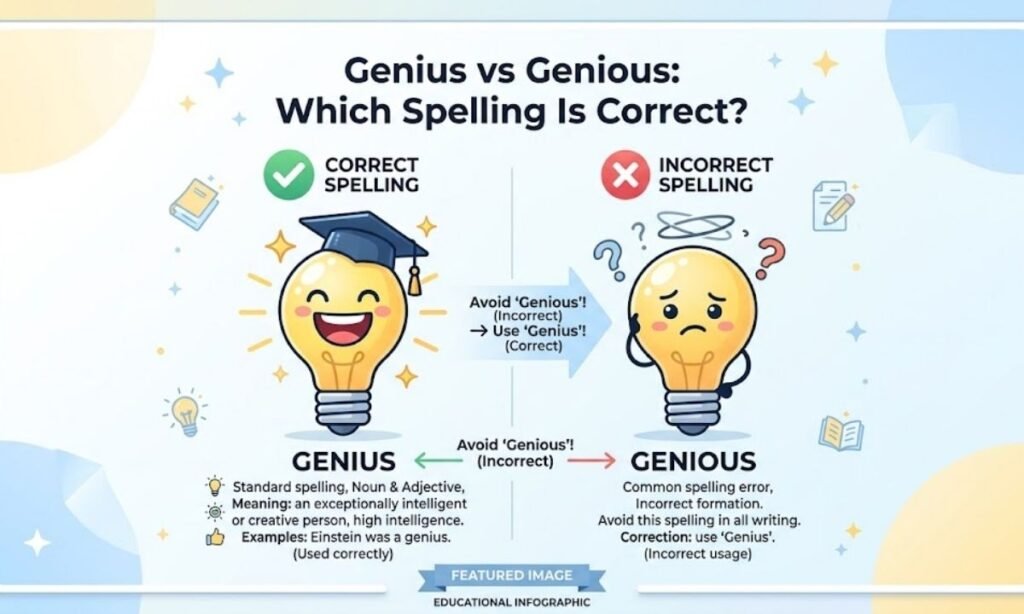
Many English learners and even native speakers pause when typing this word, unsure whether it ends in “-ius” or “-ious.” The confusion usually comes from similar-sounding words like ingenious, which share a related root but a different spelling pattern entirely.
This guide settles the question for good. You will learn the correct spelling, what genius actually means, why the genious mistake happens so often, and how to use the word correctly in everyday, academic, and professional writing.
Genius vs Genious: Which One Is Correct?
The Correct Spelling Is “Genius”
The only correct spelling is genius, spelled G-E-N-I-U-S. It ends in “-ius,” not “-ious.”
Is “Genious” a Word?
No. Genious does not appear in any major dictionary. It is a spelling error, not an alternate form.
Genius vs Genious at a Glance
| Spelling | Valid English Word? | Notes |
| Genius | Yes | Standard, dictionary-recognized spelling |
| Genious | No | Common misspelling, often confused with ingenious |
What Does Genius Mean?
Genius Meaning in English
Genius refers to exceptional intellectual ability, natural talent, or creative brilliance, whether in a person or in their work.
Genius Definition and Part of Speech
Genius functions primarily as a noun, though informal modern usage also treats it as an adjective.
What Does It Mean to Call Someone a Genius?
Calling someone a genius means recognizing an extraordinary capacity for original thought, problem-solving, or achievement in a specific field.
Can “Genius” Describe an Idea?
Yes. In casual speech and writing, people often say a plan or solution is “genius” to mean it is remarkably clever.
Why Do People Spell Genius as Genious?
The “-ious” Spelling Confusion
English has dozens of common adjectives ending in “-ious” (curious, serious, obvious), which pulls the brain toward the wrong pattern.
Why Genius and Genious Sound Similar
Both versions are pronounced almost identically aloud, so the ear offers no clue about which spelling is correct.
Does Pronunciation Cause the Spelling Mistake?
Largely, yes. English spelling doesn’t always match pronunciation, and genius is a clear example of that mismatch.
Genius vs Other Words Ending in “-ious”
Unlike curious or serious, genius keeps its Latin-based “-ius” noun ending, which is why the “-ious” pattern doesn’t apply here.
Genius vs Genious Examples
Correct Examples With Genius
● “Marie Curie was a scientific genius.”
● “That marketing campaign was pure genius.”
Incorrect Examples With Genious
● “She is a genious at math.” (Should be genius.)
● “What a genious plan!” (Should be genius.)
Genius in Everyday Sentences
People use genius casually to praise clever shortcuts, witty comments, or unexpected solutions.
Genius in School and Academic Writing
In academic contexts, genius usually describes documented intellectual achievement, such as a groundbreaking theory or invention.
Genius in Professional Writing
In business writing, genius often appears in phrases like “a genius strategy” to highlight standout results.
Genius vs Ingenious: What’s the Difference?
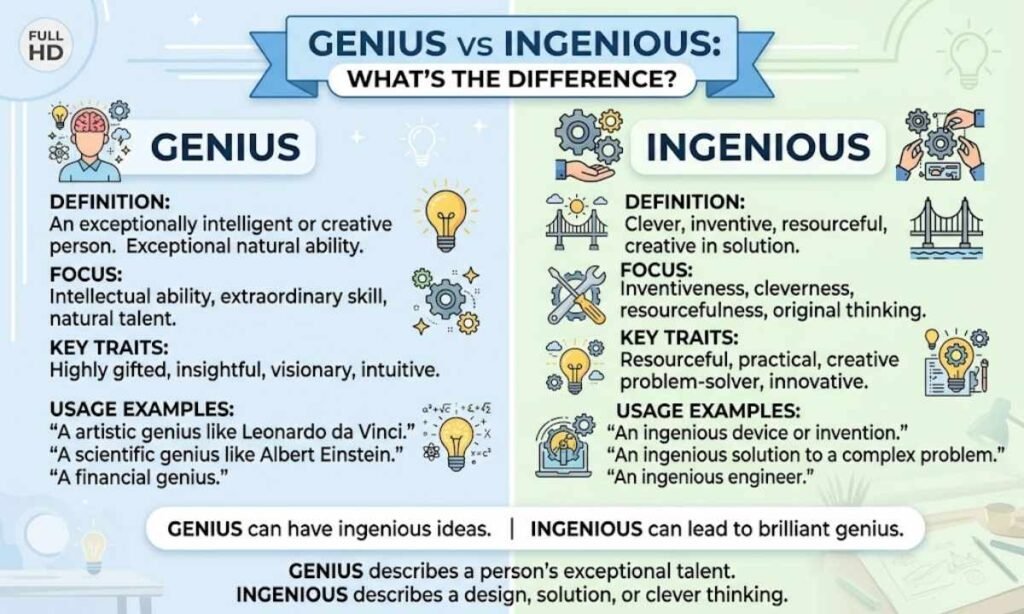
Genius Meaning vs Ingenious Meaning
Genius is a noun describing a person of exceptional intelligence. Ingenious is an adjective describing something clever, inventive, or resourceful.
When to Use Genius
Use genius when naming a person’s overall intellectual gift, as in “Einstein was a genius.”
When to Use Ingenious
Use ingenious when describing a clever method, design, or solution, as in “an ingenious workaround.”
Genius vs Ingenious Examples
● “The inventor is a genius.” (person)
● “The invention itself is ingenious.” (quality)
Why “Ingenious” Can Cause Confusion
Because ingenious contains the letters “genious” hidden inside it, people mistakenly assume genius should share that “-ious” ending.
How to Spell Genius Correctly
Genius Spelling Breakdown
G-E-N-I-U-S: five letters plus the “-ius” ending, drawn from the Latin word genius, meaning guardian spirit or innate talent.
Genius or Genious: Remember the “-ius” Ending
If you remember that genius rhymes structurally with “radius” and “stadium” rather than “curious,” the correct ending sticks better.
Easy Trick to Remember Genius
Think: “Genius is a plus, not an -ous.” The word ends the same way as “plus,” not like “obvious.”
Common Spelling Mistakes Similar to Genius
Words like “obvious,” “curious,” and “serious” often get blended mentally with genius, even though their endings differ.
How to Use Genius in a Sentence?
Genius as a Noun
“The professor is regarded as a genius in theoretical physics.”
Genius as an Informal Adjective
“That’s a genius idea for saving time.”
Genius for a Person
Genius most formally applies to a person with rare intellectual or creative power.
Genius for an Idea or Solution
Informally, genius can also praise a plan, design, or piece of writing.
Formal vs Informal Use of Genius
Formal writing favors genius as a noun; casual speech and marketing copy often stretch it into an adjective.
Is Genious Ever Correct?
Is Genious an English Word?
No, in no context is genious an accepted English word or variant spelling.
Can Genious Be Used in Formal Writing?
No. Using genious in formal or academic writing will always be flagged as an error.
What Should You Write Instead of Genious?
Always write genius, regardless of whether you mean the noun or the informal adjective use.
What If You See “Genious” Online?
Treat it as a typo. Even reputable-looking pages sometimes contain this common error.
Genius Pronunciation and Spelling
How Do You Pronounce Genius?
Genius is pronounced JEEN-yus, with stress on the first syllable.
Why Genius Is Easy to Misspell
The written form doesn’t visually match the “yus” sound, which invites guesswork.
Genius vs Genious Pronunciation
Both are spoken the same way, so pronunciation alone won’t tell you which spelling is correct.
Does American English Spell Genius Differently?
No. Genius is spelled identically in American and British English, with no regional variation.
Genius Plural: Is It Geniuses or Genii?
What Is the Plural of Genius?
Geniuses is the standard modern plural when referring to intelligent people.
Geniuses vs Genii
Genii is an older, rarer plural, historically used for mythological guardian spirits rather than people.
Examples of the Plural Form
“Several geniuses have shaped modern physics, from Einstein to Feynman.”
Common Genius Spelling Mistakes to Avoid
Genious vs Genius
Genious is incorrect; genius is correct.
Genuis vs Genius
Genuis, a simple letter swap, is also incorrect.
Genius vs Geneus
Geneus is another rare but incorrect variant sometimes seen in fast typing.
Why These Spellings Are Incorrect
None of these variants exist in any English dictionary; they are typing or memory errors, not accepted alternatives.
Genius in American English: Meaning and Usage
Genius in Everyday American English
Americans frequently use genius casually to praise clever people, products, or ideas.
Genius in Academic Writing
American academic writing reserves genius for well-documented exceptional achievement.
Genius in Business and Professional Writing
Marketing and business copy often use “genius” to make a product or strategy sound remarkably smart.
Genius in Texting and Social Media
Online, “genius” is a common compliment, often shortened or paired with emphasis like “actual genius.”
Genius in Idioms and Common Expressions
“Stroke of Genius”
This idiom describes a sudden, brilliant idea or solution.
“Evil Genius”
This phrase describes someone highly intelligent but using that intelligence for harmful or mischievous purposes.
“Comic Genius”
This describes someone with an exceptional natural talent for humor or comedic timing.
Synonyms for Genius You Can Use Instead
Prodigy
A prodigy usually refers to a young person showing extraordinary talent early in life.
Mastermind
Mastermind emphasizes strategic brilliance, often behind a plan or scheme.
Virtuoso
Virtuoso typically describes exceptional skill in a specific art form, such as music.
Savant
Savant highlights deep, sometimes narrow, expertise or brilliance in one particular area.
Genius vs Prodigy: Are They the Same?
Key Difference Between Genius and Prodigy
A prodigy is defined by achieving mastery at a young age, while genius can apply at any age.
Can a Prodigy Become a Genius?
Yes. Many prodigies go on to be recognized as full-fledged geniuses in adulthood.
How Spell Checkers and Search Engines Treat “Genious”
Does Spell Check Flag Genious?
Yes, virtually all modern spell checkers automatically flag genious as an error.
Does Google Autocorrect the Search Term?
Search engines typically recognize genious as a misspelling and show results for genius instead.
Quick Tips to Never Misspell Genius Again
● Say the word aloud and picture the “-ius” ending, not “-ious.”
● Compare it mentally to “radius,” not “curious.”
● Run a spell check before publishing any formal document.
● Remember that ingenious, not genius, carries the “-ious” ending.
Quick Comparison: Genius, Genious, and Ingenious
| Word | Standard English? | Main Meaning |
| Genius | Yes | Exceptional intelligence, ability, or talent |
| Genious | No | Common misspelling |
| Ingenious | Yes | Clever, inventive, or skillfully designed |
Frequently Asked Questions
Is it genius or genious?
Genius is correct; genious is always a misspelling.
How do you spell genius?
G-E-N-I-U-S, with the “-ius” ending, not “-ious.”
Is genious a real word?
No, genious does not exist in any English dictionary.
What does genius mean?
It refers to exceptional intellectual ability or a person who possesses it.
What is the difference between genius and ingenious?
Genius is a noun for a brilliant person; ingenious is an adjective for a clever idea or design.
How do you use genius in a sentence?
Use it as a noun for a person, or informally as an adjective for a clever idea.
What is the plural of genius?
Geniuses is the standard plural; genii is an older, rarer form.
Is genius spelled differently in British and American English?
No, the spelling is identical in both varieties of English.
Conclusion
Genius is the standard, dictionary-approved spelling.
Genious is a common misspelling that likely stems from confusion with ingenious. Whenever you mean exceptionally intelligent, talented, or creatively brilliant, write genius.