
If you’ve ever paused mid-sentence wondering whether to write “dysregulated” or “disregulated,” you’re not alone. This spelling trips up writers, students, and even healthcare professionals because both versions sound almost identical when spoken aloud.
The good news is that dictionaries and established usage give a clear answer. This guide explains exactly which spelling is correct, why the confusion exists in the first place, and how the word is actually used across psychology, medicine, and everyday English.
Dysregulated vs Disregulated: Quick Answer
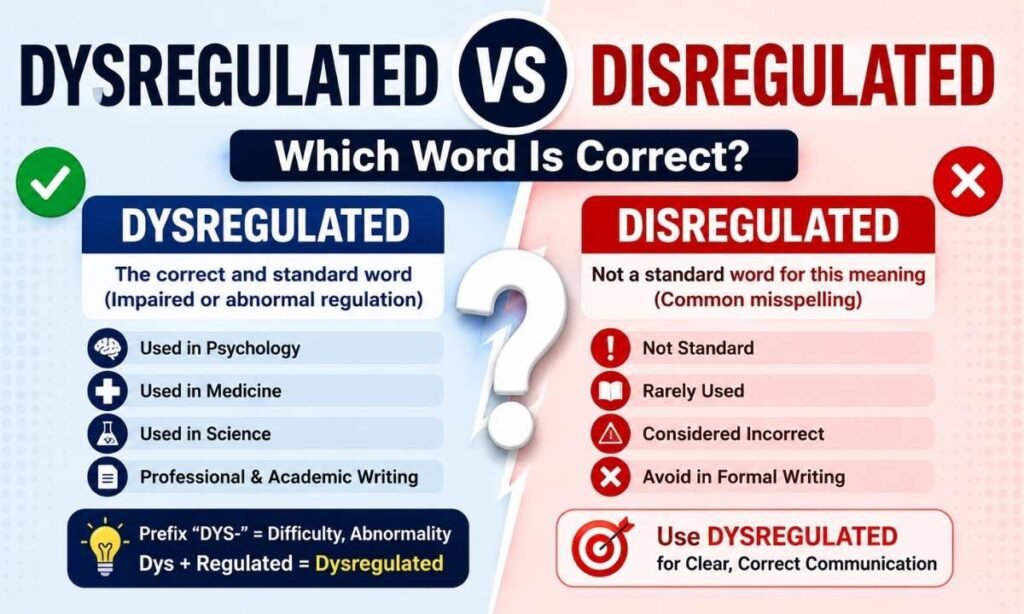
Dysregulated is the standard, dictionary-supported term describing something whose normal regulation is impaired, abnormal, or poorly controlled. Disregulated is generally treated as a nonstandard or mistaken form when this meaning is intended, even though it occasionally appears in informal writing.
Is Dysregulated the Correct Spelling?
Yes, dysregulated is the spelling recognized in dictionaries and formal writing across science, medicine, and psychology.
Is Disregulated a Word?
Disregulated shows up occasionally in casual or informal text, but it is not the established or recommended form.
Which One Should You Use in Writing?
Always choose dysregulated for formal, academic, medical, or professional writing to stay accurate and credible.
What Does Dysregulated Mean?
Dysregulated Meaning in Simple English
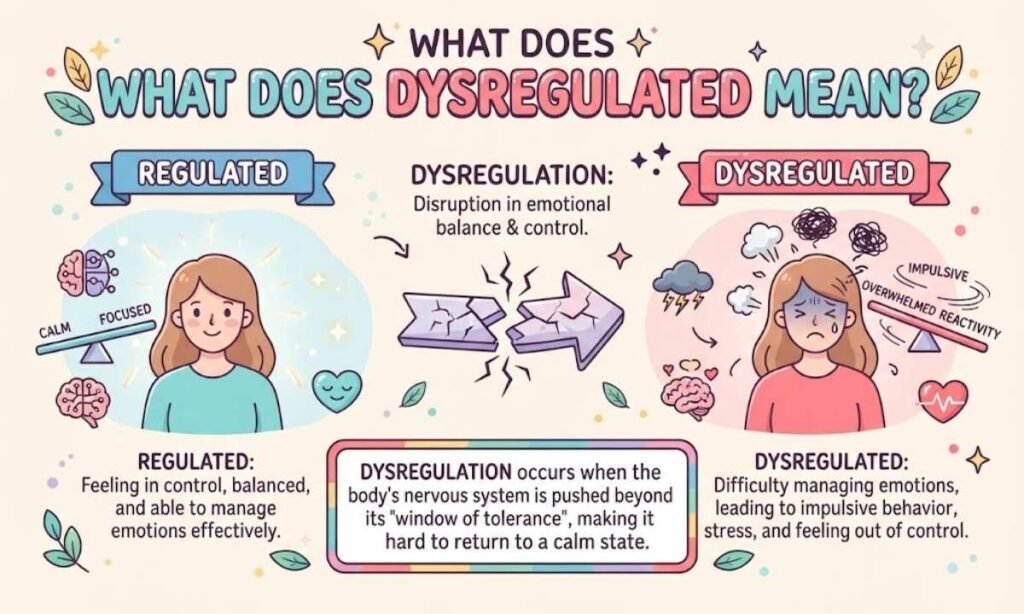
In plain terms, dysregulated means something is not being controlled or regulated the way it normally should be.
Dysregulated as an Adjective
As an adjective, dysregulated describes a system, process, or response that has lost its normal balance or control.
Dysregulated as the Past Form of Dysregulate
Dysregulated also functions as the past tense and past participle of the verb dysregulate, meaning to disrupt normal regulation.
What Does Dysregulated Mean in Psychology?
In psychology, dysregulated often describes difficulty managing emotions, reactions, or behavior in a controlled, expected way.
What Does Disregulated Mean?
Is Disregulated Correct English?
Disregulated is not considered standard English when the intended meaning is impaired regulation; dysregulated is the accurate choice.
Why Do People Write Disregulated?
Many writers default to “dis-” because it’s a more familiar prefix in everyday words like disconnect or disorganized.
Is Disregulated a Common Spelling Mistake?
Yes, it ranks among the more common prefix-based spelling mistakes, similar to confusing dysfunction with disfunction.
Dysregulated vs Disregulated: Main Difference
| Feature | Dysregulated | Disregulated |
| Standard choice | Yes | Generally no |
| Meaning | Regulation is impaired or abnormal | Usually intended as dysregulated |
| Common in medical writing | Yes | Rare |
| Common in psychology | Yes | Rare |
| Common in biology | Yes | Rare |
| Recommended for formal writing | Yes | No |
| Related noun | Dysregulation | Not applicable |
Why Is It Dysregulated, Not Disregulated?
What Does the Prefix Dys Mean?
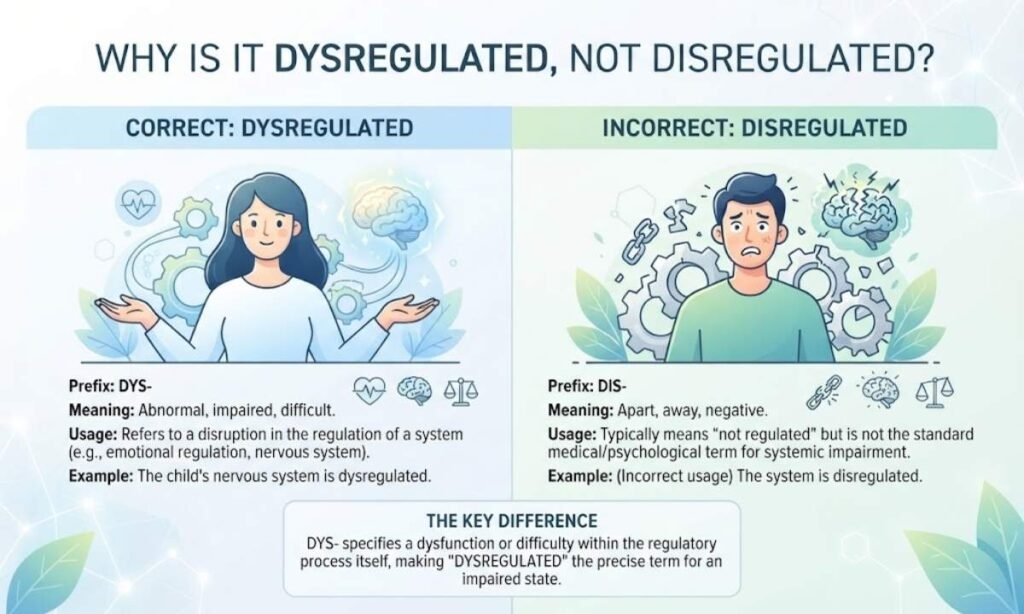
The prefix “dys-” signals abnormality, difficulty, or impaired functioning, as seen in words like dysfunction and dyslexia.
What Does Regulated Mean?
Regulated means something is controlled, adjusted, or kept within a normal or expected range.
How Dys Plus Regulated Creates Dysregulated
Combining “dys-” with “regulated” forms a word meaning regulation that has become abnormal or impaired, which is exactly the intended meaning.
Why Disregulated Looks Like It Should Be Correct
Because “dis-” commonly signals negation or reversal in English, writers assume it fits here too, even though this specific word follows the “dys-” pattern instead.
Linguistic Pattern: Words That Use Dys Instead of Dis
Recognizing a pattern helps prevent future spelling mistakes. Several established English words use “dys-” specifically to indicate abnormal or impaired function rather than simple negation:
| Word Pattern | Meaning of Dys Prefix |
| Dysfunction | Abnormal or impaired functioning |
| Dyslexia | A reading difficulty |
| Dysphoria | A state of unease or dissatisfaction |
| Dystrophy | Abnormal growth or development |
| Dysregulated | Regulation that has become abnormal or impaired |
Dysregulated fits neatly into this same family, reinforcing why “dys-” rather than “dis-” is the correct prefix.
Dysregulated Examples in Everyday English
Dysregulated Emotions
“After the argument, her emotions felt completely dysregulated.”
Dysregulated Behavior
“The child displayed dysregulated behavior during the transition between activities.”
Dysregulated Sleep
“Shift work often leads to a dysregulated sleep schedule.”
Dysregulated Body Processes
“Chronic stress can leave the body’s hormone levels dysregulated.”
Dysregulated Systems
“Researchers identified a dysregulated immune system in several patients.”
Dysregulated in Psychology and Mental Health
What Does Emotionally Dysregulated Mean?
Being emotionally dysregulated means struggling to manage or control emotional reactions in a balanced, expected way.
What Is Emotional Dysregulation?
Emotional dysregulation refers to difficulty responding to emotional experiences within a typical, manageable range.
What Does Dysregulated Behavior Mean?
Dysregulated behavior describes actions or reactions that seem disproportionate, impulsive, or hard to control given the situation.
Dysregulated Emotions vs Normal Emotional Responses
Normal emotional responses adjust to the situation, while dysregulated emotions often feel intense, prolonged, or difficult to manage.
Dysregulated in Medical and Scientific Writing
Dysregulated Biological Processes
Scientists use dysregulated to describe biological systems functioning outside their normal, healthy range.
Dysregulated Hormones and Metabolism
Hormonal imbalances are frequently described as dysregulated when normal metabolic control breaks down.
Dysregulated Immune Responses
A dysregulated immune response occurs when the immune system reacts abnormally, either overreacting or underreacting.
Dysregulated Gene Activity
Researchers describe gene expression as dysregulated when genes activate or deactivate outside normal patterns.
How Dictionaries and Style Guides Treat This Word?
Major dictionaries list dysregulate and dysregulated as standard entries, typically noting their use in psychological, medical, and scientific contexts. Style guides for academic and health-related writing consistently favor dysregulated, reinforcing that this spelling has moved firmly into accepted professional vocabulary rather than remaining a niche technical term.
Dysregulated vs Unregulated: Are They the Same?
What Does Unregulated Mean?
Unregulated means something has no rules, oversight, or control applied to it at all.
What Does Dysregulated Mean?
Dysregulated means regulation exists but is functioning abnormally or has broken down in some way.
Dysregulated vs Unregulated Examples
“An unregulated market has no governing rules,” compared to “a dysregulated market has rules that aren’t functioning properly.”
When Should You Use Each Word?
Use unregulated for a complete absence of control, and dysregulated when control exists but isn’t working correctly.
Dysregulated vs Dysregulation
Dysregulated Meaning
Dysregulated is the adjective or verb form describing an abnormal regulatory state.
Dysregulation Meaning
Dysregulation is the noun form referring to the condition or process of impaired regulation itself.
Dysregulate vs Dysregulated
Dysregulate is the base verb, while dysregulated is its past tense and adjective form.
Examples of Dysregulation in a Sentence
“Emotional dysregulation is a common focus in therapy sessions.”
Correct and Incorrect Sentence Examples
Correct Examples With Dysregulated
● Her emotions became dysregulated after the stressful event.
● The process became dysregulated over time.
● Researchers studied dysregulated behavior in the study group.
Incorrect Examples With Disregulated
Incorrect: “Her emotions became disregulated.”
Correct: “Her emotions became dysregulated.”
Common Dysregulated vs Disregulated Mistakes
● Using disregulated because dis- feels more familiar
● Confusing dysregulated with unregulated
● Misspelling dysregulated as disregulated in professional documents
● Assuming both spellings carry different meanings
● Using the wrong form in academic or clinical writing
How to Remember Dysregulated Spelling?
● Remember it as dys plus regulated, matching words like dysfunction
● Connect dysregulated to its noun form, dysregulation
● Apply the impaired regulation rule: if regulation is abnormal, the word takes dys-
Dysregulated vs Disregulated in American English
Which Spelling Is Standard in American English?
Dysregulated is the standard spelling used consistently across American academic, medical, and psychological writing.
How Is Dysregulated Used in U.S. Writing?
It appears regularly in clinical notes, research papers, and mental health resources throughout the United States.
Is Disregulated Used in American English?
Occasionally, but it is not treated as correct or standard usage in professional American writing.
Which Form Is Better for Formal U.S. Writing?
Dysregulated remains the safer, more credible choice for any formal or professional American English writing.
Frequently Asked Questions
Is it dysregulated or disregulated?
Dysregulated is correct; disregulated is a nonstandard form.
What is the difference between dysregulated and disregulated?
Dysregulated is the standard word; disregulated is usually just a misspelling of it.
Is disregulated a real word?
It appears occasionally but isn’t recognized as standard English.
What does dysregulated mean?
It means something’s regulation is impaired or abnormal.
What does emotionally dysregulated mean?
It means struggling to control emotional reactions in a balanced way.
Is dysregulated the correct spelling?
Yes, dictionaries and formal writing confirm dysregulated is correct.
What does dysregulation mean?
It’s the noun form describing impaired or abnormal regulation.
Is dysregulated the same as unregulated?
No, unregulated means no control exists; dysregulated means control exists but isn’t working properly.
Why do people say disregulated?
Because dis- feels more familiar than the less common dys- prefix.
How do you use dysregulated in a sentence?
“His sleep became dysregulated after months of night shifts.”
Conclusion
Use dysregulated whenever you mean that something is functioning with impaired, abnormal, or poorly controlled regulation. Disregulated is generally not the standard form for this meaning, even though it occasionally appears in casual writing.
Sticking with dysregulated keeps your writing accurate, professional, and aligned with dictionary and research usage.