Apostrophes cause more confusion than almost any other punctuation mark in English, and the words parent’s and parents’ sit right at the center of that confusion. One small mark changes the entire meaning of a sentence, so getting it right matters in school forms, emails, and everyday writing.
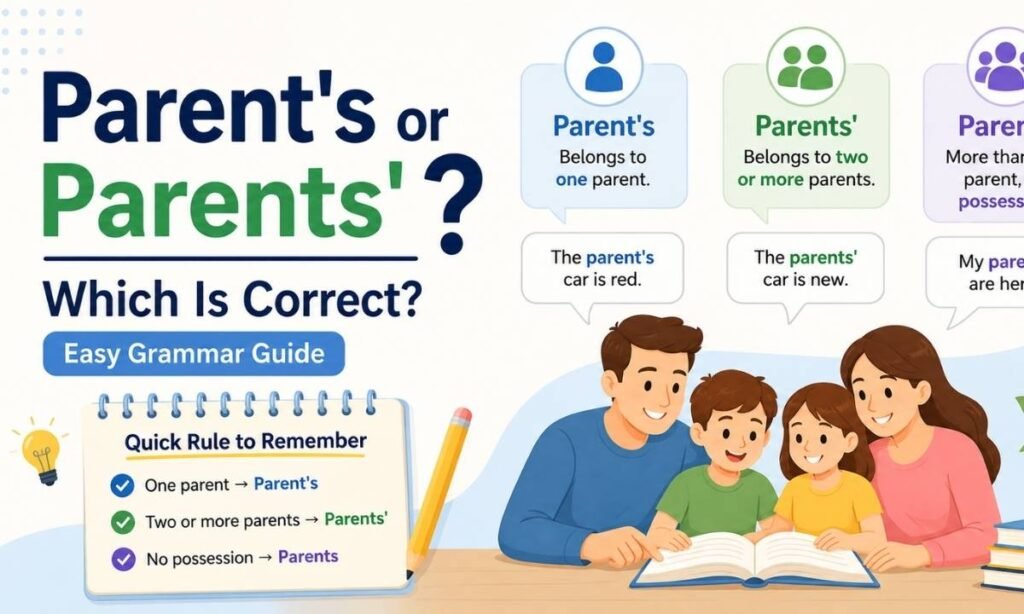
The short answer is simple. Parent’s show something belonging to one parent. Parents’ shows something belonging to two or more parents. Parents, with no apostrophe, is just the plain plural word. This guide breaks down every rule, pattern, and real world example so you never second guess the placement again.
Parent’s or Parents’: What’s the Difference?
The difference comes down to ownership and number, not sound. All three forms are pronounced the same way, which is exactly why people mix them up in writing.
- Parent: one mother or father, no ownership involved
- Parent’s: something owned by a single parent
- Parents: more than one mother or father, no ownership involved
- Parents’: something owned by two or more parents
Parent’s Shows One Parent Owns Something
Use parent’s when a single mother or father possesses or is linked to an object, trait, or responsibility. Example: The parent’s signature was missing from the form.
Parents’ Shows Multiple Parents Share Something
Use parents’ when two or more parents jointly own or are connected to something. Example: The parents’ decision affected the whole family.
Parents Is Simply the Plural Noun
Use parents with no apostrophe when you are only talking about more than one mother or father, without showing possession. Example: My parents are visiting this weekend.
Quick Comparison Table
This table gives an instant reference for how each form works in a sentence.
| Form | Meaning | Example Sentence |
| Parent | One mother or father | The parent picked up the child. |
| Parent’s | Belongs to one parent | The parent’s car was parked outside. |
| Parents | More than one parent, no ownership | My parents live nearby. |
| Parents’ | Belongs to two or more parents | My parents’ car needs repair. |
The Core Apostrophe Rule Behind Parent’s and Parents’
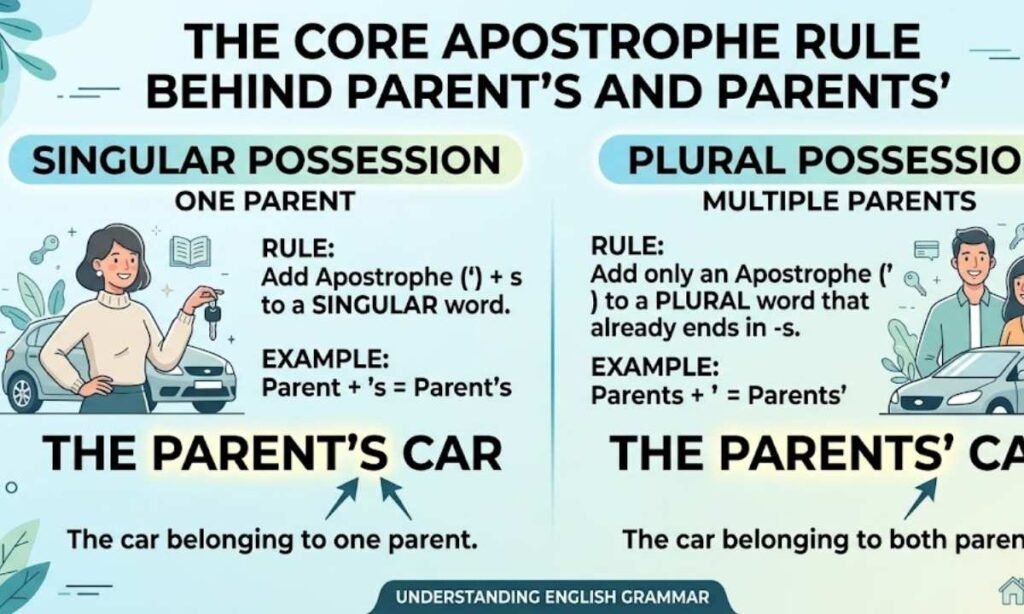
English possessives follow one consistent pattern once you know where the plural s falls.
- Singular nouns take an apostrophe plus s, as in parent’s.
- Plural nouns already ending in s take only an apostrophe, as in parents’.
- Irregular plurals that do not end in s, like children, still take apostrophe plus s, as in children’s.
This is why parent’s and parents’ look almost identical but serve completely different jobs. The apostrophe position tells the reader how many parents are involved before they even reach the noun that follows.
Parent’s or Parents’ in Everyday Phrases
Certain phrases come up constantly in school communication, legal paperwork, and daily conversation, so seeing them side by side helps lock in the rule.
| Phrase | Correct Version | When to Use It |
| House | Parent’s house / Parents’ house | One parent’s home versus a home shared by both parents |
| Meeting | Parents’ meeting | A school event usually involving multiple parents |
| Signature | Parent’s signature | Almost always one signature from one parent |
| Permission | Parent’s permission / Parents’ permission | Depends on whether one or both parents must approve |
| Name | Parent’s name / Parents’ names | Singular for one form field, plural when both are listed |
Is It Parent’s House or Parents’ House?
Parent’s house refers to a home belonging to one mother or father. Parents’ house means the home belongs to both parents together.
Is It Parents’ Meeting or Parent’s Meeting?
Parents’ meeting is the standard phrase because school meetings usually involve many parents at once. Parent’s meeting would only apply to one specific parent attending alone.
Common Mistakes People Make With Parent’s and Parents’
Even confident writers slip up with this pair, so it helps to know the traps in advance.
- Writing parents’s instead of parents’, which is never correct in standard English
- Using parent’s when both parents are actually involved
- Dropping the apostrophe entirely and writing parents when possession is intended
- Assuming pronunciation gives a clue, when in fact all forms sound identical
- Mixing singular and plural possessives within the same document
Is Parents’s a Real Word?
Parents’s is not standard English. Once a plural noun already ends in s, English grammar rules only require an added apostrophe, never an extra s. The correct plural possessive is always parents’, never parents’s, regardless of how the phrase sounds when spoken aloud.
Apostrophe Rules for Other Family Words
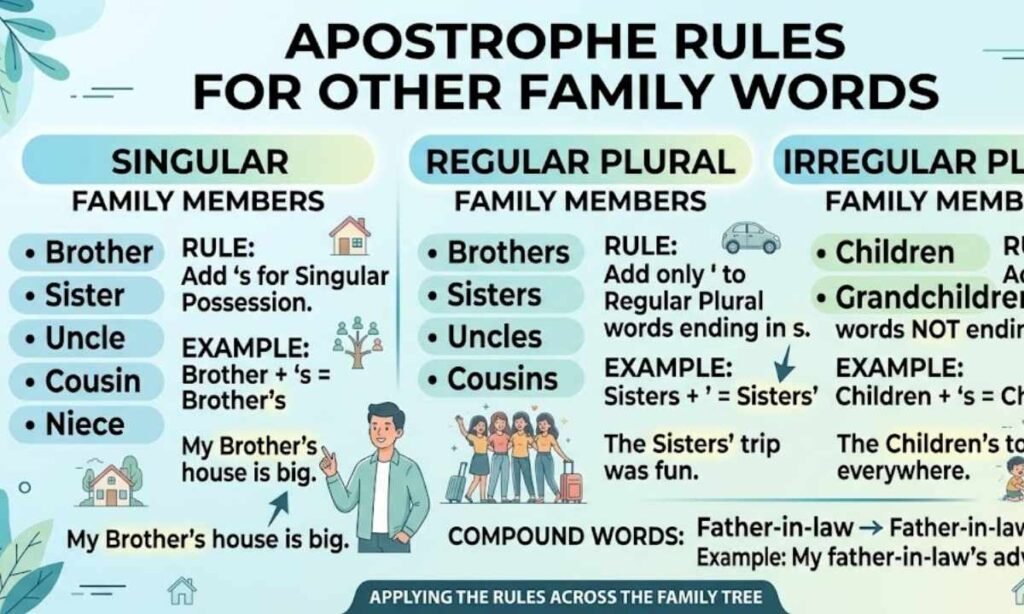
The same logic that governs parent’s and parents’ also applies to related family terms, and understanding the wider pattern makes the whole rule easier to remember.
- Mom’s coat belongs to one mother
- Dad’s keys belong to one father
- Grandparents’ cabin belongs to two or more grandparents
- Sibling’s toy belongs to one brother or sister
- Siblings’ room belongs to more than one brother or sister
Once you can apply the rule to parent and parents, it transfers directly to every other family noun without any extra memorization.
Parent’s or Parents’ in Legal and Medical Forms
Official paperwork often forces a choice between these forms, and getting it wrong can create real confusion in a legal or medical setting.
- Custody documents typically use parent’s when referring to one legal guardian and parents’ when both guardians share rights
- Medical intake forms usually request a parent’s signature, since one authorized adult is enough for consent
- School enrollment forms sometimes ask for parents’ names in the plural, allowing space for both guardians
Choosing the correct form on official documents avoids ambiguity about who is responsible or authorized.
How Style Guides Handle Parent’s and Parents’?
Major American style guides, including AP and Chicago style, follow the same basic possessive rule described earlier. There is no special exception carved out for the word parent or parents in any widely used style manual. The only guidance style books add is a reminder to check whether the sentence truly involves one parent or more than one before choosing the apostrophe placement, since the grammar itself never changes.
Parent’s or Parents’ in American English Versus British English
American and British English apply the exact same possessive rule to parent and parents. There is no regional difference in apostrophe placement for this word pair. What does vary slightly is phrasing choice, since American school communication tends to favor parents’ meeting or parents’ night, while British schools more often use parents’ evening, still following identical apostrophe logic.
Simple Trick to Remember the Rule
Ask yourself how many parents are involved before writing the apostrophe.
- One parent involved: write parent’s
- Two or more parents involved: write parents’
- No ownership at all: write parents with no apostrophe
This one question resolves almost every real world sentence you will encounter involving these words.
Tips for Teachers and Students Learning This Rule
Educators often introduce this exact word pair when teaching possessive nouns because it demonstrates singular versus plural possession so clearly.
- Have students first identify whether one or two parents are being discussed
- Practice rewriting sentences by moving the apostrophe and checking if the meaning still makes sense
- Use real school examples like permission slips and report cards, since students already recognize these documents
- Review the exception for irregular plurals like children’s, so students see the rule is consistent, not random
Frequently Asked Questions
Is parent’s singular or plural?
Parent’s is singular possessive, meaning it shows something belongs to one mother or father only.
Is parents’ singular or plural?
Parents’ is plural possessive, showing that two or more parents own or share something together.
Is parents’s ever correct?
No, parents’s is not standard English. The correct plural possessive form is always parents’ with no added s.
Is it parent’s house or parents’ house?
Parent’s house means one parent owns the home, while parents’ house means both parents share ownership.
Is it parent’s signature or parents’ signatures?
Most forms ask for a parent’s signature, since only one authorized adult typically needs to sign.
Are parent’s and parents’ pronounced the same way?
Yes, both forms sound identical when spoken, which is exactly why the written apostrophe placement matters so much.
What is the easiest way to remember this rule?
Count how many parents are involved first, then place the apostrophe before the s for one and after the s for two or more.
Conclusion
Parent’s show possession belonging to a single mother or father. Parents’ shows possession shared by two or more parents. Parents, without any apostrophe, is simply the plain plural word with no ownership implied.
Keep this one question in mind whenever you write the word: how many parents actually own or are connected to the thing in this sentence. Answer that first, and the apostrophe will always land in the right place.