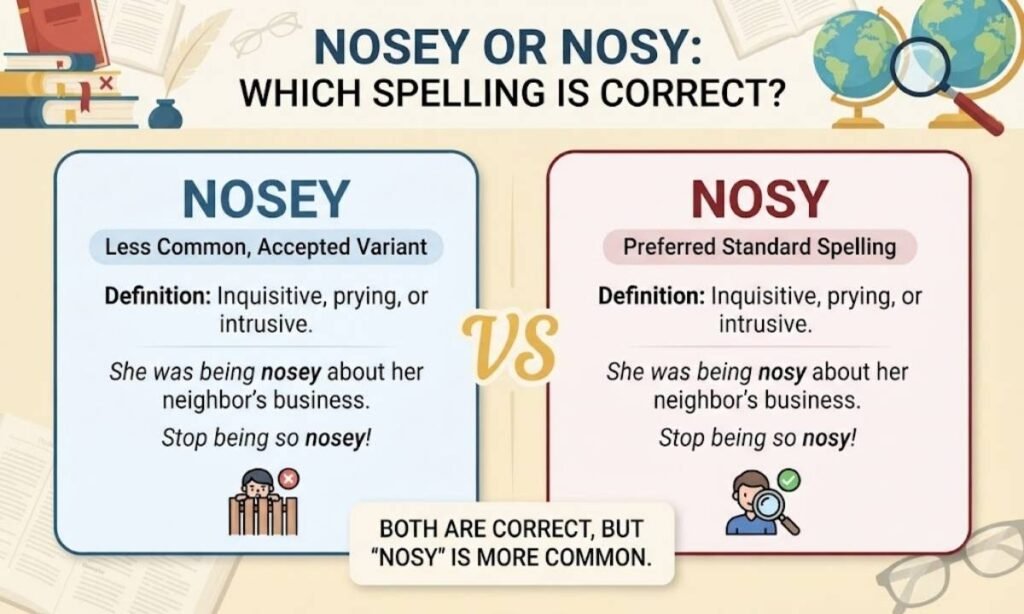
Nosy is the preferred spelling in most dictionaries, while nosey is an accepted variant that appears often in everyday writing. Both words describe a person who shows too much interest in other people’s private business, and both are pronounced the same way. The choice between them is about style and audience, not meaning.
This guide explains what nosy means, why two spellings exist, and how American and British writers tend to use them. You will also find clear examples, related word forms, and simple tips for choosing the right word in casual, academic, or professional writing, so you can write with confidence.
Nosey or Nosy? The Quick Answer
Use nosy as your default. It is the form listed first in major dictionaries, including Cambridge, Oxford, and Merriam Webster, and it is the safest choice for formal, academic, and publishing contexts. Nosey is a recognized variant, so it is not a spelling error.
• Nosy: the preferred, standard spelling.
• Nosey: an accepted variant, common in casual writing.
• Meaning and pronunciation: identical (NOH zee).
| Spelling | Status | Best Use |
| Nosy | Preferred standard spelling | Formal, academic, professional, and general writing |
| Nosey | Accepted variant | Casual writing, dialogue, and personal messages |
What Does Nosy Mean?
The Meaning of Nosy in Everyday English
Nosy is an adjective for someone who asks too many questions or pries into matters that are not their concern. It can describe a neighbor who watches every driveway, a coworker who reads over your shoulder, or a relative who wants every detail of your life. The word grows out of nose, because a person who pokes their nose into other people’s affairs is seen as intrusive.
Is “Nosy” Positive, Negative, or Rude?
It is mostly negative. Dictionaries label it informal and disapproving. Calling someone nosy to their face can sound rude, although friends often use it playfully. Healthy curiosity is different, because nosy suggests the interest is unwelcome.
Nosey vs. Nosy: What Is the Difference?
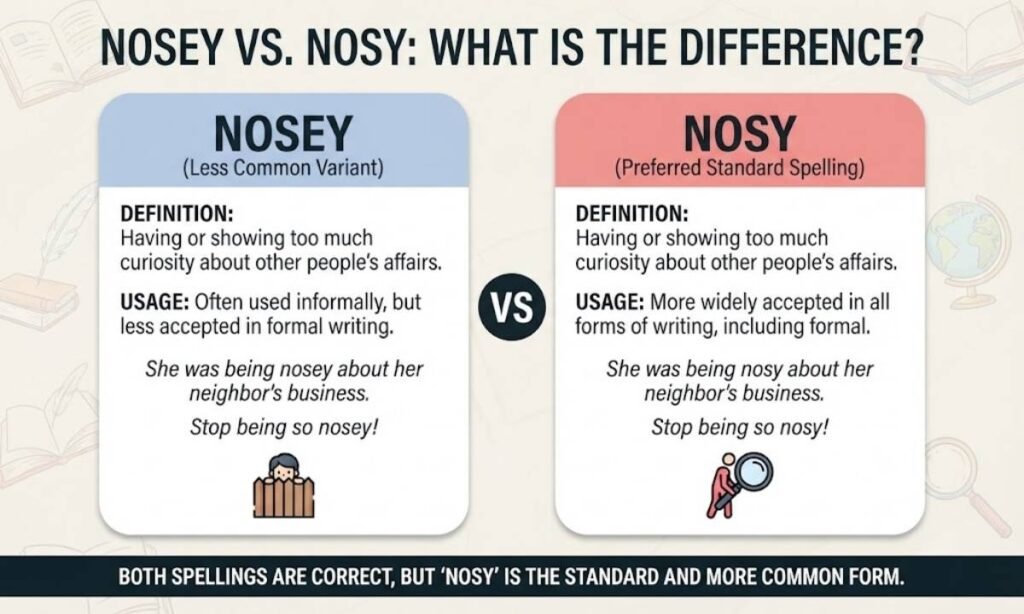
Same Meaning, Same Pronunciation, Different Spelling
There is no difference in definition, grammar, or sound. Only the letters on the page change. Both forms are adjectives and both follow the same patterns of use.
Why Does “Nosey” Look So Natural?
Many writers keep the e from nose when adding y, much as they do in horsey. The result looks logical, which is why nosey spreads easily through texts, captions, and fiction.
Is “Nosey” Actually Wrong?
No. Reputable dictionaries record it as a variant, so calling it a mistake is too strong. It is simply less standard, and an editor or style guide may still change it to nosy for consistency.
Which Spelling Should You Use in American English?
Why “Nosy” Is the Safer U.S. Default
Cambridge’s American dictionary gives nosy first with nosey as an alternative, and Oxford’s American dictionary does the same. Choosing nosy keeps your work aligned with most U.S. editorial standards, school assignments, and publishing guidelines.
When “Nosey” Is Still Acceptable
Use it in dialogue, informal blog posts, or social media where a conversational voice matters. Whichever form you pick, stay consistent within the same piece.
Nosey or Nosy in British English
Is “Nosey” a British Spelling?
Not exclusively. The claim that nosey is British and nosy is American is an oversimplification. Both forms are recognized in British dictionaries, although nosey shows up more visibly in British usage and informal writing.
Can British Writers Use “Nosy”?
Yes. Nosy is fully accepted in British English. If you want one spelling that works for readers on both sides of the Atlantic, nosy is the better pick.
How to Use Nosy and Nosey in a Sentence
Examples With “Nosy”
• My nosy neighbor asked how much rent I pay.
• Sorry if this sounds nosy, but where did you buy that jacket?
• The gossip made her nosier with every passing day.
Examples With “Nosey”
• Don’t be so nosey, it is none of your business.
• The nosey clerk read my postcard before handing it over.
• He gave me a nosey look across the table.
“Being Nosy” vs. “Being Nosey”
Both phrases are grammatical and mean the same thing. “Being nosy” is the standard form, while “being nosey” is a casual variant. Either one pairs naturally with “about,” as in “nosy about my plans.”
Nosy vs. Curious, Inquisitive, and Prying
Nosy vs. Curious
Curious is neutral or positive and shows a wish to learn. Nosy adds an unwelcome focus on private matters.
Nosy vs. Inquisitive
Inquisitive often suggests a sharp, eager mind and can be a compliment. Nosy rarely is.
Nosy vs. Prying
Prying is stronger and more critical, suggesting deliberate intrusion rather than simple overcuriosity.
| Word | Meaning | Tone | Typical Context |
| Nosy | Too interested in others’ business | Informal, disapproving | Neighbors, gossip, personal questions |
| Curious | Eager to learn or know | Neutral to positive | Learning, children, research |
| Inquisitive | Fond of asking questions | Neutral to positive | Students, reporters, thinkers |
| Prying | Intruding into private matters | Strongly negative | Privacy, snooping, personal records |
Nosy Word Forms and Related Expressions
Nosier and Nosiest
The comparative is nosier and the superlative is nosiest, as in “She is the nosiest person on our street.”
Nosiness and Nosily
Nosiness is the noun, and nosily is the adverb. Example: “He nosily scanned the open letter.”
What Does “Nosy Parker” Mean?
A nosy Parker is a person who is overly interested in other people’s affairs. Oxford labels the phrase British, informal, and becoming old fashioned, so it is more likely to appear in British books and older conversation than in modern American writing.
Common Mistakes With Nosey and Nosy
Assuming “Nosey” Is Always Incorrect
It is a recognized variant, so avoid marking it as an error in someone else’s work.
Assuming the Two Spellings Have Different Meanings
They do not. Any difference people sense is about style, not definition.
Confusing “Nosy” With “Noisy”
Noisy means loud, while nosy means overly curious. One extra letter changes the entire sentence.
Mixing Both Spellings Without a Reason
Switching between nosy and nosey in one article looks careless. Pick one form and keep it throughout.
What Should You Write in Formal or Professional English?
When “Nosy” Is Appropriate
Nosy works in conversational articles, creative writing, and everyday communication. Because it is informal and disapproving, it fits best where a casual tone is expected.
When “Intrusive,” “Prying,” or “Overly Personal” Is Better
In reports, workplace emails, and official documents, choose a more neutral term. Phrases such as “intrusive questions” or “overly personal inquiries” sound more professional and avoid blaming the person directly.
Frequently Asked Questions
Is nosey or nosy correct?
Both are accepted, but nosy is the preferred spelling. Nosey is a recognized variant.
Is “nosey” a real word?
Yes. Major dictionaries list nosey as a variant of nosy with the same meaning.
Is nosy the preferred spelling in American English?
Yes. American dictionaries list nosy first, so it is the safer choice in U.S. writing.
Is nosey a British spelling?
Not strictly. It appears often in British usage, but both spellings are recognized in the UK and the US.
Do nosey and nosy have the same meaning?
Yes. Both mean overly interested in other people’s private affairs.
Is being nosey grammatically correct?
Yes. “Being nosey” is grammatical, though “being nosy” is the standard spelling.
Is nosy a rude or negative word?
It is usually negative and informal. It can sound rude if said directly to someone.
Conclusion
Nosy is the preferred spelling, and nosey is an accepted variant with the same meaning and pronunciation. For school, work, and publishing, nosy is the safer default. For casual dialogue or personal messages, nosey is perfectly understandable.
Whichever form you choose, keep it consistent, avoid confusing it with noisy, and switch to words like intrusive or prying when you need a more professional tone.