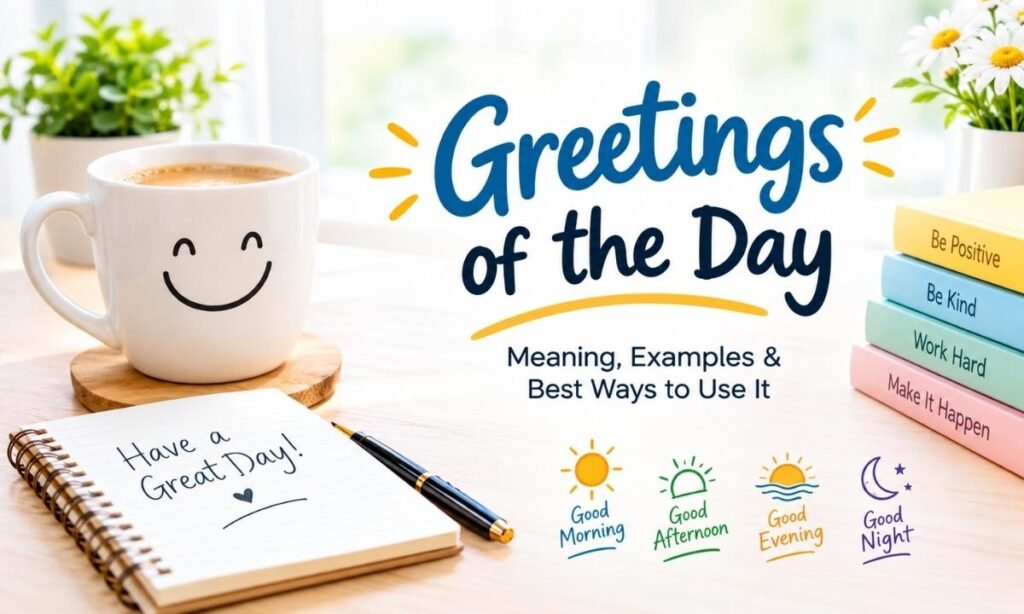
A warm opening line can shape how an entire message is received, and “greetings of the day” is one phrase people often reach for when they want to sound polite and welcoming. It is common in emails, announcements, and formal messages across many parts of the world.
This guide explains what the phrase really means, whether it sounds natural in everyday English, and which alternatives work better depending on the situation, audience, and time of day.
What Does Greetings of the Day Mean?
“Greetings of the day” is a general welcome phrase used to open a conversation, email, or announcement regardless of the exact time. It essentially means “hello” or “welcome,” offered as a friendly opening line rather than a specific wish tied to morning, afternoon, or evening.
The phrase works as an umbrella greeting. Instead of choosing between good morning, good afternoon, or good evening, the speaker uses one line that fits any hour, which is why it shows up often in group emails, newsletters, and announcements sent to a wide audience across time zones.
Is Greetings of the Day Correct English?

Grammatically, the phrase is acceptable, though native English speakers in the United States and United Kingdom rarely use it in casual conversation. It appears more frequently in South Asian business English and formal written communication than in spoken American or British English.
For readers who want a phrase that feels effortless and modern, simpler options like “hello” or “good morning” usually sound more natural. The phrase is not wrong, but it can come across as stiff or translated when used in everyday chat, texts, or informal emails.
When Should You Use Greetings of the Day?
This phrase fits best in specific, limited situations rather than as a default opener for every message.
- Formal announcements sent to a large group
- Company wide emails covering multiple time zones
- Written notices, circulars, or memos
- Opening lines of presentations or webinars
- Greeting cards or festive messages
It is less suitable for one on one conversations, quick chats, casual texts, or replies to a colleague sitting a few desks away, where a simple hello feels far more natural.
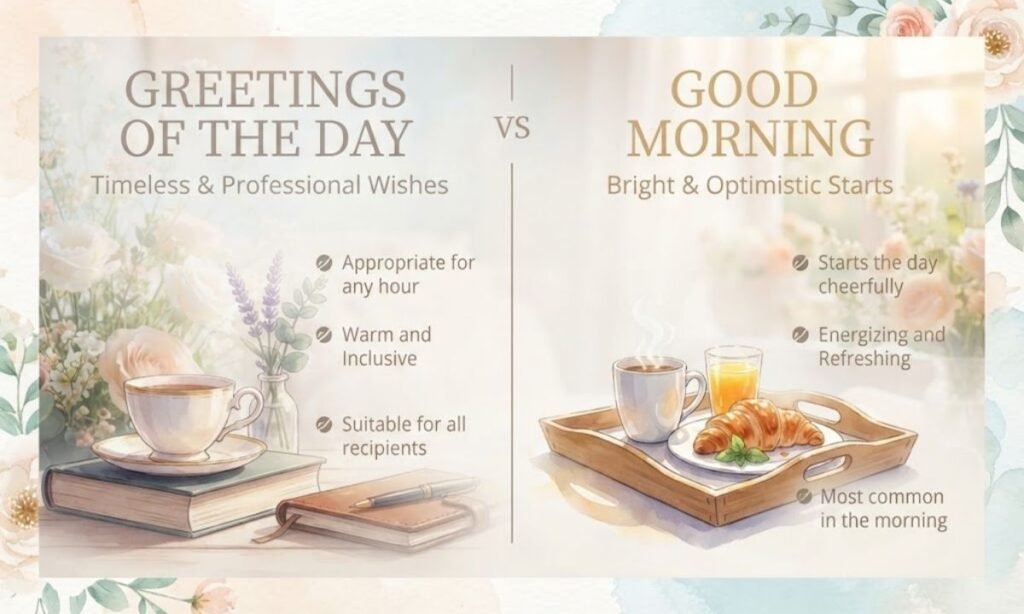
Greetings of the Day Versus Good Morning
| Feature | Greetings of the Day | Good Morning |
| Time restriction | None, works anytime | Only until noon |
| Formality level | Formal to very formal | Neutral to friendly |
| Common in US English | Rare | Very common |
| Best used for | Group emails, notices | Daily conversation, emails |
| Sounds natural in speech | Sometimes stiff | Always natural |
The main difference comes down to flexibility versus familiarity. Greetings of the day offers time flexibility, while good morning offers a tone that feels closer to how people actually speak.
Time Based Greetings Explained
English greetings usually change with the clock, and knowing the right window keeps a message from feeling out of place.
| Time of Day | Typical Hours | Common Greeting |
| Morning | 5 AM to 12 PM | Good morning |
| Afternoon | 12 PM to 5 PM | Good afternoon |
| Evening | 5 PM to 9 PM | Good evening |
| Night | After 9 PM | Good night (used as a farewell) |
Good night is worth noting separately because it functions as a closing line before sleep or when leaving, not as an opening greeting the way the other three are used.
50 Plus Greetings You Can Use
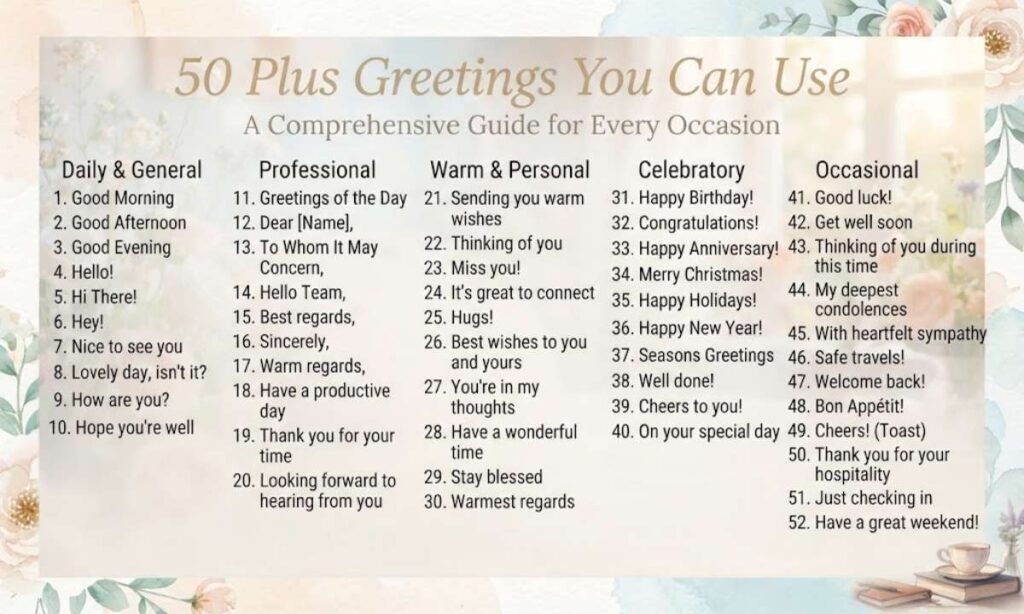
Short and simple: Hello, Hi, Hey there, Good day, Welcome
Friendly everyday options: Hope you are doing well, Nice to see you, How is your day going, Hey, how have you been, Great to connect with you
Professional choices: Good morning team, Dear valued client, Thank you for joining today, I hope this message finds you well, Warm regards to start the day
Warm and positive lines: Wishing you a productive day, Sending positive vibes your way, Have an amazing day ahead, Hope your week is off to a good start
Creative options for friends: Rise and shine, Morning sunshine, What is up, Hey stranger, Long time no talk
Professional Greetings for the Workplace
Choosing the right workplace greeting depends on the audience.
- For coworkers: “Good morning, hope you had a great weekend.”
- For clients: “Good afternoon, thank you for your time today.”
- For managers: “Good morning, following up on yesterday’s discussion.”
- For meetings: “Good morning everyone, let’s get started.”
- For internal messages: “Hi team, quick update below.”
These options sound polished without feeling overly formal, which matters for daily workplace communication.
Email Greetings That Actually Work
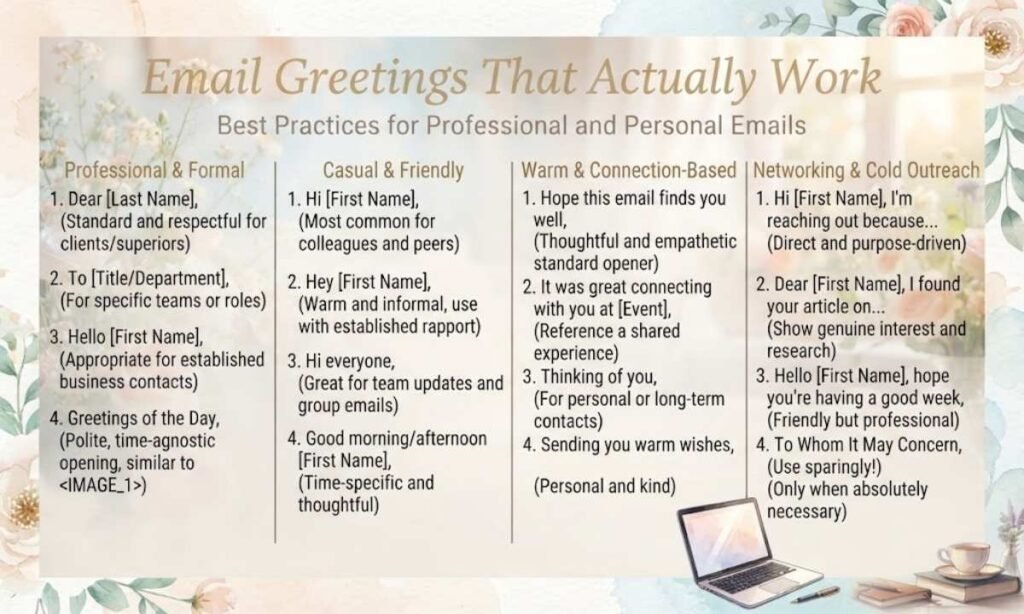
Email openers set the tone before the reader even reaches the first sentence.
- Formal: “Dear Mr. Khan, I hope this email finds you well.”
- Semi formal: “Hello Sarah, hope your week is going smoothly.”
- Friendly professional: “Hi team, sharing a quick update.”
- Client facing: “Good afternoon, thank you for reaching out.”
Avoiding “greetings of the day” in most American business emails and choosing time based or simple greetings instead tends to read as more current and natural.
Best Alternatives to Greetings of the Day
- Good morning
- Good afternoon
- Good evening
- Hello
- Hi there
- Good day
- Hope you are having a great day
Each alternative carries a slightly different tone, so matching it to the reader and setting makes the message feel intentional rather than generic.
Greetings for Friends and Family
Casual relationships call for a lighter tone.
- Casual morning lines: “Morning, sleepyhead,” “Rise and shine”
- Sweet text greetings: “Thinking of you today,” “Hope your day is as lovely as you”
- Funny daily greetings: “Coffee first, questions later,” “Survived Monday, that counts”
- Positive personal notes: “Sending good energy your way today”
Greetings for Different Situations
The right greeting also depends on the setting.
- Meetings: “Good morning everyone, thanks for joining.”
- Presentations: “Good afternoon, I appreciate you all being here.”
- School or college: “Good morning class.”
- Social media captions: “Happy Monday everyone.”
- Text messages: “Hey, good morning.”
How to Respond to Greetings of the Day?
Formal reply: “Greetings to you as well, thank you for reaching out.”
Friendly reply: “Hello, hope you are doing great too.”
Short text reply: “Hey, good to hear from you.”
Professional email reply: “Thank you for your message, I hope you are doing well.”
Common Mistakes to Avoid
- Using the phrase in every single email, which quickly feels repetitive
- Choosing it when a time specific greeting would sound more natural
- Making a short, simple message sound overly formal
- Mixing up “good night” with a standard greeting
Formal or Casual: Understanding the Tone
The phrase leans formal by default, which makes it suitable for official notices but less fitting for personal or quick exchanges. Matching formality to the relationship, rather than defaulting to the most polite sounding option, usually produces clearer communication.
Greetings of the Day in American English
In the United States, workplace culture tends to favor short, time based greetings such as good morning or simply hello. Native speakers rarely open a message with “greetings of the day,” and using it heavily can make writing feel translated rather than locally written. For American audiences, a simple hello or a time based greeting almost always reads as more natural and current.
Greetings of the Day Across Global Cultures
Greeting customs vary widely outside the United States. In South Asia, the Middle East, and parts of Southeast Asia, formal umbrella greetings are common in business writing and are seen as respectful rather than outdated. Understanding a reader’s regional background before choosing a greeting style can prevent a message from feeling mismatched in tone.
The Psychology Behind a Strong Opening Line
Research on first impressions shows that an opening line shapes how the rest of a message is perceived, often within seconds. A greeting that matches the reader’s expectations builds trust quickly, while one that feels out of place can create subtle friction before the main content is even read. This is why tone matching matters as much as grammar when choosing how to open a message.
Greetings in the Digital Age
Texts, direct messages, and video calls have shortened greeting habits considerably. A quick hi or hey now often replaces longer traditional lines, especially among younger professionals. On video calls, a brief good morning or good afternoon followed directly by the agenda has become the standard, since attention spans in digital settings are shorter than in written letters or emails.
Greetings of the Day for Customer Service Teams
Customer facing teams benefit from consistent, brand appropriate greetings that still feel personal.
- “Good morning, thank you for contacting support, how can I help today?”
- “Hello, I appreciate your patience, let’s get this resolved.”
- “Good afternoon, happy to assist with your request.”
Consistency here builds recognition, while small tone variations keep responses from feeling scripted.
Seasonal and Holiday Greetings of the Day
Certain times of year call for greetings tied to the season or occasion rather than the clock.
- “Wishing you a wonderful holiday season”
- “Hope your new year is off to a great start”
- “Happy Friday, enjoy the weekend ahead”
These seasonal openers work well in newsletters, closing lines, and social posts where a purely time based greeting would feel out of place.
Real World Examples
Formal: “Greetings of the day, please find the attached report for your review.”
Casual: “Hey, good morning, ready for coffee later?”
Workplace: “Good morning team, here is today’s agenda.”
Email: “Hello, thank you for your quick response yesterday.”
Group message: “Good afternoon everyone, reminder about tomorrow’s meeting.”
Frequently Asked Questions
What does greetings of the day mean?
It is a general, time neutral way of saying hello, often used in formal emails and announcements.
Is greetings of the day correct?
Yes, it is grammatically correct, though uncommon in casual native English speech.
Is it professional to say greetings of the day?
Yes, especially in formal notices, though time based greetings often sound more current.
Is greetings of the day commonly used in America?
No, Americans typically prefer good morning, good afternoon, or a simple hello.
What is a better alternative to greetings of the day?
Good morning, good afternoon, or a simple hello usually work better in most settings.
Can I use greetings of the day in an email?
Yes, particularly for formal, multi time zone, or group emails.
What is the difference between greetings of the day and good morning?
Greetings of the day is time flexible, while good morning is limited to the morning hours only.
Conclusion
“Greetings of the day” remains a useful phrase for formal, group, or multi time zone communication, even though it is less common in everyday American or British speech. Choosing between it and simpler, time based alternatives comes down to audience, formality, and context.
Matching the greeting to the reader almost always makes a message feel more natural, more polished, and more likely to land the way it was intended.