
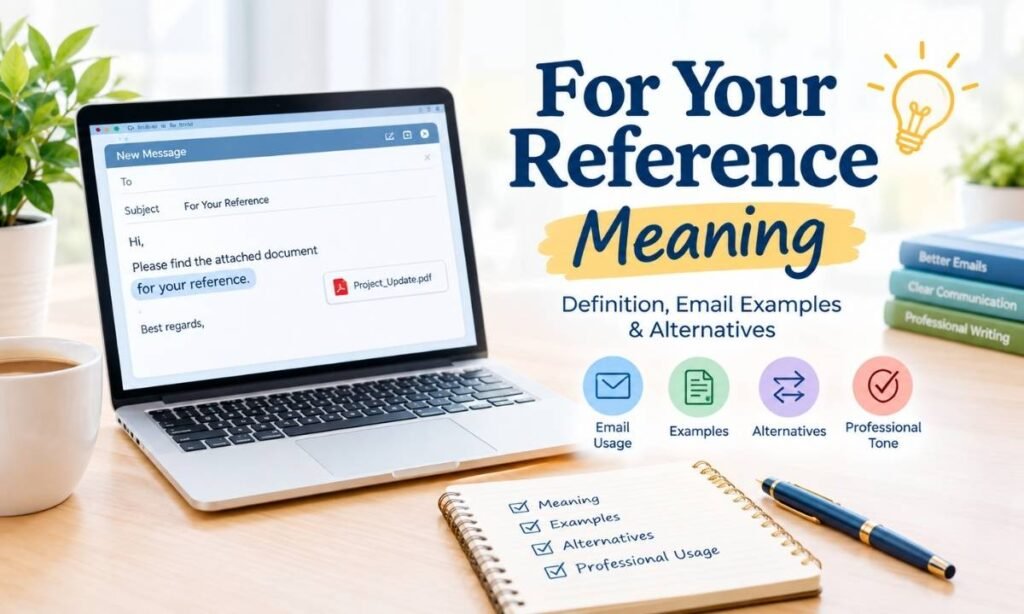
“For your reference” is one of the most common phrases used in workplace emails, yet many people still wonder what it truly signals. It generally means that a document, link, or piece of information is being shared so the recipient can consult it whenever needed, without any immediate action required.
This guide breaks down the real meaning of “for your reference,” explains how it works in professional emails, and shows you natural alternatives you can use depending on tone and context. By the end, you will know exactly when and how to use it correctly.
What Does “For Your Reference” Mean?
“For your reference” means that the sender is sharing information, a file, or a detail purely for the recipient’s knowledge or future use. It does not usually ask for a reply, approval, or edit; it simply provides material the reader might find useful later.
Simple Definition of “For Your Reference”
It means “keep this information available in case you need it,” with no expectation of immediate action from the reader.
What Does “For Your Reference” Mean in Email?
In email writing, this phrase tells the recipient that an attachment or note is informational only, added to keep them updated or informed.
Does It Mean You Need to Take Action?
No. It typically signals that no response or task is required, only awareness of the shared content.
“For Your Reference” Meaning in Email
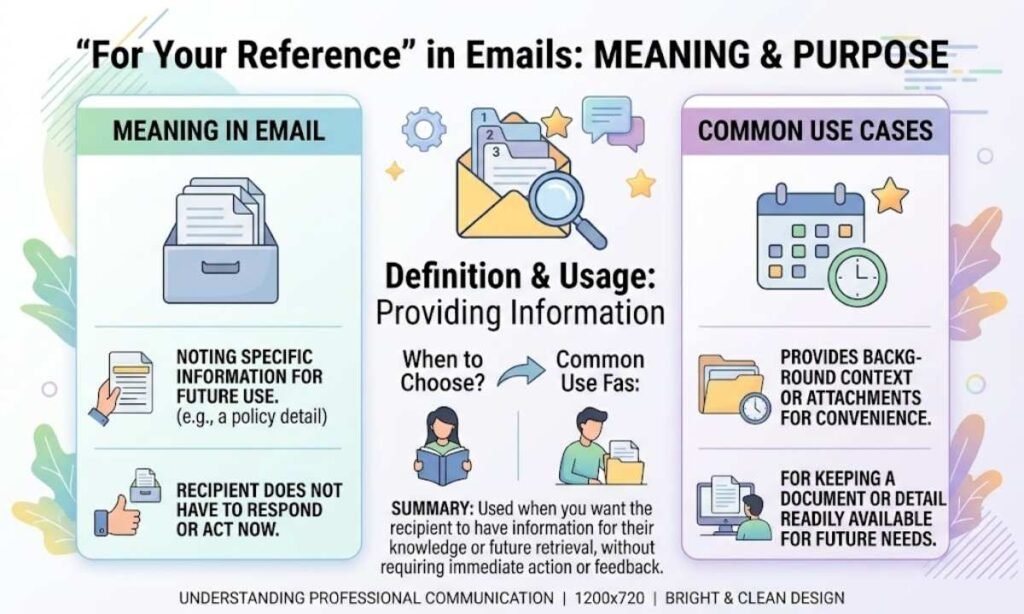
In professional and workplace emails, this phrase sets expectations clearly. It tells the reader how to treat the message: read it, store it, or use it later, but not necessarily respond right away.
When “For Your Reference” Means No Action Is Needed
Most commonly, it is used when sharing background material, past conversations, or supporting documents that support a decision already made.
When You Should Ask for a Review Instead
If you actually want feedback or corrections, “for your review” is more accurate, since “reference” implies passive reading rather than active checking.
When You Should Ask for a Reply or Approval
If a decision or confirmation is required, phrases like “please approve” or “kindly confirm” communicate the need for action far better than “for your reference.”
Is “For Your Reference” Professional and Polite?
Yes, it is widely accepted in business communication and is considered both formal and courteous when used correctly.
Is “For Your Reference” Formal?
It fits comfortably into formal business emails, reports, and internal memos.
Is “For Your Reference” Polite?
It is polite because it offers information without pressuring the recipient to respond immediately.
Can “For Your Reference” Sound Rude or Stiff?
It can feel repetitive or overly formal if used in every email, so it works best when applied selectively.
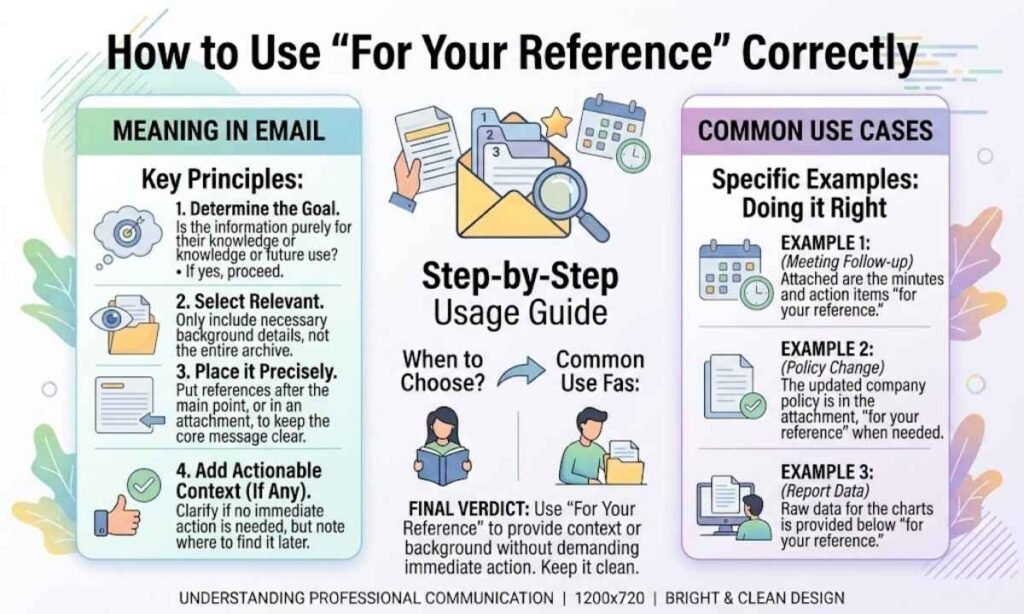
How to Use “For Your Reference” Correctly?
“For Your Reference” at the Beginning of a Sentence
Example: “For your reference, the updated pricing sheet is attached below.”
“For Your Reference” at the End of a Sentence
Example: “I have attached the meeting notes for your reference.”
“For Your Reference” With an Email Attachment
It commonly pairs with attachments, letting the reader know the file is supplementary rather than something requiring urgent action.
“For Your Reference” With a Link or Document
The same rule applies to shared links; the phrase signals that clicking or reading is optional and helpful rather than mandatory.
“For Your Reference” Examples in Emails
Example for Sharing a Report
“Please find the quarterly report attached for your reference.”
Example for Sharing a Document
“Attached is the signed contract for your reference and records.”
Example for Sharing Previous Information
“For your reference, here is the email thread from last week discussing this issue.”
Example When No Response Is Needed
“No action needed; this is simply for your reference going forward.”
Example for a Manager or Boss
“For your reference, I have summarized the client feedback below.”
Example for a Client or Customer
“For your reference, our support hours and contact details are listed in the attached PDF.”
Example for a Coworker
“Sharing the updated template for your reference before tomorrow’s meeting.”
Other Ways to Say “For Your Reference”
| Alternative Phrase | Meaning | Best Used When |
| For your information | Sharing a fact or update | Casual or neutral updates |
| For your review | Requesting feedback or checking | Draft documents needing input |
| For your records | Something worth keeping long term | Contracts, invoices, receipts |
| For your consideration | Asking for thought before deciding | Proposals or requests |
| For your awareness | Making someone aware, not asking action | Status updates |
| For context | Adding background detail | Explaining a decision |
| In case it’s helpful | Optional supporting material | Non essential extra info |
| Please see the attached | Directing attention to a file | Straightforward attachments |
| Attached for your reference | Combining both attachment and reference tone | Formal emails |
| Thought you might find this useful | Friendly, informal tone | Peer to peer sharing |
“For Your Reference” vs. Similar Phrases
For Your Reference vs FYI
Both are informational, but FYI feels casual and conversational, while “for your reference” sounds more formal and workplace appropriate.
For Your Reference vs For Your Review
“Reference” implies passive reading; “review” implies active checking or feedback.
For Your Reference vs For Your Records
“Records” suggests long term storage or legal documentation, while “reference” suggests general awareness.
For Your Reference vs For Your Information
“Information” is broader and more casual; “reference” often implies the material may be revisited later.
For Your Reference vs For Your Consideration
“Consideration” asks the reader to think or decide; “reference” simply asks them to note the content.
“Please Find the Attached File for Your Reference” Meaning
What Does “Please Find Attached” Mean?
It means the sender has included a file with the email and is pointing the reader toward it.
Is “Please Find the Attached File” Correct?
It is grammatically acceptable but considered slightly outdated and overly formal by modern email standards.
More Natural Ways to Mention an Attachment
Try phrases like “I’ve attached the file below” or “You’ll find the document attached.”
Example Email With an Attached File
“Hi Sarah, please find the signed agreement attached for your reference. Let me know if you need anything else.”
What Is the Short Form of “For Your Reference”?
Is FYR Used for “For Your Reference”?
Yes, FYR is the accepted abbreviation, though it is far less common than FYI.
FYR vs FYI: Which Is More Common?
FYI is used much more widely and is instantly recognized across industries and regions.
Should You Use FYR in a Professional Email?
It is safer to spell out the full phrase with external clients or unfamiliar recipients, since FYR may cause confusion.
Common Mistakes When Using “For Your Reference”
- Using it when you actually need action, which creates confusion about next steps
- Using it when you need approval, since it does not request a decision
- Using it when you need feedback, since “review” fits that purpose better
- Repeating the phrase too often in a single email or thread
- Using it in casual conversations, where simpler phrasing sounds more natural
When Should You Use “For Your Reference”?
- Use it for background information that supports a topic already discussed
- Use it for supporting documents attached to a main message
- Use it for previous correspondence being resurfaced for context
- Use it for information someone may need later, even if not right now
“For Your Reference” in Business Writing Beyond Email
This phrase also appears in reports, meeting minutes, proposals, and internal memos, where it introduces supplementary data such as charts, appendices, or policy notes that support the main content without demanding immediate response.
How Native English Speakers Use “For Your Reference”?
Native speakers often shorten or soften the phrase in daily conversation, favoring “just so you know” or “heads up” in casual settings while reserving the formal version for written business communication.
Cultural Differences in Using “For Your Reference”
In some workplace cultures, particularly in parts of Asia, this phrase is used very frequently as a polite, low pressure way to share updates, while Western business writing tends to favor more direct alternatives like “FYI” or “for context.”
Grammar Rules Behind “For Your Reference”
Grammatically, the phrase functions as a prepositional phrase and can sit at the start or end of a sentence without changing its meaning, though placing it at the start often reads as slightly more formal.
Tips to Sound More Professional Than “For Your Reference”
Pair the phrase with a clear reason for sharing, such as naming why the information matters, and avoid stacking it with other filler transitions in the same paragraph to keep the tone crisp and confident.
Quick Guide: Which Phrase Should You Use?
| If You Want To… | Better Phrase |
| Share information | For your information / FYI |
| Give background | For your reference / For context |
| Ask someone to read something | For your review |
| Ask for approval | For your approval |
| Tell someone to save a document | For your records |
| Provide optional help | In case it’s helpful |
| Ask for consideration | For your consideration |
Frequently Asked Questions
What does “for your reference” mean?
It means information or a document is shared so the reader can use or consult it later, without needing to act immediately.
Is “for your reference” correct English?
Yes, it is grammatically correct and widely used in professional writing.
Is “for your reference” professional?
Yes, it fits naturally into formal and business email communication.
Is “for your reference” polite?
Yes, it offers information without pressuring the reader to respond.
Does “for your reference” mean no action is required?
Generally yes, though the surrounding sentence should always confirm this clearly.
What is another way to say “for your reference”?
Common alternatives include “for your information,” “for your records,” and “for context.”
What is the short form of “for your reference”?
The short form is FYR, though FYI remains far more commonly recognized.
Conclusion
“For your reference” means that shared information, a document, or a link is meant for the reader’s awareness or future use, not immediate action. It differs from “for your review,” which asks for active feedback, and from “for your records,” which implies long term storage.
Choosing the right alternative depends entirely on what response, if any, you expect from the reader.