Many English learners search for through meaning because the word “through” appears in almost every sentence, yet its meaning shifts depending on context. Sometimes it points to movement, sometimes to time, and sometimes to a finished task or a method of doing something.
This guide explains the common uses of “through” in plain language, with real example sentences. It also clears up confusion with similar-sounding words like “threw” and “thorough,” so you never second-guess your spelling or usage again.
Understanding the Word Through at a Glance
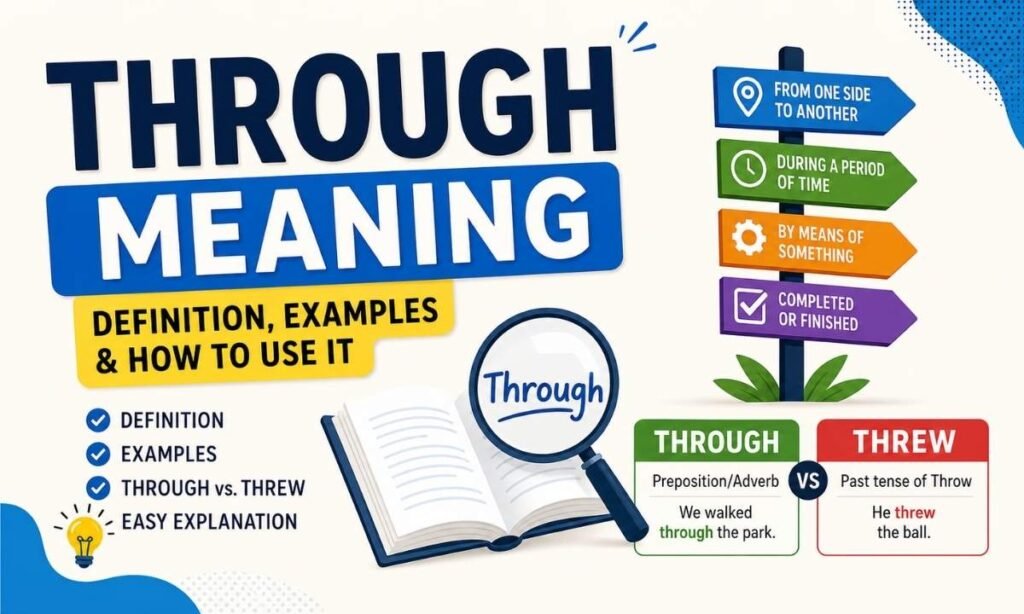
Through is one of the most flexible words in English. It works as a preposition, an adverb, and occasionally as an adjective, and its meaning changes based on the sentence around it.
In simple terms, through usually describes:
- Moving from one side of something to the other
- Continuing for the whole length of a time period
- Completing a task or process
- Using a certain method or channel to achieve something
Because the word carries so many roles, dictionaries such as Merriam Webster and Cambridge list several definitions under a single entry, and grammar sites often pair it with threw to highlight the spelling difference.
Through as a Preposition and Adverb Explained
Most grammar resources agree that through functions mainly as a preposition and an adverb.
As a preposition, it connects a noun to the rest of the sentence and usually shows movement or direction, such as walking through a door. As an adverb, it modifies a verb without needing an object, as in the sentence “she pushed the door and it opened right through.”
Recognizing this dual role helps learners understand why through can appear in so many sentence patterns without changing its core meaning of passage, continuation, or completion.
Different Contexts Where Through Changes Meaning
The word through rarely means only one thing. Its sense depends heavily on the surrounding words.
- Movement from one point to another: The kids ran through the garden.
- Duration across a period: He studied through the entire afternoon.
- Method or means: They solved the issue through teamwork.
- Cause or reason: The delay happened through no fault of the driver.
- Completion or finishing: I am finally through with this project.
- Inclusive range: The offer runs Monday through Friday.
Each of these uses appears frequently in news articles, dictionaries, and casual conversation, which is why through remains one of the most searched function words in English.
Through in Everyday Conversations and Writing
Native speakers use through constantly without noticing it, which makes the word easy to overlook when studying grammar.
- “I read through the report before the meeting.”
- “We got through the storm safely.”
- “She looked through the window at the rain.”
- “He is halfway through the book.”
These examples show how through connects actions to a sense of progress, distance, or process. Writers rely on it to keep sentences smooth instead of using longer phrases like “from one end to the other” or “during the entire period.”
Through Threw and Thorough Side by Side
Confusing through, threw, and thorough is one of the most common English spelling mistakes, mainly because the words sound somewhat similar when spoken quickly.
| Word | Part of Speech | Meaning | Example Sentence |
| Through | Preposition or adverb | Passage, duration, method, or completion | We walked through the tunnel. |
| Threw | Verb (past tense of throw) | An action of throwing something | He threw the ball across the yard. |
| Thorough | Adjective | Complete, careful, and detailed | She gave the essay a thorough review. |
A simple way to remember the difference is that through relates to a path or process, threw describes a single physical action, and thorough describes how carefully something was done.
Popular Idioms and Expressions With Through
English contains many everyday phrases built around through, and learning them naturally expands vocabulary and listening comprehension.
- Go through: to experience or examine something carefully
- Get through: to survive a hard situation or finish a task
- Follow through: to complete a promise or plan as intended
- See through: to notice the truth behind something misleading
- Break through: to succeed after facing resistance or difficulty
- Come through: to succeed despite challenges or deliver on a promise
These expressions show up in workplace emails, casual chats, and news headlines, so recognizing them helps readers understand meaning quickly without translating word by word.
Through in Digital Communication and Texting
In texting and social media, through does not gain a new secret meaning. It simply keeps its normal grammar rules in a shorter, faster writing style.
Common examples include:
- “I’m through with this app, it keeps crashing.”
- “Talk through the plan with me before we post it.”
- “I’ll get through my messages tonight.”
Many people also use the informal spelling “thru” in texts, road signs, and casual captions, such as “drive thru” or “thru the night.” This shortened form is acceptable in casual writing but should be avoided in formal documents, resumes, or academic work.
Quick Reference Table for Through Meanings
For readers who want a fast summary, the table below lists the core meanings side by side with a matching example.
| Meaning of Through | Example Sentence |
| Movement across space | The train passed through the valley. |
| Duration of time | We waited through the whole storm. |
| Method or channel | She learned French through daily practice. |
| Cause or reason | The mistake happened through poor planning. |
| Completion | He is finally through with training. |
| Inclusive range | Open Tuesday through Sunday. |
Keeping this table nearby can help writers quickly choose the correct sense of through while drafting emails, essays, or social posts.
Mistakes to Avoid When Using Through
A few recurring errors appear again and again in learner writing and everyday typing.
- Writing “threw” instead of “through” in sentences about movement or process
- Confusing “thorough” with “through” when describing careful work
- Assuming through only means movement and forgetting its time or completion senses
- Overusing the informal spelling “thru” in professional writing
Reviewing sentences once before sending an email or publishing content usually catches these small slips before they cause confusion.
Frequently Asked Questions
What is the simple meaning of through?
Through generally means moving from one side of something to another, or completing a process from start to finish.
Is through a preposition or an adverb?
Through works as both a preposition and an adverb, depending on whether it has an object in the sentence.
What is the difference between through and threw?
Through relates to movement, time, or process, while threw is simply the past tense of the verb throw.
What is the difference between through and thorough?
Through describes passage or completion, while thorough describes something done carefully and in complete detail.
Can through mean finished?
Yes, through often means finished or done, as in the sentence “I am through with my homework.”
Is thru the correct spelling?
Thru is an informal shortcut used in casual writing and signage, but through remains the correct spelling for formal use.
Does through only refer to physical movement?
No, through also describes time, method, cause, and completion, not only physical passage.
Conclusion
Through is a small word that carries a surprising amount of meaning across everyday English. It can describe a walk across a park, a long night of work, a method of learning, or the simple feeling of finally being done with something.
Once the difference between through, threw, and thorough becomes clear, most writing mistakes around this word disappear naturally, leaving sentences that read smoothly and sound confident in both casual and formal settings.