Few English words cause as much second-guessing as embarrass. If you search for “Spell Embarrass,” you are likely wondering how many r’s and s’s belong in the word.
This guide settles the question straight away, then walks through the meaning, pronunciation, related word forms, frequent misspellings, and simple memory tools, so the spelling sticks for good instead of needing a lookup every time.
Embarrass: The Correct Spelling Explained
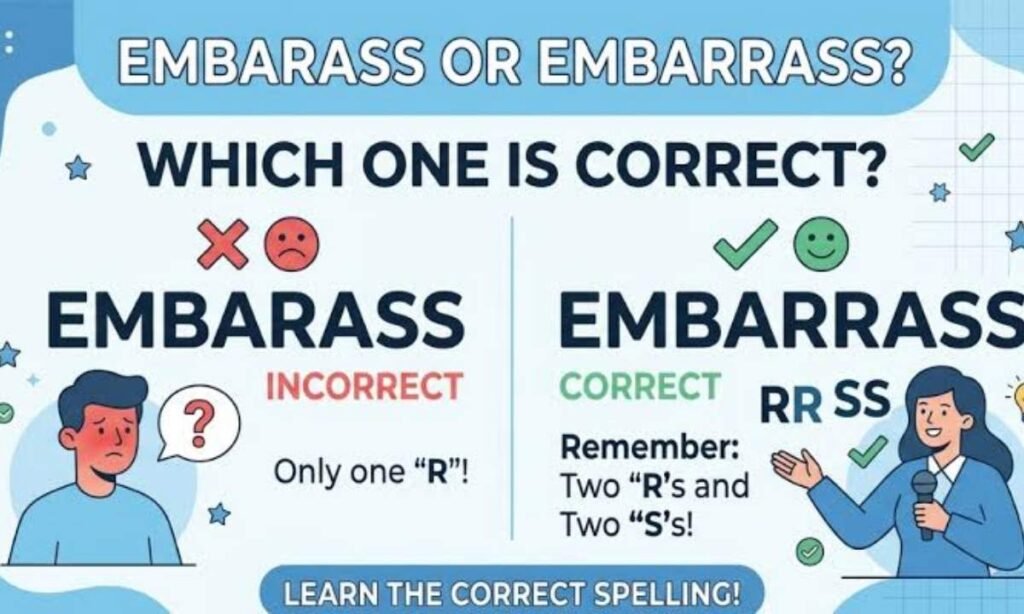
The word is spelled embarrass, using nine letters: e, m, b, a, r, r, a, s, s. Both the r and the s appear twice, which is exactly the part most people get wrong. A quick way to lock this in is a short rhyme-style phrase: “double r, double s, that’s the way to spell success with embarrass.”
Embarrass or Embarass: Spotting the Wrong Version
“Embarass” is one of the most frequent incorrect spellings, since it drops one of the r’s. Another common slip is “embarras,” which removes a final s. Neither version is correct in standard English, and spell-checkers will typically flag both as errors, though the intended word is usually still obvious from context.
Why This Word Trips People Up?
Unlike many English words, embarrass doesn’t sound out its double letters clearly when spoken, so writers often guess based on pronunciation rather than the written form. The word’s roots trace to the French verb embarrasser, which explains the extra consonants that don’t feel typical for shorter English vocabulary. Because the doubled letters aren’t emphasised in speech, they’re easy to forget under time pressure, such as during a fast email or a spelling test.
A Step-by-Step Way to Build the Word
Breaking embarrass into smaller pieces removes the guesswork:
- Begin with the opening sound: em
- Add the doubled r: em + barr
- Close with the doubled s: barr + ass
- Put it together and check it reads correctly: embarrass
Writing the word in these four chunks, rather than all at once, is one of the more reliable tricks for remembering both double letters at the same time.
Meaning of Embarrass
Used as a verb, embarrass describes causing someone to feel self-conscious, uneasy or exposed in front of others. It can apply to a comment, an action, a mistake, or even an entire situation. A secondary and much less common sense of the word relates to hindering or obstructing something, a meaning that has mostly faded from everyday use.
Pronouncing Embarrass Correctly
The word is pronounced roughly as im-BEH-ruhs, with the emphasis landing on the middle syllable. Saying the three sound chunks slowly — im, ber, uhs — can help connect the spoken word back to its written spelling, even though the pronunciation itself won’t tell you where the double letters sit.
Embarrass and Its Word Family
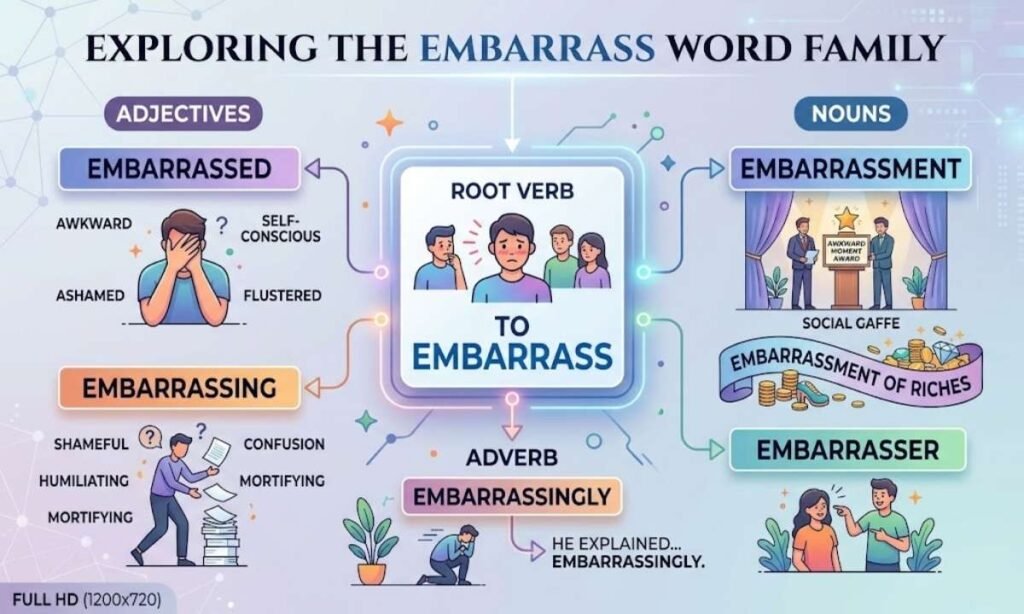
Several related forms of this word show up often in writing and everyday speech.
| Word Form | Function | Example Sentence |
| Embarrass | Verb (base form) | Please don’t embarrass me in front of the class. |
| Embarrassed | Adjective / past tense | He looked embarrassed after forgetting his lines. |
| Embarrassing | Adjective | It was an embarrassing silence during the call. |
| Embarrassment | Noun | She apologised for the embarrassment she caused. |
Every form keeps the same double r and double s, so learning the base spelling covers the whole word family at once.
Frequent Misspellings and Their Fixes
Here are the errors that show up most often, lined up against the correct spelling.
| Incorrect Version | Correct Version |
| embarass | embarrass |
| embarras | embarrass |
| embarased | embarrassed |
| embarasing | embarrassing |
| embarasment | embarrassment |
Keeping this short reference nearby clears up nearly every version of the mistake in one glance.
Embarrass Used in Real Sentences
Seeing the word in context makes both the spelling and meaning easier to remember together.
- I didn’t want to embarrass my sister at her own party.
- Would it embarrass you if I mentioned this in the meeting?
- The typo embarrassed the whole marketing team.
- Try not to embarrass yourself during the interview.
- Some students get embarrassed when asked to speak in front of the class.
Where the Spelling Comes From?
Embarrass entered English through French, borrowed from embarrasser, a verb linked to blocking or obstructing something. Over the centuries, the meaning gradually shifted from a physical blockage toward the emotional discomfort we associate with the word now. This French origin is the main reason the spelling keeps its heavier double-letter pattern instead of simplifying the way many native English words eventually do.
Simple Ways to Remember the Spelling for Good
- Repeat the phrase “two r’s, two s’s” until it becomes automatic
- Split the word into em, barr and ass while writing it slowly
- Copy the word by hand three or four times in a row
- Write an original sentence using the word rather than only reading examples
- Cover the word, write it from memory, then compare it letter by letter
Embarrass vs. Other Tricky Double-Letter Words
Embarrass isn’t alone in causing double-letter confusion. Comparing it with a couple of similar words helps the pattern stick.
| Word | Letter Pattern | Quick Note |
| Embarrass | Double r, double s | Two of each letter |
| Harass | Single r, single s | Often confused with embarrass |
| Necessary | Single c, double s | One c, two s’s |
Harass is the word people mix up most often with embarrass, since the two look related but follow opposite double-letter rules — harass has only one r and one s.
Is Embarrass a Verb, Adjective or Noun?
On its own, embarrass functions only as a verb, describing the act of causing discomfort. Its relatives shift into other grammatical roles: embarrassed and embarrassing typically work as adjectives, while embarrassment is the noun. Knowing which form fits a sentence also makes spelling easier, since every version still carries the same double r and double s no matter its grammatical job.
Test Your Spelling
Try these short prompts before moving on to check how well the spelling has stuck.
- Pick the correct version: embarras / embarrass / embarass
- Fill in the blanks: em _ arr _ ss
- Complete this sentence: “He tried not to ______ himself during the speech.”
- Write the full word from memory, then check every letter.
Answer key: 1. embarrass 2. embarrass 3. embarrass 4. e-m-b-a-r-r-a-s-s
Frequently Asked Questions
How do you spell embarrass correctly?
It’s spelled embarrass, with a double r and a double s.
Is embarrass spelled with one R or two?
Two r’s are correct, as in em-barr-ass.
Is embarrass spelled with one S or two?
The word ends with two s’s, not one.
What is the difference between embarrass and embarrassed?
Embarrass is the base verb; embarrassed is its adjective or past-tense form.
What is the correct spelling of embarrassing?
It’s spelled embarrassing, keeping the same double letters throughout.
How do you pronounce embarrass?
Roughly im-BEH-ruhs, with stress on the middle syllable.
What does embarrass mean?
It means to make someone feel awkward, uneasy or self-conscious.
What is a simple sentence using embarrass?
“Please don’t embarrass me in front of everyone.”
Conclusion
The correct spelling is embarrass: two r’s, two s’s, no exceptions. Once that pattern feels natural, every related form — embarrassed, embarrassing and embarrassment — becomes just as easy to write correctly.
A few days of short practice, using the word in your own sentences, is usually all it takes to stop second-guessing this spelling for good.