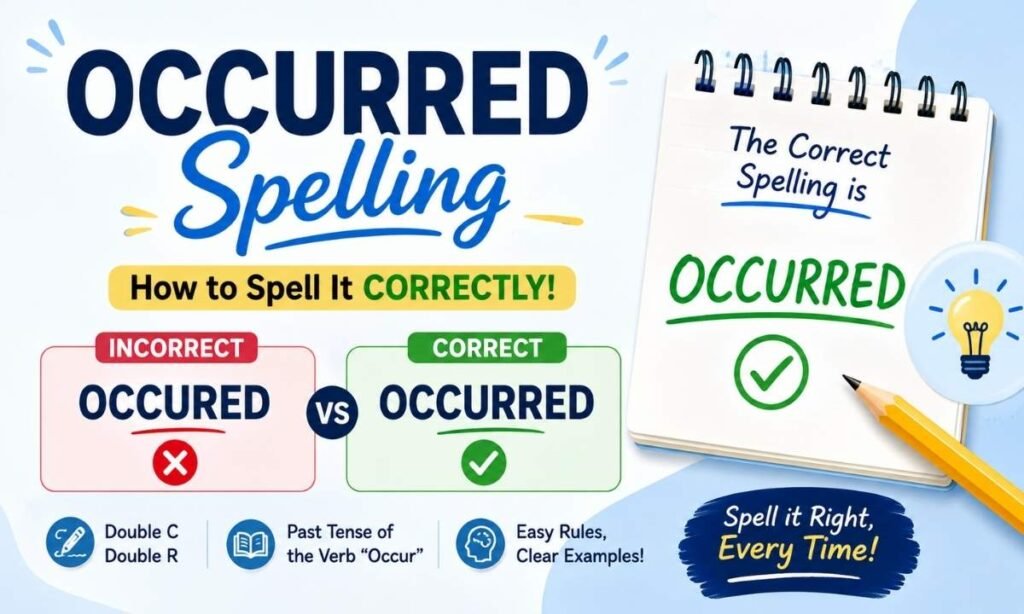
Is it occurred or occured? This single word trips up more writers than almost any other in the English language, and the double letters are usually to blame. The correct spelling is occurred, written with two c’s and two r’s, and it is the past tense and past participle of the verb occur.
In this guide, you will learn why occurred is spelled the way it is, what it actually means, how it differs from occured and ocurred, and how to use it correctly in everyday and formal writing. By the end, spelling this word will feel automatic.
Occurred vs Occured: Which Spelling Is Correct
Occurred Is the Standard Spelling
Dictionaries and style guides agree that occurred is the only accepted form. It carries two c’s and two r’s, as in: “The storm occurred late last night.”
Occured Is a Widespread Misspelling
Occured drops one of the r’s and is not recognized as standard English. Compare the two forms side by side:
| Spelling | Status | Example |
| Occurred | Correct | The delay occurred without warning. |
| Occured | Incorrect | The delay occured without warning. |
| Ocurred | Incorrect | The delay ocurred without warning. |
How to Spell Occurred Step by Step
Breaking the Word Into Parts
A simple way to visualize the word is: oc + cur + red = occurred. Spelled out letter by letter, it reads O-C-C-U-R-R-E-D.
Why the Final R Is Doubled
English has a doubling rule for short verbs that end in a single vowel followed by a single consonant, when the stress falls on the last syllable. Occur fits this pattern exactly, so when the -ed ending is added, the final r doubles before the suffix attaches. This same rule explains related words like occurring and occurrence.
A Quick Memory Trick
Picture two pairs standing together: two c’s up front, two r’s in the middle. If you can remember “double c, double r,” you will spell occurred correctly every time.
What Does Occurred Mean?
Occurred Means Happened or Took Place
In its most common sense, occurred describes an event that has already happened. Examples:
- The accident occurred on a quiet street.
- A power outage occurred during the storm.
Occurred Can Also Mean Came to Mind
The phrase “it occurred to me” describes a thought or realization that suddenly appeared, rather than a physical event. For example: “It occurred to me that I had left the door unlocked.”
Occurred Used in Real Sentences
- The meeting occurred earlier than scheduled.
- A problem occurred while processing the payment.
- It never occurred to him that the answer was so simple.
Occur, Occurs, Occurred, and Occurring Compared
| Form | Tense | Example Sentence |
| Occur | Base form / infinitive | Mistakes occur even in careful work. |
| Occurs | Present tense (singular) | The issue occurs mainly in winter. |
| Occurred | Past tense / past participle | The issue occurred last winter. |
| Occurring | Present participle | The issue is occurring right now. |
Common Misspellings of Occurred
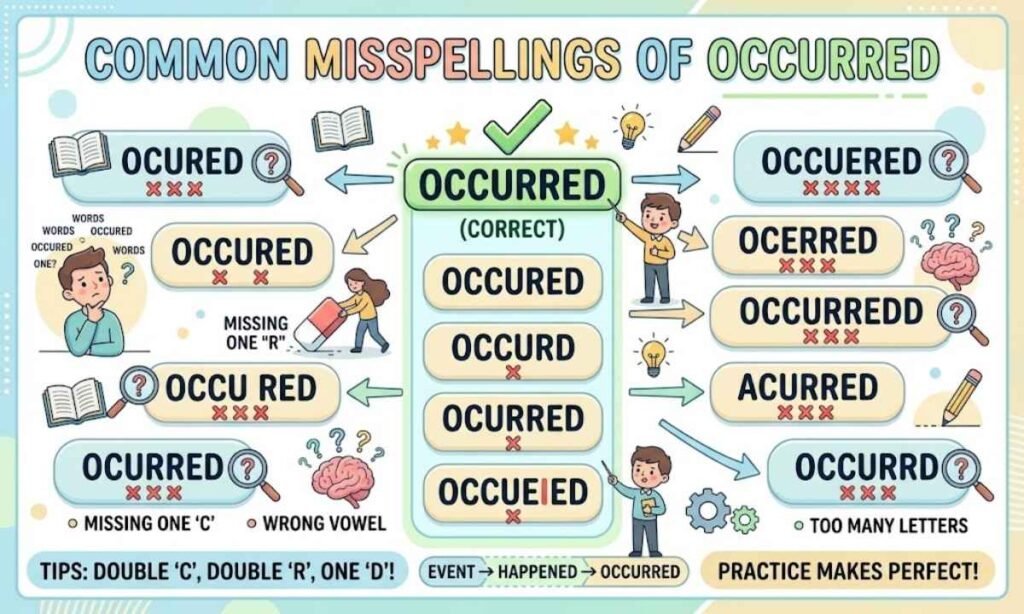
Writers usually drop one letter from a doubled pair simply because English doubling rules aren’t intuitive. The most frequent errors include:
- Occured – missing the second r
- Ocurred – missing the second c
- Occured/Ocurred confusion – mixing up which letter should be doubled
Keeping the “double c, double r” rule in mind clears up nearly every version of this mistake.
How to Use Occurred in a Sentence?
Describing Past Events
- The change occurred after the software update.
- The fire occurred sometime after midnight.
- A shift in strategy occurred following the review.
Describing a Thought or Idea
- The solution occurred to her while she was cooking.
- It occurred to the team that the deadline was unrealistic.
Formal vs Everyday Usage
Occurred fits naturally into reports, news writing, and academic papers because it sounds more neutral and objective than happened. In casual conversation, happened is often the more natural choice, though both are grammatically correct.
Occurred in American and British English
The spelling of occurred does not change between American English and British English. Both varieties use the same double-c, double-r form, unlike words such as color/colour or organize/organise, which do shift between dialects.
Synonyms and Antonyms of Occurred
Knowing alternative words helps you vary your sentences and avoid repetition.
Synonyms: happened, took place, transpired, arose, materialized, emerged, came about
Antonyms: vanished, disappeared, receded
Example swap: “The delay occurred overnight” can also be written as “The delay took place overnight” without changing the meaning.
Occurred in Academic and Professional Writing
In scientific papers, business reports, and technical documentation, occurred is preferred over happened because it reads as more precise and impersonal. For example, a lab report might state, “The reaction occurred at temperatures above sixty degrees Celsius,” while an incident report might read, “The error occurred during data transfer.” This makes occurred a reliable word choice whenever you want your writing to sound formal and fact-based.
Word Origin of Occurred
Occurred traces back to the Latin verb occurrere, a combination of ob- (toward) and currere (to run), roughly meaning “to run toward” or “to meet.” Over time, its meaning shifted in English toward the modern sense of something happening or coming to mind, while the doubled consonants remained from its Latin root.
Related Words: Occurrence, Occurring, and Occurs
Occurrence vs Occurred
Occurrence is a noun referring to an event itself, as in “a rare occurrence.” Occurred is a verb describing that the event happened.
Occurring vs Occurred
Occurring describes something happening right now, while occurred describes something that has already finished happening.
Occurs vs Occurred
Occurs is used for present, repeated, or general truths, while occurred is reserved strictly for the past.
Tips to Avoid Misspelling Occurred Again
- Say the word aloud slowly, emphasizing “oc-CUR-red” to hear the doubled sounds.
- Write the word by hand a few times, spelling it out loud: O-C-C-U-R-R-E-D.
- Use a spell checker as a backup, but don’t rely on it entirely, since occured is sometimes autocorrected incorrectly.
- Compare it mentally to other doubled-consonant words like referred or preferred, which follow the same rule.
Quick Recap Table
| Question | Answer |
| Correct spelling? | Occurred |
| Number of c’s and r’s? | Two of each |
| Word type? | Past tense/past participle of occur |
| Changes in British English? | No |
| Common misspellings? | Occured, Ocurred |
Frequently Asked Questions
Is “Occured” a Correct Word?
No, occured is not a recognized spelling. The correct form is always occurred.
How Do You Spell Occurred in American English?
American English uses the same spelling as British English: occurred, with two c’s and two r’s.
What Is the Past Tense of Occur?
The past tense and past participle of occur is occurred.
Why Is the R Doubled in Occurred?
Because occur ends in a stressed syllable with a single vowel and consonant, English doubling rules require the final r to double before adding -ed.
What Does “It Occurred to Me” Mean?
It means an idea or realization suddenly came to mind, not that a physical event took place.
Is “Occurred” the Same as “Happened”?
They are close synonyms, though occurred often sounds more formal or neutral than happened.
Does the Spelling of Occurred Ever Change?
No, occurred keeps the same spelling in every English dialect and in both formal and informal writing.
Conclusion
Occurred is the only correct spelling, always written with two c’s and two r’s. Occured and ocurred are common but incorrect variations. Whether you’re writing a casual message or a formal report, remembering the simple pattern O-C-C-U-R-R-E-D will keep this tricky word spelled right every time.