Many writers pause at the same spot in a sentence: is it “I want to go” or “I want too go”? Both words sound identical when spoken, yet they carry completely different jobs in written English. Getting this right instantly makes your writing look more polished and professional.
This guide breaks down the meaning of to, the meaning of too, and how the number two fits into the picture. You will also find comparison tables, common mistakes, memory tricks, and a short practice test to check what you have learned.
To or Too: The Fast Answer
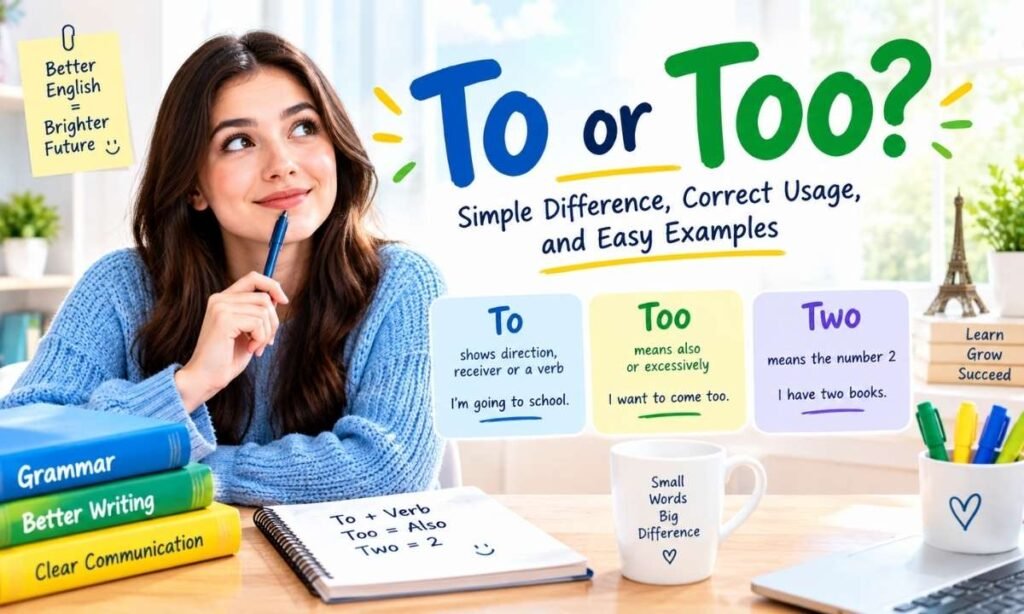
Use to when you are describing direction, connecting a verb, or pointing toward a person who receives something. Use too when you mean also or when you are describing something excessive.
- I am going to the gym. (direction)
- She wants to help. (verb connector)
- Give the flowers to her. (receiver)
- I am coming too. (also)
- The soup is too spicy. (excessive)
Understanding “To” in a Sentence
To is a small but versatile word. It often works as a preposition or as part of an infinitive verb.
- Movement or direction: We drove to the coast.
- Infinitive verb form: I need to study tonight.
- Pointing to a receiver: Send the invitation to Mark.
- Common set phrases: according to, next to, up to you, talk to me
Because to almost always sits before a noun, pronoun, or base verb, it rarely stands alone at the end of a short phrase.
Understanding “Too” in a Sentence
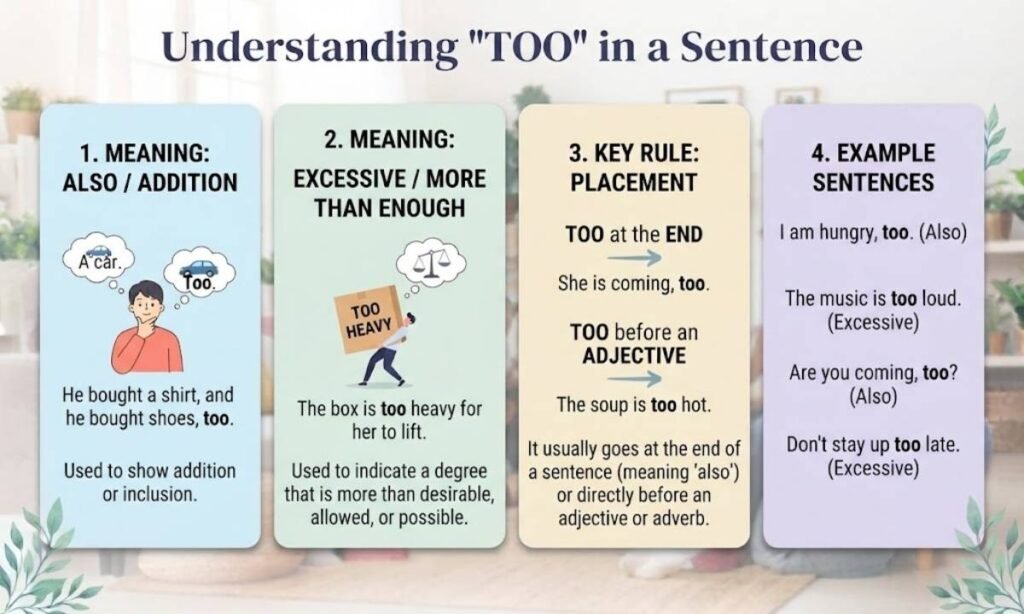
Too is an adverb, and it only carries two main meanings: also and excessively.
- Meaning also: My sister is joining us too.
- Meaning excessively: This jacket is too small.
- Modifying an adjective: The exam felt too long.
- Modifying a quantity: There were too many emails this morning.
A simple test is to swap too for also or for very. If the sentence still makes sense, too is the correct choice.
To vs Too vs Two at a Glance
These three words are classic homophones, meaning they sound the same but differ in spelling and meaning. The table below summarizes each one.
| Word | Function | Meaning | Example |
| To | Preposition or infinitive marker | Direction, receiver, or before a verb | I want to travel. |
| Too | Adverb | Also, or more than needed | I want to travel too. |
| Two | Number | The number 2 | I booked two tickets. |
Everyday Examples That Make It Click
Seeing the words in short, realistic sentences helps the rule stick faster than any definition alone.
- Correct: I want to go home.
- Correct: I love you too.
- Correct: This bag is too heavy.
- Correct: Give this note to Sarah.
- Correct: We arrived too early.
- Correct: I need two more minutes.
- Correct: She plans to travel next spring.
- Correct: The coffee is too hot to drink right now.
- Correct: He gave his notice to the manager.
- Correct: They bought two tickets for the show.
Mistakes People Make With To and Too
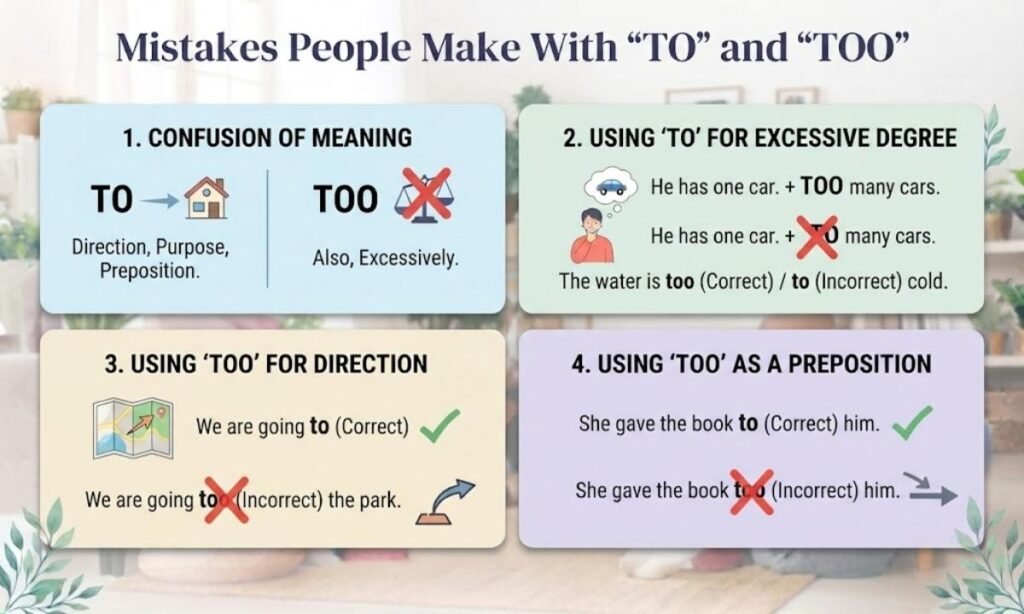
Even confident writers slip up when typing quickly. Here are the patterns that cause the most confusion.
- Writing “I want too eat” instead of “I want to eat”
- Writing “Me to” instead of “Me too”
- Writing “to much noise” instead of “too much noise”
- Writing “to many choices” instead of “too many choices”
- Dropping the number two into a sentence where too or to belongs
A quick proofreading habit is to read the sentence aloud. If the word means also or excessive, it needs the extra O.
Memory Tricks That Actually Work
- The extra O trick: too has an extra letter, and it often points to something extra, such as also or an excessive amount.
- Replace and check: swap the word for also. If the sentence still works, keep too.
- Verb check: if a base verb comes right after the word, such as to eat or to sleep, then to is almost always correct.
- Count check: if you can replace the word with the digit 2, you need two instead.
To or Too in American English Writing
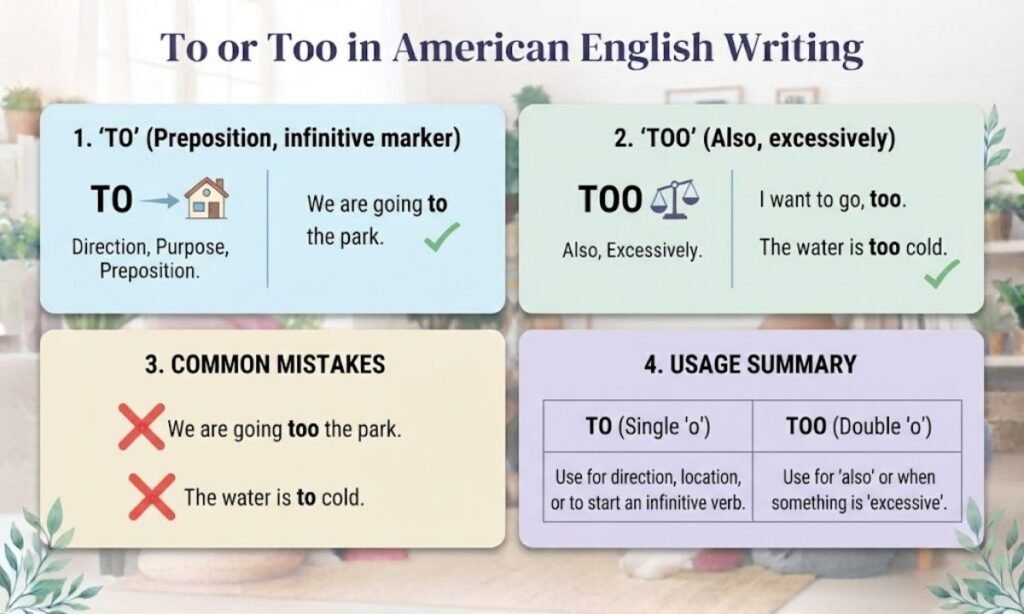
The rules for to and too do not change between American and British English. Both varieties follow the same grammar logic, so the same tricks apply whether you are writing an email, an essay, or a text message.
- I am heading to the office this morning.
- Thanks for the update, and congratulations to you too.
- It is too cold to sit outside today.
- I have two meetings scheduled for Friday.
In school assignments and workplace emails, proofreading slowly for these two words prevents small errors that readers notice quickly.
Quick Practice: Test Yourself
Fill in each blank with to, too, or two, then check your answers in the table below.
- I want ___ see the new movie.
- She brought her brother ___.
- We adopted ___ kittens last month.
- It is ___ late to call him now.
- Please hand this file ___ the manager.
| Sentence Blank | Correct Word | Reason |
| I want ___ see the movie | to | before a base verb |
| She brought her brother ___ | too | means also |
| We adopted ___ kittens | two | refers to the number |
| It is ___ late to call | too | means excessively |
| Hand this file ___ the manager | to | points to a receiver |
Frequently Asked Questions
What is the difference between to and too?
To usually shows direction, purpose, or connects to a verb, while too means also or excessively.
Is it “I love you to” or “I love you too”?
The correct form is “I love you too,” since it means also.
Is it “me too” or “me to”?
“Me too” is correct because it expresses agreement or addition.
Is it “too much” or “to much”?
“Too much” is correct, since the phrase describes an excessive amount.
How can I remember the difference quickly?
Remember that too has an extra O, which often signals something extra or additional.
Does American English use different rules for to and too?
No, American and British English follow the exact same grammar rules for these words.
What is the difference between to, too, and two?
To relates to direction or verbs, too means also or excessive, and two is simply the number 2.
Conclusion
Remembering three short rules solves almost every mix up. Use to for direction, a receiver, or before a verb. Use too for also or for anything excessive. Use two only when you are counting.
Bookmark this guide, try the quick practice section above, and share it with anyone who still mixes up these everyday words.