
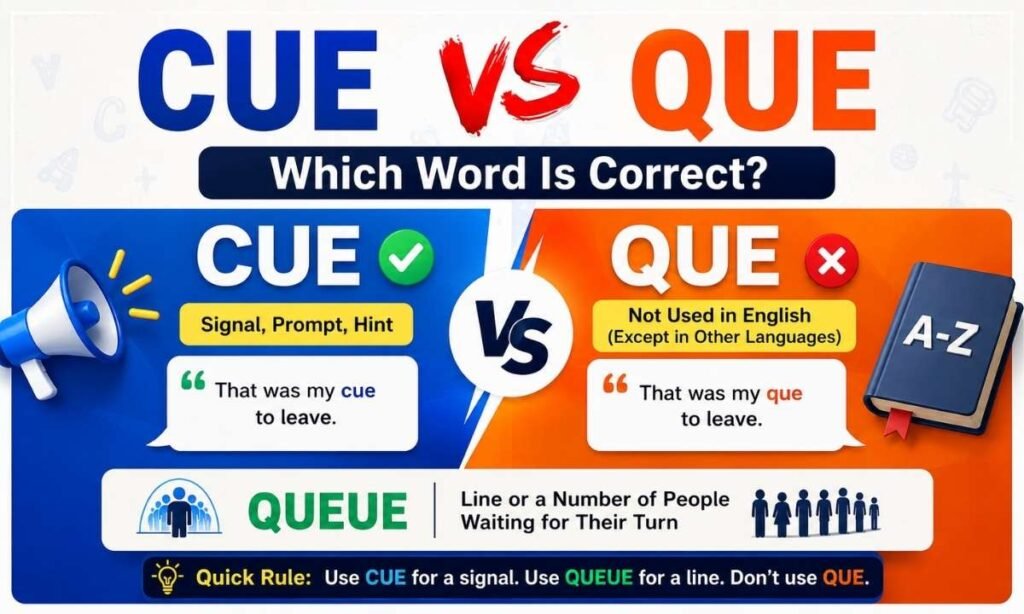
Many English learners and even native speakers type “que” when they actually mean “cue.” This mix-up happens because both words sound almost identical when spoken quickly, and autocorrect does not always catch the error.
This guide breaks down the real meaning of cue, explains where que actually comes from, and clears up the common confusion with queue. If you’re comparing Cue vs Que, you’ll learn exactly which word to use and why, along with practical examples you can apply in writing, texting, and everyday conversation.
Quick Answer: Cue or Que?
Cue is the correct English word when you mean a signal, prompt, hint, or indication that it is time to act. Que is not standard English; it usually belongs to Spanish or French. Queue is a separate word entirely, referring to a line of people or items waiting in order.
What Does Cue Mean?
Cue as a Noun
As a noun, a cue is a signal that tells someone when to start, stop, or respond. Actors wait for a cue to walk on stage, and a nod can be a social cue to end a conversation.
Cue as a Verb
As a verb, to cue means to give someone that signal. A director cues the actors, a DJ cues the next track, and a teacher might cue students to begin an exercise.
Cue in Everyday Communication
Beyond theater and music, cue shows up constantly in daily language: body language cues, conversational cues, visual cues in design, and emotional cues in relationships. It is a versatile word rooted in the idea of timing and prompting.
What Does Que Mean?
Is Que an English Word?
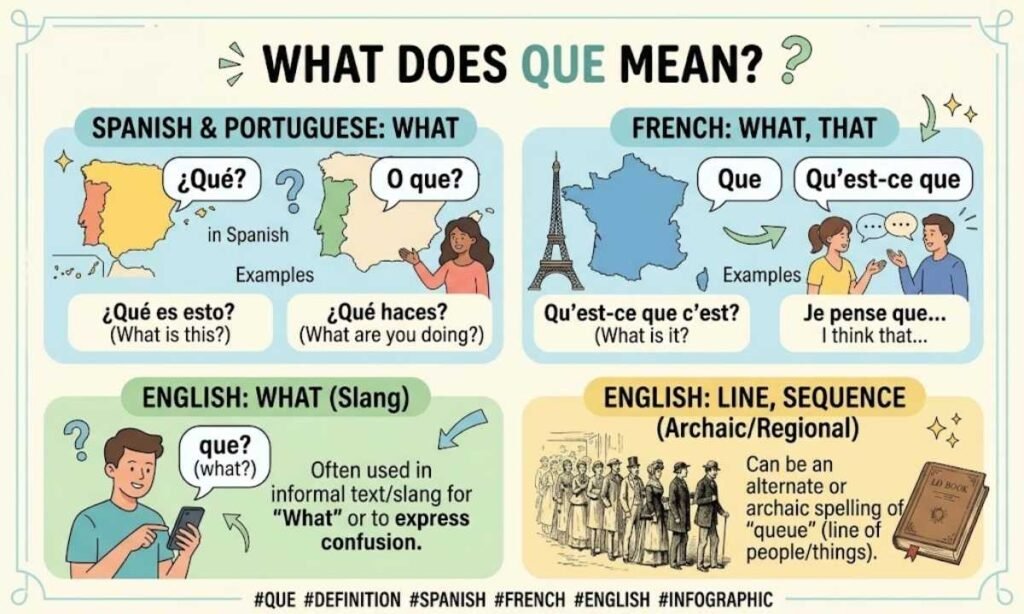
On its own, que is not a recognized standard English word. It is not listed as an alternative spelling of cue in major dictionaries, and using it in place of cue is considered a spelling mistake in formal writing.
Que in Spanish and French
In Spanish, que commonly translates to “that,” “which,” or “than,” depending on sentence structure. In French, que functions similarly as a conjunction or relative pronoun. Both uses are grammatically correct within their own languages.
When Que Can Appear Correctly
Que is acceptable in English text only in specific situations, such as:
● Quoting Spanish or French phrases directly
● Proper nouns or brand names that include “que”
● Bilingual or multilingual writing where the foreign word is intentional
Outside these cases, que should not replace cue in standard English sentences.
Cue vs Que: Key Differences at a Glance
| Word | Meaning | Standard English Word | Example Sentence |
| Cue | Signal, prompt, or hint | Yes | That was my cue to leave the meeting. |
| Que | Foreign language term (Spanish/French) | No, not as a substitute for cue | Spanish: “Creo que es verdad.” |
| Queue | A line or ordered sequence | Yes | We stood in the queue for twenty minutes. |
Cue vs Que vs Queue: Don’t Mix Them Up
Cue Means Signal or Prompt
Use cue whenever you are describing a hint or trigger for action, such as “her tone was my cue to stop talking.”
Que Is Usually Foreign Vocabulary
Reserve que for genuine Spanish, French, or other foreign language contexts rather than as a shortcut spelling of cue.
Queue Means a Waiting Line
Queue refers to people, tasks, or items arranged in order, such as a print queue on a computer or a queue at a checkout counter.
Cue and Queue Share the Same Sound
Both cue and queue are pronounced the same way in standard English, which is the main reason people confuse their spellings, even though queue also means “line” or “order.”
Pronunciation Guide: Cue, Que, and Queue
Since sound confusion is the root cause of most spelling errors here, a quick pronunciation breakdown helps:
● Cue is pronounced like the letter “Q”
● Queue is also pronounced like the letter “Q,” despite having four extra letters
● Que, in Spanish, is pronounced closer to “keh,” which is noticeably different from the English cue
Recognizing this pronunciation gap makes it easier to remember that que does not belong in place of cue in English writing.
Synonyms for Cue You Can Use Instead
If you want to vary your vocabulary while keeping the same meaning, consider these alternatives depending on context:
● Signal
● Prompt
● Hint
● Indication
● Trigger
● Reminder
Choosing the right synonym depends on tone; “signal” fits technical or theatrical writing, while “hint” feels more casual and conversational.
Cue vs Cued vs Cues: Word Forms Explained
Understanding how cue changes across tenses avoids further spelling slips:
| Form | Type | Example |
| Cue | Base verb/noun | Give me a cue when ready. |
| Cues | Plural noun/present tense verb | She reads social cues well. |
| Cued | Past tense verb | The stage manager cued the lights. |
| Cueing/Cuing | Present participle | The host is cueing the next guest. |
Note that “cuing” and “cueing” are both accepted spellings, though “cueing” is slightly more common in American English.
Common Cue vs Que Mistakes
“That Was My Que”
This is incorrect. The correct sentence is “that was my cue,” since it refers to a signal, not a foreign word or a line.
“She Gave Me a Que to Start”
Again, cue is correct here. Que has no functional meaning as a standalone signal word in English.
Confusing Cue With Queue
Writers sometimes swap cue and queue entirely, saying “wait for your cue” when they mean “wait in the queue,” which changes the meaning completely.
Typing Que Because It Sounds Like Cue
Phonetic spelling and fast typing are the biggest reasons que appears where cue should be, especially in texting and social media captions.
How to Remember Cue vs Que vs Queue
● Cue rhymes with clue, and a clue is essentially a hint or signal, which matches the meaning of cue
● Queue has extra letters, just as a line has multiple people or items waiting their turn
● Que belongs to Spanish and French sentences, not English signals or prompts
Cue vs Que in American English
Is Cue Correct in American English?
Yes. Cue is fully standard in American English whenever referring to a prompt, hint, or signal, and it appears regularly in scripts, presentations, and casual speech.
Is Que Correct in American English?
Not typically. Que appears in American English only when borrowed intentionally from Spanish, such as in bilingual content or direct quotations.
Line vs Queue in American Usage
American English speakers often say “line” instead of “queue,” while British English speakers use “queue” more frequently; both are grammatically correct English words.
Cue vs Que in Texting and Social Media
Texting speed often causes people to drop letters or misspell words phonetically. Que shows up in casual messages and captions purely because it types faster, not because it is correct. Expressions like “cue the drama” or “cue the dramatic music” remain popular in memes and captions, and both should always use cue, never que.
Common Expressions Using Cue
● On cue: happening exactly at the expected moment, such as “right on cue, it started raining”
● Take your cue from: to follow someone’s example or lead
● Cue the music: a phrase used to signal that music should start, often used humorously in everyday speech
● Right on cue: emphasizing perfect timing in a situation
Business and Academic Writing Considerations
In professional documents, resumes, and academic papers, spelling errors like que instead of cue can affect credibility. Editors and grammar checkers consistently flag que as nonstandard unless the surrounding text is explicitly in Spanish or French.
When in doubt, proofreading tools and dictionaries confirm that cue is the reliable choice for formal English writing.
Frequently Asked Questions
Is it cue or que?
Cue is correct when referring to a signal, prompt, or hint in English.
Is que a correct English word?
No, que is not standard English; it is primarily a Spanish or French word.
What does cue mean?
Cue means a signal or prompt that tells someone when to act or respond.
What does que mean in Spanish?
In Spanish, que typically means “that,” “which,” or “than,” depending on context.
Is cue and queue pronounced the same?
Yes, cue and queue share the same pronunciation in standard English.
What is the difference between cue and queue?
Cue means a signal or prompt, while queue means a line or ordered sequence.
How do I remember cue vs queue?
Think of cue as related to clue, and queue as a line with extra letters representing extra people.
Conclusion
Cue means a signal, prompt, or hint, and it is the word you want in almost every English sentence involving timing or prompting. Que belongs to Spanish and French and should not replace cue in standard writing.
Queue refers to a line or ordered sequence, sharing the same sound as cue but a completely different meaning. Keeping these three words separate instantly improves the accuracy and professionalism of your writing.