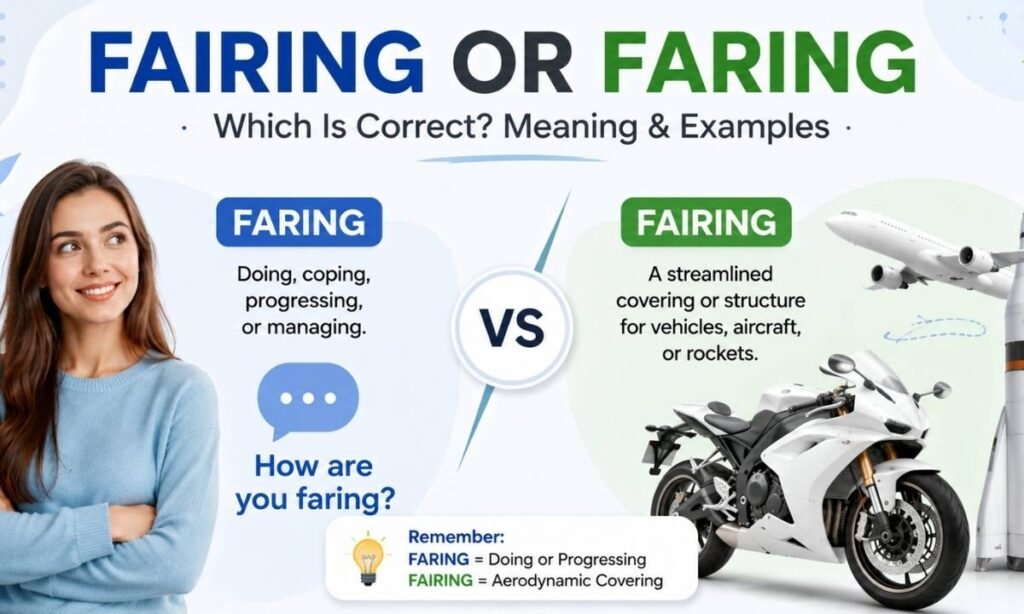
Many English speakers mix up fairing and faring because they sound identical when spoken aloud. Despite the similar pronunciation, these two words belong to completely different categories and carry entirely different meanings.
This guide breaks down the difference in simple terms, shows you exactly when to use each word, and gives real examples so you never second-guess your spelling again.
Fairing vs Faring: Quick Comparison Table
| Word | Part of Speech | Core Meaning | Common Context |
| Faring | Verb (present participle of “fare”) | Doing, coping, progressing, getting along | People, businesses, teams, situations |
| Fairing | Noun | A smooth, streamlined covering or panel | Motorcycles, aircraft, rockets, boats |
If you remember nothing else, remember this: faring relates to how someone or something is progressing, while fairing relates to a physical, aerodynamic covering used in engineering and transportation.
What Does Faring Mean?
Faring comes from the verb “fare,” an older English word meaning to travel, experience, or get along. When used with “-ing,” it describes an ongoing state of doing well, doing poorly, or simply managing through circumstances.
Faring Meaning in Plain English
In everyday language, faring simply means “getting along” or “doing.” It answers the question of how a person, group, or situation is currently progressing.
How Are You Faring Meaning?
This popular phrase is a more formal or literary way of asking:
- How are you doing?
- How are things going for you?
- How are you coping with a situation?
- How are you managing right now?
What Does Fairing Mean
Fairing is a noun rooted in engineering and design. It refers to a structure that smooths airflow around a vehicle or machine, reducing drag and often protecting internal components from wind, debris, or impact.
Where the Word Fairing Is Commonly Used?
You will most often encounter fairing in these industries:
- Motorcycles, where it shields the engine and rider from wind resistance
- Aviation, where fairings streamline joints between aircraft parts
- Aerospace, where a payload fairing protects a satellite during launch
- Marine engineering, where hull fairings improve hydrodynamics
- Cycling, where aerodynamic fairings reduce drag on racing bikes
How Are You Faring or Fairing: The Correct Phrase
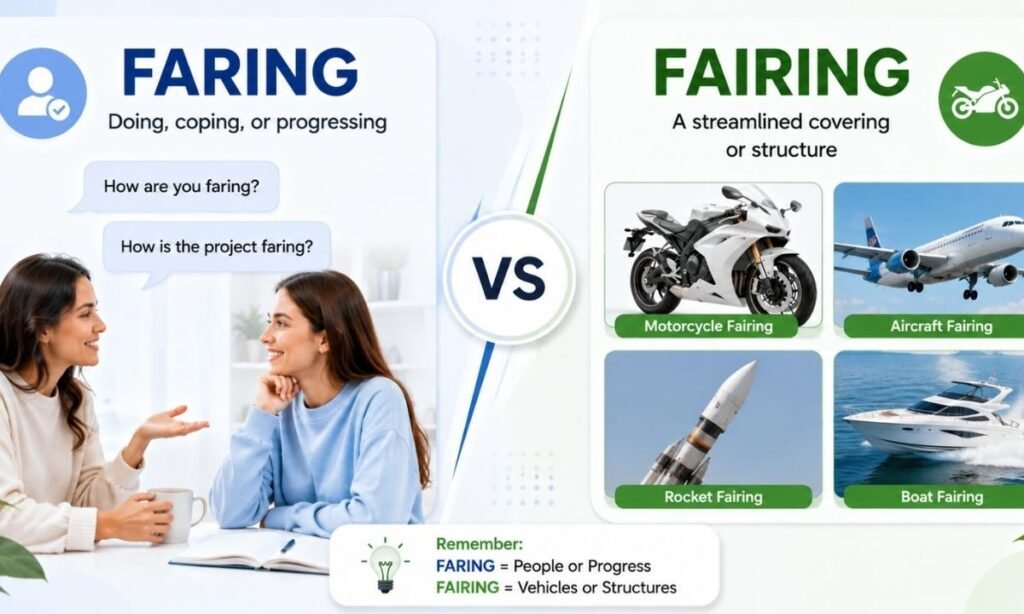
The correct expression is always “how are you faring.” Using “fairing” here is a spelling mistake because fairing is not a verb and cannot describe someone’s condition or progress.
Why the Confusion Happens?
Because faring and fairing are homophones, spellcheck tools often fail to catch the error, and many writers default to the more visually familiar spelling without realizing the meaning shifts entirely.
Common Fairing and Faring Mistakes to Avoid
Below are frequent errors seen in blogs, emails, and social captions, along with the corrected version.
- Incorrect: I hope you’re fairing well. Correct: I hope you’re faring well.
- Incorrect: How are things fairing? Correct: How are things faring.
- Incorrect: The company is fairing well this quarter. Correct: The company is faring well this quarter.
- Incorrect: The bike’s faring cracked. Correct: The bike’s fairing cracked.
Faring in Everyday Sentences
Faring shows up naturally in conversations about people, work, school, and life transitions.
- How are you faring in your new job?
- The students are faring well this semester.
- How has your family been faring since the move?
- The startup is faring better than analysts predicted.
- How are you faring after the surgery?
Also Read This: Encorporate vs Incorporate: The Correct Spelling Explained
Fairing in Technical and Industry Sentences
Fairing appears mostly in technical writing, product descriptions, and engineering documentation.
- The motorcycle’s front fairing cracked after the fall.
- Engineers tested a new lightweight rocket fairing.
- The aircraft’s nose fairing reduces aerodynamic noise.
- A carbon fiber fairing was added to cut wind resistance.
- The boat’s fairing improved fuel efficiency at high speeds.
Fairing Types by Industry
| Industry | Type of Fairing | Purpose |
| Motorcycles | Full or half fairing | Wind protection and styling |
| Aerospace | Payload fairing | Protects cargo during launch |
| Aviation | Wing-to-body fairing | Reduces drag at structural joints |
| Marine | Hull fairing | Improves speed and fuel efficiency |
| Cycling | Aero fairing | Reduces rider drag in racing |
Origin and Etymology of Faring and Fairing
The word fare traces back to Old English “faran,” meaning to travel or journey, which is also the root of the modern word “farewell.” Faring naturally evolved from this travel-related meaning into a broader sense of experiencing or progressing through life.
Fairing, on the other hand, developed from the word “fair” in its sense of smooth or even, later adopted by engineers to describe a covering that creates a smooth, even surface for reduced air or water resistance.
Faring and Fairing in Literature and Media
Faring appears frequently in classic literature and poetry, often in phrases like “fare thee well” or descriptions of how a character is faring on a journey. This literary root is why faring can feel slightly more formal than casual alternatives like “doing” or “going.”
Fairing, meanwhile, shows up almost exclusively in technical writing, product manuals, aviation reports, and motorsport coverage, rarely appearing in fiction or casual storytelling unless the topic itself involves vehicles or machinery.
Regional Differences: British vs American Usage
Faring is used in both British and American English with an identical meaning, though British speakers may use it slightly more often in formal writing and journalism. Fairing, by contrast, is a globally standardized engineering term with no meaningful regional variation, since it describes a physical part rather than a cultural expression.
Faring vs Fairing in Business and Professional Writing
In business journalism, faring is the correct choice when discussing performance, such as how a company, market, or industry is progressing through a fiscal period. Writers covering the automotive, aerospace, or motorsport industries, however, will regularly use fairing when describing vehicle components, product specifications, or design updates.
Using the wrong term in professional content can undermine credibility, especially in technical or financial writing where precision signals expertise and attention to detail.
Quick Memory Tricks to Never Confuse Them Again
- Faring contains “fare,” and fare relates to how a journey or situation is going.
- Fairing contains “fair,” and a fair, even surface is exactly what an aerodynamic covering creates.
- Person or progress pairs with faring.
- Vehicle or aerodynamics pairs with fairing.
- If you can replace the word with “doing,” use faring every time.
Conclusion
Faring and fairing may sound the same, but their meanings sit in completely different worlds. Faring describes how someone or something is doing, coping, or progressing, while fairing describes a physical, streamlined covering used in vehicles, aircraft, and machinery. Keeping the simple association of faring with fare and progress, and fairing with fair and smooth surfaces, will help you use both words correctly every time.
Frequently Asked Questions
Is it “how are you faring” or “how are you fairing”?
“How are you faring” is correct when asking about someone’s wellbeing or progress.
What does faring mean in a sentence?
Faring means doing, coping, or progressing, as in “she is faring well after the move.”
What does fairing mean in engineering?
Fairing means a smooth covering that reduces drag and protects parts on vehicles or aircraft.
Is fairing only used for motorcycles?
No, fairing also applies to aircraft, rockets, boats, and racing bicycles.
Why do people confuse faring and fairing?
Both words are pronounced the same, which causes frequent spelling mix-ups.
Can faring describe a business or company?
Yes, faring can describe how a company, team, or market is performing over time.
What is the easiest way to remember the difference?
Faring relates to progress like “fare,” and fairing relates to a smooth surface like “fair.”