If you have ever paused mid-sentence wondering whether to write “modeled” or “modelled,” you are not alone. This is one of the most common spelling mix-ups between American and British English, and it trips up students, writers, and professionals alike. The good news is that the rule behind it is simple once you understand where it comes from.
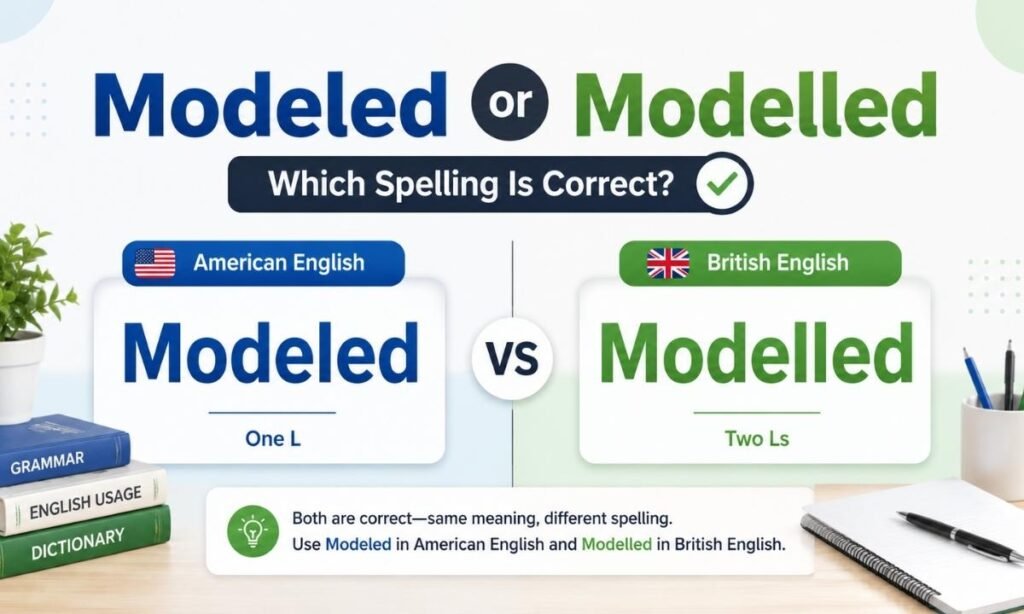
In short, modeled is the standard American English spelling, while modelled is the standard British English spelling. Both words come from the verb “model” and carry the exact same meaning. The only real difference is regional style, not grammar or definition.
Modelled or Modeled: The Core Difference
The split between these two spellings follows a pattern found throughout English. American English tends to simplify double consonants when adding suffixes like “-ed” or “-ing,” while British English generally keeps them doubled. This same pattern shows up in word pairs such as “traveled/travelled,” “canceled/cancelled,” and “labeled/labelled.”
So when you are deciding between modeled and modelled, you are really deciding which English variant you are writing in — not choosing a “correct” versus “incorrect” word in any absolute sense.
Why American English Uses One L?
American spelling conventions were heavily influenced by lexicographer Noah Webster, who favored simplified, phonetic spellings in the early 1800s. Webster’s dictionaries dropped the second “l” from many verbs ending in a single vowel plus “l,” which is why words like modeled, traveled, and labeled became standard in the United States.
This simplification wasn’t random. It reflected a broader effort to make American English spelling more consistent and easier to teach, especially in schools. Over time, “modeled” became the accepted form across US textbooks, newspapers, and style guides, including the Associated Press Stylebook and the Chicago Manual of Style.
Why British English Uses Two Ls?
British English, by contrast, follows an older spelling convention rooted in traditional English grammar rules. In this system, a single-syllable-stressed final consonant is typically doubled before adding a suffix that starts with a vowel, regardless of where the stress falls in longer words like “model.”
This is why UK dictionaries, including the Oxford English Dictionary, list “modelled” and “modelling” as the standard forms. Writers in the United Kingdom, Ireland, Australia, and many Commonwealth countries generally follow this same double-L pattern.
Modelled or Modeled: Quick Reference Table
| Feature | Modeled | Modelled |
| English variety | American English | British English |
| Consonant pattern | Single L | Double L |
| Meaning | Same | Same |
| Grammatical role | Past tense / past participle | Past tense / past participle |
| Common regions | United States, Canada (mixed usage) | United Kingdom, Australia, Ireland |
Modeled and Modelled in Real Sentences
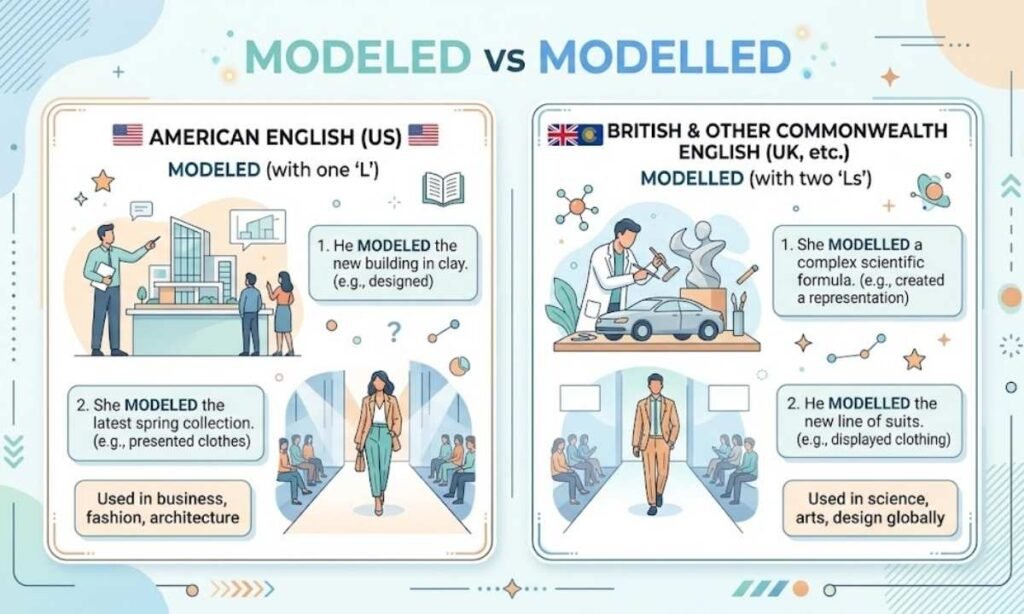
Seeing both spellings in context makes the distinction easier to remember.
Examples with modeled (American English):
- The new curriculum was modeled on successful programs from other states.
- She modeled the dress for the spring catalog.
- Researchers modeled climate patterns using historical data.
- The startup modeled its pricing strategy after larger competitors.
Examples with modelled (British English):
- The policy was modelled on similar reforms introduced in Europe.
- He modelled clothing for a well-known London fashion house.
- Scientists modelled the spread of the disease across the region.
- Their business plan was modelled closely on an established franchise.
Notice that the sentence structure and meaning stay identical — only the spelling shifts depending on the intended audience.
Modeling, Modeled, and Modeler: The Full Pattern
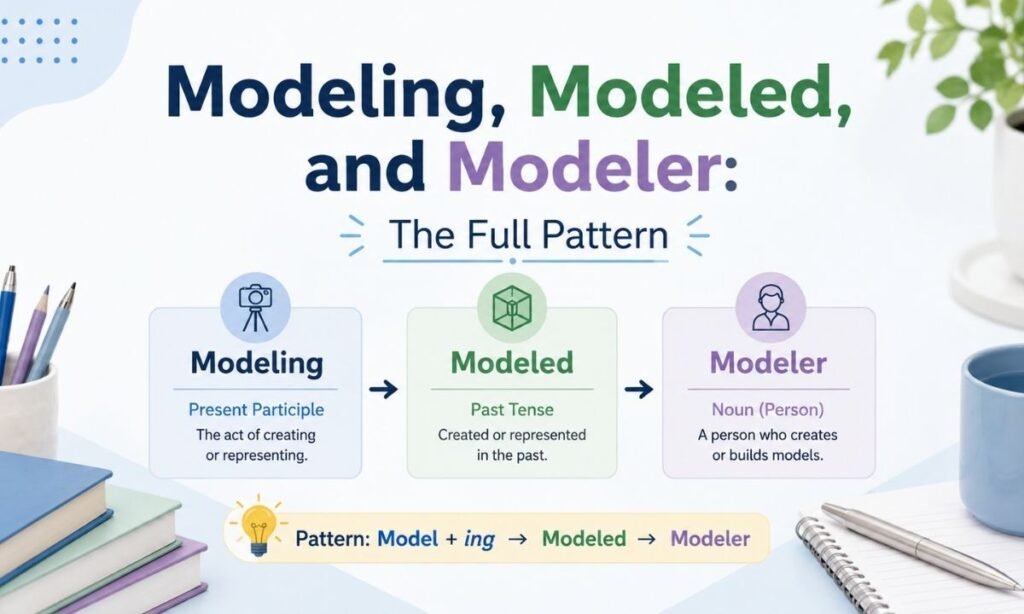
The one-L versus two-L rule doesn’t stop at the past tense. It carries through every related form of the word.
American English:
- Model (base verb)
- Modeled (past tense)
- Modeling (present participle)
- Modeler (a person who models)
British English:
- Model (base verb)
- Modelled (past tense)
- Modelling (present participle)
- Modeller (a person who models)
Keeping this pattern consistent throughout a document is important. Mixing “modeled” with “modelling” in the same piece of writing is a common and easily avoidable mistake.
Modeled On vs Modeled After: What’s the Difference?
Beyond spelling, many writers also mix up the phrases “modeled on” and “modeled after.” Both are grammatically acceptable and widely used, though there are subtle stylistic preferences.
“Modeled on” tends to appear more often in formal, academic, and British writing, suggesting that something was deliberately designed using another thing as a template. “Modeled after” is more common in American English and often implies a looser, inspiration-based resemblance rather than an exact template.
For example:
- The building’s design was modeled on classical Greek architecture (structured, intentional reference).
- Her leadership style was modeled after her mentor’s approach (inspired by, but not identical to).
Either phrase is correct, and the choice usually comes down to regional habit and personal style rather than strict grammar rules.
Choosing the Right Spelling for Your Audience
The most practical way to decide is to think about who will be reading your content.
- Writing for a US audience, American publication, or US-based business: use modeled, modeling, and modeler.
- Writing for a UK, Australian, or other Commonwealth audience: use modelled, modelling, and modeller.
- Writing for an international or mixed audience: pick one spelling system and apply it consistently throughout the entire piece.
Most word processors and browsers have a language setting that can be adjusted to match your target region. Setting this correctly before you start writing helps avoid unintentional spelling inconsistencies flagged by spellcheck tools.
Common Mistakes to Avoid
Even experienced writers slip up with these spellings. Watch out for:
- Switching between modeled and modelled within the same document
- Using “modeling” with a British audience when “modelling” is expected
- Assuming modelled is a typo rather than a legitimate British spelling
- Letting a misconfigured spellcheck language silently “correct” the wrong variant
- Forgetting that the same one-L/two-L rule applies to modeler/modeller as well
A quick proofreading pass focused specifically on this word family can catch most of these errors before publication.
Academic and Professional Writing Guidance
In academic papers, the expected spelling usually depends on the institution’s location and the style guide required. US universities typically expect modeled, while UK, Irish, and Australian institutions expect modelled. When submitting to international journals, check the publication’s author guidelines, since many specify a preferred English variant regardless of the author’s home country.
On a resume or professional document, consistency matters more than which variant you choose. A US-based hiring manager will expect modeled; a UK-based one will expect modelled. Business reports intended for a global audience should stick to one spelling system from start to finish to appear polished and professional.
Conclusion
For American English, use modeled. For British English, use modelled. Both are correct spellings of the same verb form, so this is a regional spelling difference rather than a question of right versus wrong.
The key is picking one variant based on your audience and staying consistent with it throughout your writing, including related forms like modeling/modelling and modeler/modeller.
Frequently Asked Questions
Is “modeled” the correct American spelling?
Yes, “modeled” is the standard and correct spelling in American English.
Is “modelled” a spelling mistake?
No, “modelled” is the correct British English spelling, not an error.
Are modeled and modelled pronounced the same?
Yes, both spellings are pronounced identically in speech.
Do modeled and modelled have different meanings?
No, they share the exact same meaning and grammatical function.
Should I use modeled or modelled in the USA?
Use “modeled” when writing for a US audience or publication.
Is modeling or modelling correct?
“Modeling” is American English; “modelling” is British English.
Is modeler or modeller correct?
“Modeler” is used in the US; “modeller” is used in the UK.
Which spelling should I use in academic writing?
Follow your institution’s or journal’s required English variant.
Can I use modelled in American English?
It’s understood but considered nonstandard in US writing.
Why does British English use two Ls?
It follows a traditional rule of doubling the final consonant before a suffix.