Learning to spell is one of the biggest milestones in a child’s first year of primary school. Year 1 spelling words are usually short, one or two syllable words built around common phonics patterns such as short vowels, long vowels, blends and digraphs, along with a set of high frequency sight words that appear again and again in early reading books.
This guide brings together more than 100 Year 1 spelling words used across Australian classrooms, organised by pattern so parents and teachers can practise them quickly at home or in class. You will also find simple activities, a printable style word table and answers to the questions families ask most often about Year 1 spelling.
Why Year 1 Spelling Words Matter?
Spelling at this stage is not about memorising random words. It is about teaching children to notice patterns in sounds and letters so they can read and write with confidence. A strong Year 1 word bank helps children:
- Recognise common letter patterns in new words
- Build reading fluency alongside spelling accuracy
- Gain confidence writing simple sentences
- Prepare for the slightly longer word lists used in Year 2
Most Australian programs, including those used in New South Wales, Victoria, Queensland and Western Australia, follow a similar phonics based sequence even though the exact weekly lists can vary between schools.
Year 1 Spelling Word List by Phonics Pattern
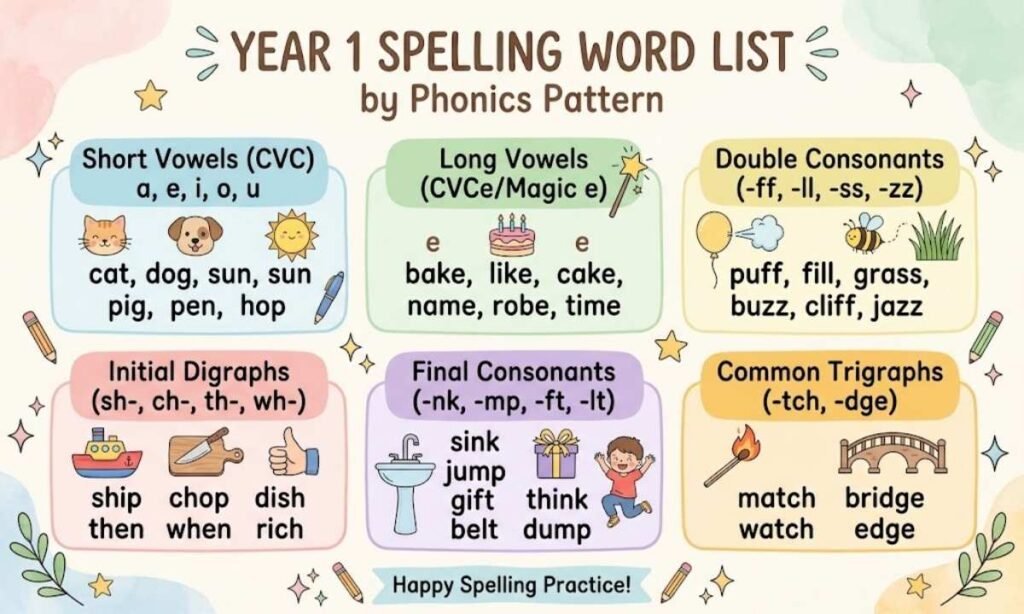
Short vowel and CVC words are usually taught first, followed by long vowel patterns and silent e words as children grow more confident.
Short vowel words: cat, dog, sun, red, big, hot, map, hen, sit, bed, cup, rug, mud, pig, fan
Long vowel and silent e words: cake, bike, home, tune, rose, made, five, note, cute, tape
Two syllable words: rabbit, pencil, garden, basket, sister, magnet, picnic, insect
| Pattern Type | Example Words |
| Short a | cat, map, fan, hand, sand |
| Short e | hen, bed, red, ten, wet |
| Short i | pig, sit, big, fish, milk |
| Short o | dog, hot, top, shop, sock |
| Short u | sun, cup, rug, mud, jump |
| Long a | cake, made, play, tail, rain |
| Long e | tree, sheep, seat, read, feed |
| Long o | note, home, coat, boat, snow |
High Frequency and Sight Words for Year 1
Sight words are common words that do not always follow regular spelling rules, so children learn them by sight rather than by sounding them out alone.
Common sight words: said, they, come, here, were, have, when, from, this, that, with, then, them, there, could, would, should, about, their, because
Tricky words to revisit often: was, of, one, two, once, people, friend, again
Practising sight words in short bursts every day tends to work better than one long session per week, since young children retain small amounts of new information more easily when it is repeated often.
Blends and Digraphs Words for Year 1
Consonant blends and digraphs teach children that two letters can work together to make a single sound or a blended sound.
- Initial blends: bl, cl, fl, gl as in blue, clap, flag, glad
- R blends: br, cr, dr, fr, gr, pr, tr as in brush, crab, drum, frog, grass, prize, tree
- Digraphs: sh, ch, th, wh as in ship, chip, thin, when
- Final blends: nt, nd, nk, mp, st as in tent, hand, pink, jump, best
These patterns show up constantly in early reader books, so practising them supports both spelling and reading progress at the same time.
How Australian Schools Structure Year 1 Spelling?
Most Australian classrooms teach spelling in a weekly cycle rather than as one large list to memorise. A typical week introduces a small pattern, practises it through short activities, and ends with a quick check.
| Day | Typical Focus |
| Monday | Introduce new pattern and words |
| Tuesday | Sound out and sort words by pattern |
| Wednesday | Write each word in a simple sentence |
| Thursday | Practice test or word games |
| Friday | Final spelling check |
This weekly rhythm, sometimes paired with a look, say, cover, write, check routine, is one of the most widely used approaches in Australian primary schools because it breaks spelling into small, manageable steps.
Fun and Effective Ways to Practise Spelling at Home
Repetition works best when it feels like play rather than a chore. Try mixing a few of these into your weekly routine:
- Word hunt: search a book or magazine for spelling words
- Missing letter game: write a word with one letter left blank
- Word sorting: group words by pattern, such as short a versus long a
- Rainbow spelling: trace each word in three different colours
- Sentence challenge: use three spelling words in one silly sentence
- Quick quiz: read a word aloud and have your child write it down
Ten minutes a day is usually enough at this age. Short, consistent sessions build stronger memory than one long weekend practice block.
Common Mistakes Parents Make When Teaching Spelling
A few habits can slow progress without anyone realising it.
- Focusing only on memorising the full list instead of the underlying pattern
- Skipping sight words because they seem too easy
- Correcting every mistake mid sentence instead of after the child finishes writing
- Practising only right before a test instead of little and often across the week
- Ignoring reading time, even though reading and spelling reinforce each other
Avoiding these habits often makes a bigger difference than adding extra word lists.
Printable and Weekly Spelling List Ideas
A simple printable checklist can make home practice easier to manage. A useful format includes the word, a space for the child to copy it three times, and a box to tick once they can spell it without looking.
Parents can also create a rotating weekly list by pulling ten words from the pattern based lists above, mixing in two or three sight words, and repeating any words the child found tricky the previous week.
How Spelling Connects to Reading and Writing Skills
Spelling, reading and writing develop together rather than in isolation. A child who can spell a word usually reads it faster the next time they see it, and using new spelling words inside their own sentences helps that word move from short term memory into long term recall. Encouraging children to use their spelling words in a diary entry, a short story or even a shopping list turns a rote task into real world writing practice.
Signs Your Child Is Ready for the Next Spelling Level
Most children are ready to move on from basic Year 1 lists once they can spell short vowel and simple sight words automatically, blend two consonant sounds together without sounding them out letter by letter, and read short one and two syllable words fluently in books. If a child is still guessing rather than sounding out familiar patterns, it is usually worth slowing down and repeating the current list before adding new words.
Frequently Asked Questions
What spelling words should a Year 1 child know?
Most Year 1 children should know short vowel CVC words, a small bank of sight words and simple blends like sh, ch and bl.
How many spelling words should Year 1 students learn each week?
Most Australian classrooms introduce around eight to twelve new words each week alongside a few revision words.
What are the easiest spelling words for Year 1?
Short, three letter words such as cat, dog, sun and hot are usually the easiest starting point for new spellers.
What are common Year 1 sight words?
Words like said, they, come, were and there are common Year 1 sight words that do not follow regular spelling rules.
How can I help my child practise spelling at home?
Short daily sessions using games, word sorting and writing sentences work better than one long weekly session.
Are these spelling words aligned with the Australian Curriculum?
Yes, the patterns and word types used here reflect the phonics based approach followed across most Australian states.
How long should a Year 1 spelling practice session last?
Around ten minutes a day is usually enough to build steady progress without overwhelming a young child.
Conclusion
Year 1 spelling is less about memorising a giant word list and more about recognising the patterns that sit underneath everyday words. By working through short vowels, sight words, blends and digraphs a little at a time, children build the reading and writing foundation they will rely on for years to come.
A short, playful daily routine, backed by a simple printable checklist, is usually all it takes to keep progress steady across the school year.