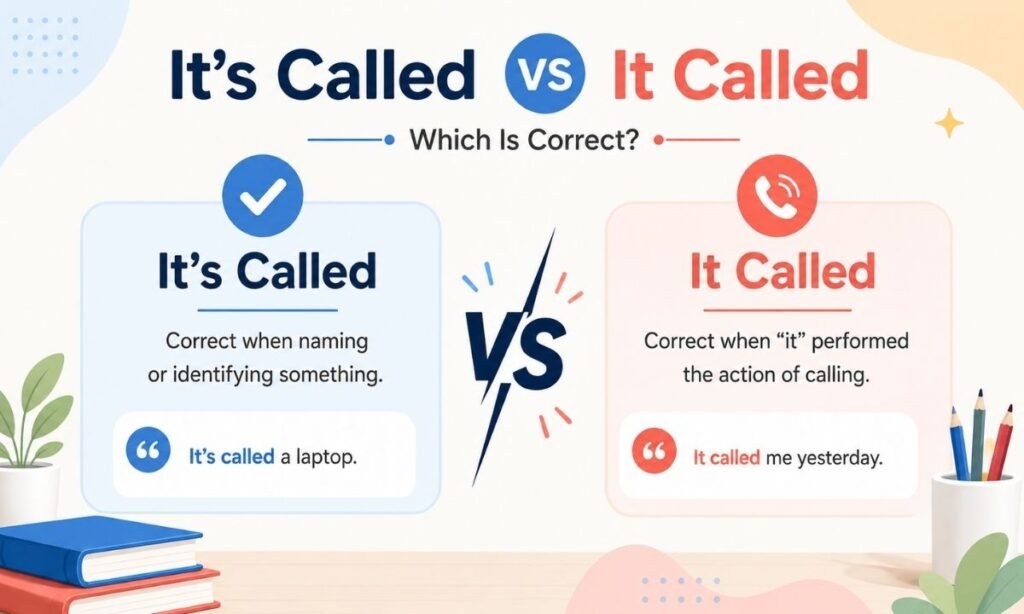
Most people type “its called” or mix up It’s Called vs It Called without realizing these three forms mean completely different things. One names something, one describes a past action, and one is simply a spelling mistake that changes the meaning of your sentence entirely.
This guide breaks down the grammar in plain English, shows real examples from everyday conversation, and gives you a one-second test you can use every single time you write.
The Short Answer
“It’s called” is correct when you are naming or identifying something, because it’s is short for “it is.” “It called” is a past tense verb phrase used when something actually performed the action of calling, such as a person, animal, or machine. “Its called” is almost always wrong when you mean “it is called,” since “its” without an apostrophe is a possessive pronoun, not a contraction.
Where the Confusion Between These Phrases Comes From
English learners and even native speakers mix these forms up for a simple reason: “it’s,” “its,” and “it” all sound identical or nearly identical when spoken aloud. Autocorrect tools also silently swap “it’s” for “its” on mobile keyboards, which makes the mistake spread through texting and casual writing.
Here is why each version trips people up:
- The apostrophe in “it’s” is invisible in speech, so the ear cannot tell the difference between “its” and “it’s.”
- “Called” can function as a naming verb (“named”) or an action verb (“phoned, shouted, summoned”), and readers often assume only one meaning applies.
- Passive voice constructions like “it’s called” feel unnatural to explain, so many writers guess instead of applying a rule.
Once you understand the grammar behind each phrase, the confusion disappears.
“It’s Called” Means “It Is Called”
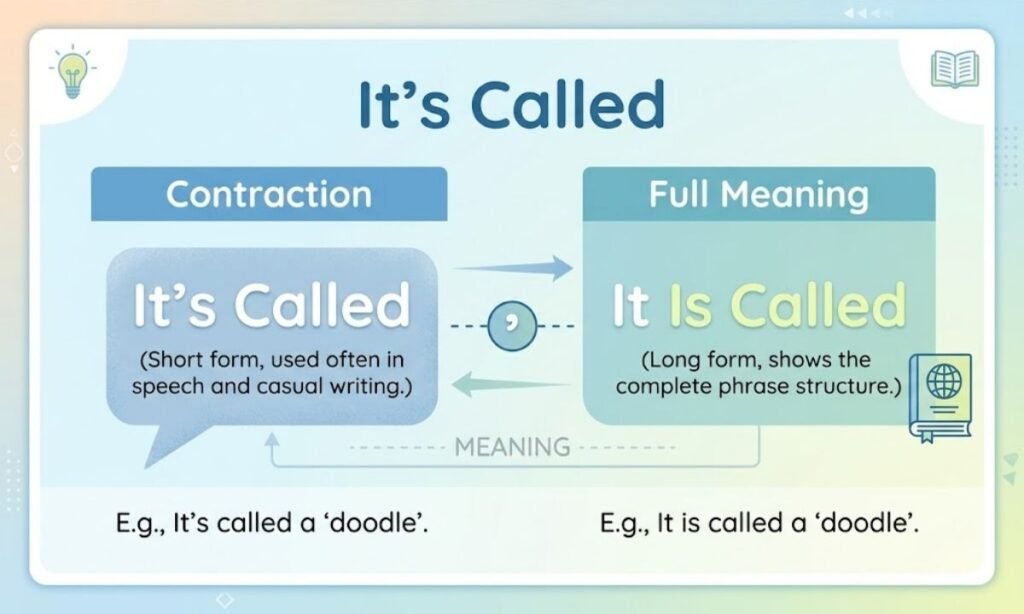
“It’s” is a contraction of “it is.” When you attach “called” after it, you create a present passive construction that identifies or names something. Think of it as the answer to the question “What is this thing named?”
Examples:
- It’s called a smartphone.
- It’s called a hoodie.
- It’s called photosynthesis.
- It’s called the Golden Gate Bridge.
In each case, nobody is performing an action. You are simply stating a name or label.
“It Called” Describes a Past Action
“It called” drops the word “is” entirely because “called” is now functioning as a standalone past tense verb. Here, “it” is the subject doing something, and that something is calling, whether that means phoning, shouting, summoning, or communicating in some way.
Examples:
- It called me yesterday.
- The bird called from the tree.
- The system called the emergency number automatically.
- The machine called the office before shutting down.
Notice that in every one of these sentences, an actual event happened. Something reached out, made a sound, or triggered contact.
Why “Its Called” Is Usually Wrong?
“Its” without an apostrophe is a possessive pronoun, meaning “belonging to it.” It never functions as a contraction of “it is,” which is exactly why “its called” cannot correctly replace “it’s called” in a naming sentence.
Compare:
- Incorrect: Its called a laptop.
- Correct: It’s called a laptop.
- Correct possessive use: The company changed its logo.
- Correct possessive use: The dog wagged its tail.
If you can substitute “it is” into the sentence and it still makes sense, you need the apostrophe.
Real Examples From Everyday English Usage
Native speakers use all three forms constantly in daily conversation, texting, and writing. Seeing them side by side in natural context makes the rule stick faster than any definition.
Correct examples with “it’s called”:
- It’s called a wrench, not a spanner, in American English.
- It’s called burnout when stress builds up over time.
- It’s called ghosting when someone suddenly stops replying.
- It’s called a food coma after a big meal.
Correct examples with “it called”:
- It called twice while you were in the meeting.
- The alarm system called security after the door opened.
- The whale called out across the ocean.
- Grandma said the doctor’s office called this morning.
Regional and Formal Writing Differences
American and British English handle these phrases the same way grammatically, but tone and formality shift how often each form appears. In academic or business writing, “it is called” often replaces the contraction “it’s called” to sound more formal, while spoken and casual writing almost always favors the shortened version.
Key style notes:
- Formal reports and technical documents lean toward “it is called” or restructure the sentence entirely, such as “this process is known as photosynthesis.”
- Conversational blogs, texts, and social captions almost always use “it’s called” because contractions read as natural and friendly.
- “It called” appears equally in both formal and informal writing since it describes a factual, completed action rather than a stylistic choice.
It’s vs Its vs It Called: The Easy Rule
| Form | Meaning | Function | Example |
| It’s | It is / it has | Contraction | It’s called a tablet. |
| Its | Belonging to it | Possessive pronoun | The bird flapped its wings. |
| It called | It performed the action of calling | Past tense verb phrase | It called the office twice. |
The fastest way to check yourself is the substitution test: replace the word with “it is.” If the sentence still makes sense, use “it’s.” If it sounds wrong or clunky, you likely need “its” or “it called” instead.
How Search Engines and Grammar Tools Interpret These Phrases?
Grammar checkers and search engines increasingly rely on context rather than word matching alone, which is why “its called” often gets flagged automatically as an error while “it called” does not. Search engines treat “it’s called” and “it is called” as semantically identical, which is why both phrases can rank for the same query, while “it called” is treated as a separate, unrelated intent tied to actions rather than definitions.
This distinction matters for writers because:
- Search intent behind “it’s called” queries is almost always definitional, meaning readers want a name or label.
- Search intent behind “it called” queries usually involves a completed event, such as a phone call, an animal sound, or a system alert.
- Mixing the two in an article confuses both readers and ranking algorithms, since the topics do not actually overlap in meaning.
Common Mistakes to Avoid
- Writing “its called” without the apostrophe when you mean “it is called.”
- Using “it called” when you actually mean to name or identify something.
- Confusing the possessive “its” with the contraction “it’s” in unrelated sentences.
- Dropping “is” from a passive sentence, leaving “it called a smartphone,” which is grammatically incomplete for naming purposes.
- Assuming “called” only ever means “named,” when it frequently means phoned, shouted, or summoned.
What Is the Difference Between “What Is It Called?” and “It’s Called”
“What is it called?” is a question that asks someone to identify or name a thing. “It’s called…” is the natural response that supplies that name.
Example exchange:
- Question: What is this tool called?
- Answer: It’s called a wrench.
- Question: What is this dish called?
- Answer: It’s called shakshuka.
It’s Called vs It Called vs It Was Called
Understanding tense helps clarify the full picture of how these phrases shift over time.
- It’s called the Liberty Bell. (present naming)
- It was called something different years ago. (past naming, before a change)
- It used to be called something else. (former name, now retired)
- Is it called a sedan or a coupe? (a direct question about naming)
Quick Reference Cheat Sheet
| Situation | Correct Phrase | Example |
| Naming or identifying something | It’s called | It’s called a keyboard. |
| Describing a past action | It called | It called twice yesterday. |
| Showing possession | Its | The cat licked its paw. |
| Formal or written tone | It is called | This condition is called insomnia. |
| Asking about a name | Is it called | Is it called a hoodie or a sweatshirt? |
How to Remember the Correct Form?
A single memory trick covers almost every situation you will run into:
- Name equals “it’s called.”
- Action equals “it called.”
- Possession equals “its,” with no apostrophe.
If you are ever unsure, say the sentence out loud with “it is” instead of the contraction. If it still makes sense, the apostrophe belongs there.
Frequently Asked Questions
Is “it’s called” grammatically correct?
Yes, it is fully correct when naming or identifying something, since it simply means “it is.”
Is “it called” grammatically correct?
Yes, it is correct whenever “it” performs the actual action of calling, phoning, or summoning.
Is “its called” correct?
No, this is almost always incorrect when you mean “it is called,” because “its” is a possessive pronoun, not a contraction.
What is the difference between it’s and its?
“It’s” means “it is” or “it has,” while “its” shows possession, meaning something belongs to it.
Can “it called” mean “it is called”?
No, “it called” only describes a past action and cannot be used to name or identify something.
What does “it’s called” mean?
It means something is named or identified by a specific term, label, or title.
Should I write “it’s called” or “it is called”?
Both are correct, but “it’s called” sounds conversational while “it is called” suits formal writing.
Conclusion
Use “it’s called” whenever you are naming or identifying something. Use “it called” whenever “it” actually performed the action of calling in the past. If you meant “it is called,” always write “it’s called” with the apostrophe, never “its called.”