Anyone who has typed “Per Se vs Per Say” into a search bar has probably paused halfway through, unsure whether it ends in “se” or “say.” The confusion is completely understandable because of how the words sound out loud.
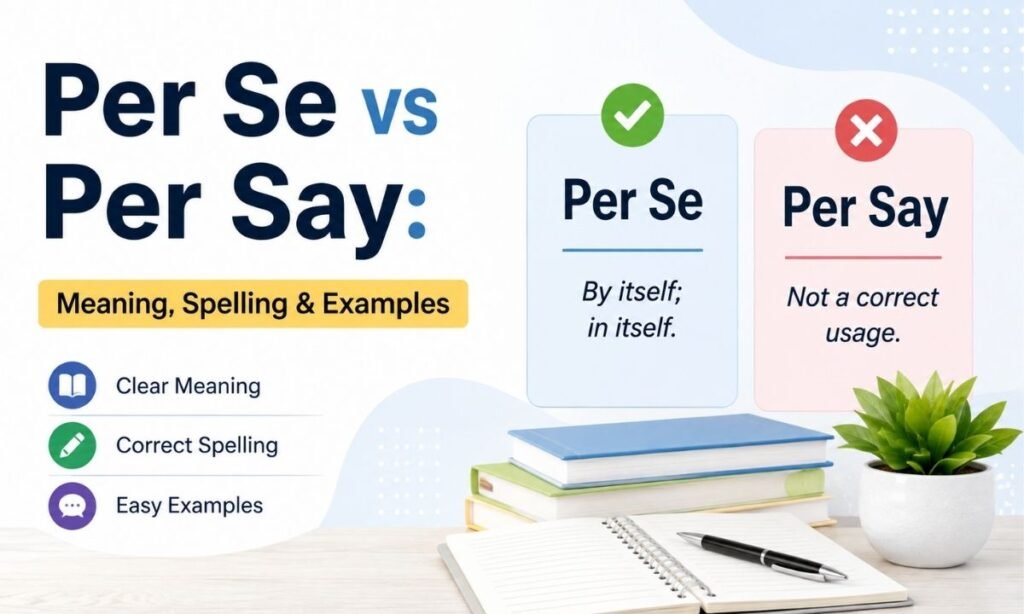
The short answer is that per se is the only correct spelling. Per say is simply a phonetic misspelling that happens because the Latin phrase is pronounced almost exactly like the word “say.” Once you understand where the phrase comes from, the confusion tends to disappear for good.
Per Se or Per Say: Which One Is Correct
Per se is a Latin expression that has been fully absorbed into everyday English writing. Per say is not a recognized word or phrase in any major dictionary, including Merriam-Webster, Cambridge, and Collins.
Is Per Se the Correct Spelling?
Yes. Every major dictionary lists only per se as the accepted spelling for this expression.
Is Per Say Ever Correct?
No. Per say has no dictionary entry and is treated purely as an error in professional and academic writing.
Why Do People Spell It Per Say?
People rely on how a phrase sounds rather than how it is written, and the second syllable of per se sounds almost identical to the word say.
What Does Per Se Mean?
Per se translates loosely as “by itself,” “in itself,” or “intrinsically.” It is used to isolate one specific quality of something from the larger picture surrounding it.
Per Se Meaning in Simple English
In plain terms, per se means you are talking about a thing purely on its own, without factoring in anything connected to it.
What Does Per Se Mean in a Sentence?
When placed in a sentence, per se usually signals a contrast, such as saying something is not the real issue by itself, but rather something related to it is.
Per Se Meaning in American English
American writers frequently use per se in journalism, business writing, and casual conversation to soften or clarify a statement.
Origin and Latin Roots of the Phrase
Per se comes directly from Latin, combining per, meaning “by” or “through,” with se, meaning “itself.” Collins traces its first recorded English use back to the 1500s, and it has remained largely unchanged in meaning ever since.
Where the Phrase Came From?
Latin legal and academic texts used per se to separate a concept from its surrounding context, a habit English writers eventually adopted.
Why English Kept the Latin Form?
Rather than translating it fully, English speakers kept the original Latin words because the phrase became a recognizable and efficient shorthand.
How to Use Per Se Correctly?
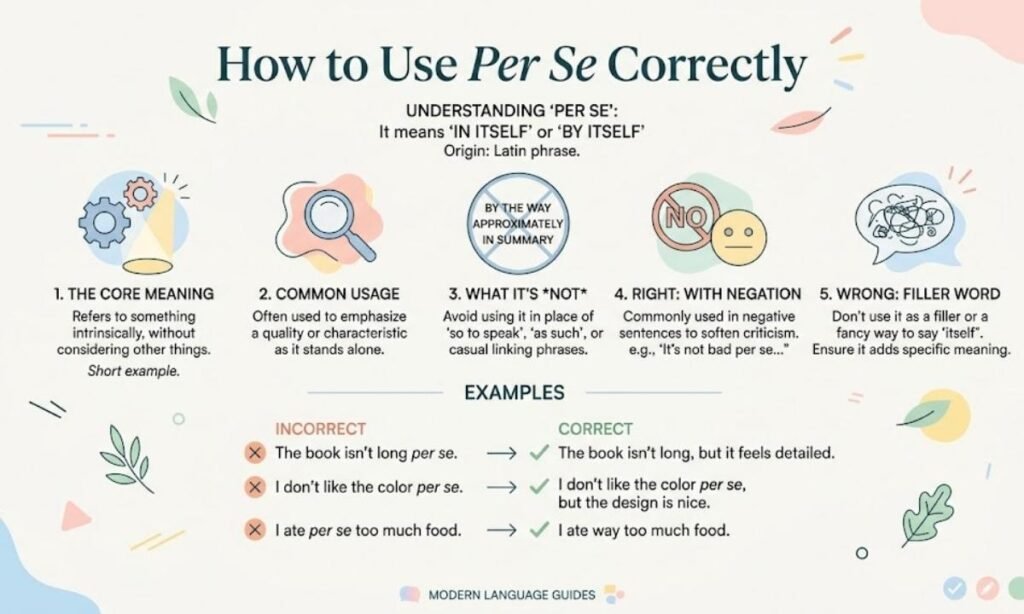
Per se typically appears right after the noun or idea it modifies, and it is often paired with a “not X per se, but Y” structure.
When Should You Use Per Se?
Use it when you want to separate one narrow idea from a broader situation, especially when correcting a misunderstanding.
How to Place Per Se in a Sentence?
Most writers insert per se directly after the subject being discussed, frequently setting it off with commas for clarity.
Can Per Se End a Sentence
Yes, it can appear at the end of a sentence for emphasis, such as saying something “isn’t the problem, per se.”
Per Se Examples in Everyday Writing
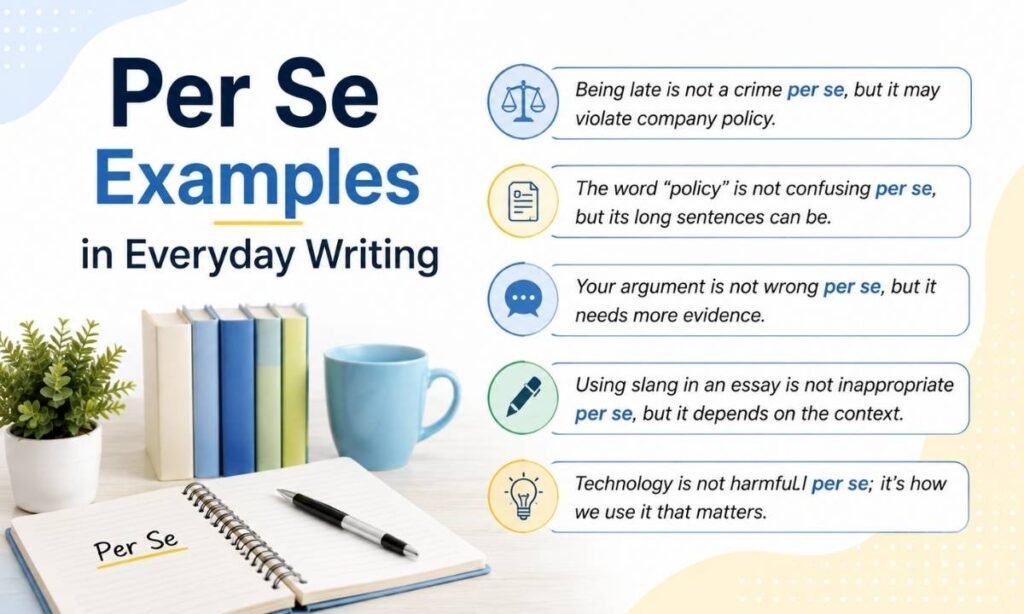
Below are natural examples showing how flexible the phrase is across different writing styles.
- I do not dislike the plan per se, but I think the timeline is unrealistic.
- The product itself is not expensive per se, but the shipping fees add up quickly.
- It was not the long hours per se that bothered her, but the lack of recognition.
- Height per se does not determine success in basketball, but it certainly helps.
- The meeting was not unproductive per se, just longer than it needed to be.
Per Se in Casual Conversation
Spoken English often uses per se to soften a criticism without sounding overly harsh.
Per Se in Professional Writing
Business emails and reports use per se to clarify that a specific detail, rather than the whole plan, is the focus.
Per Se in Academic Writing
Students and researchers use per se to narrow an argument to one precise variable being studied.
Per Se vs Per Say Comparison Table
| Expression | Correct Usage | Meaning or Status |
| Per se | Yes | By itself, in itself, intrinsically |
| Per say | No | Common misspelling with no dictionary listing |
| Per Say | No | Same error, incorrect capitalization does not fix it |
| Perse | No, for this phrase | A separate word referring to a grayish blue color |
Per Se Pronunciation Guide
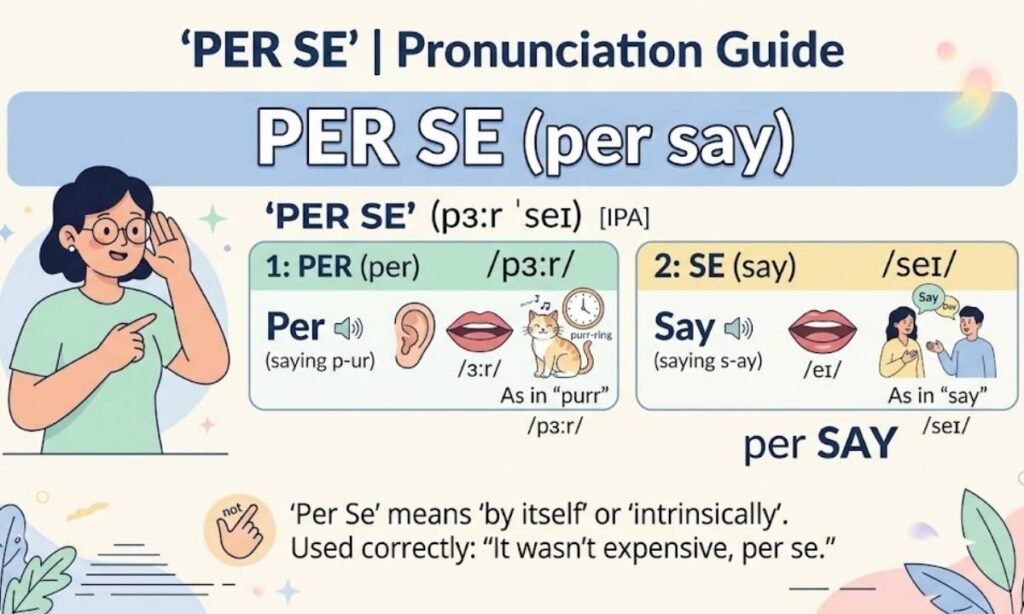
Cambridge lists the standard American pronunciation as close to “per say,” which is exactly why the misspelling is so widespread.
How to Pronounce Per Se?
Say it as two syllables, with the second syllable rhyming with the word “day.”
Why Does It Sound Like Per Say?
Latin vowel sounds are carried into English pronunciation differently than Latin spelling, creating a mismatch between how it looks and how it sounds.
Per Se Grammar and Punctuation Rules
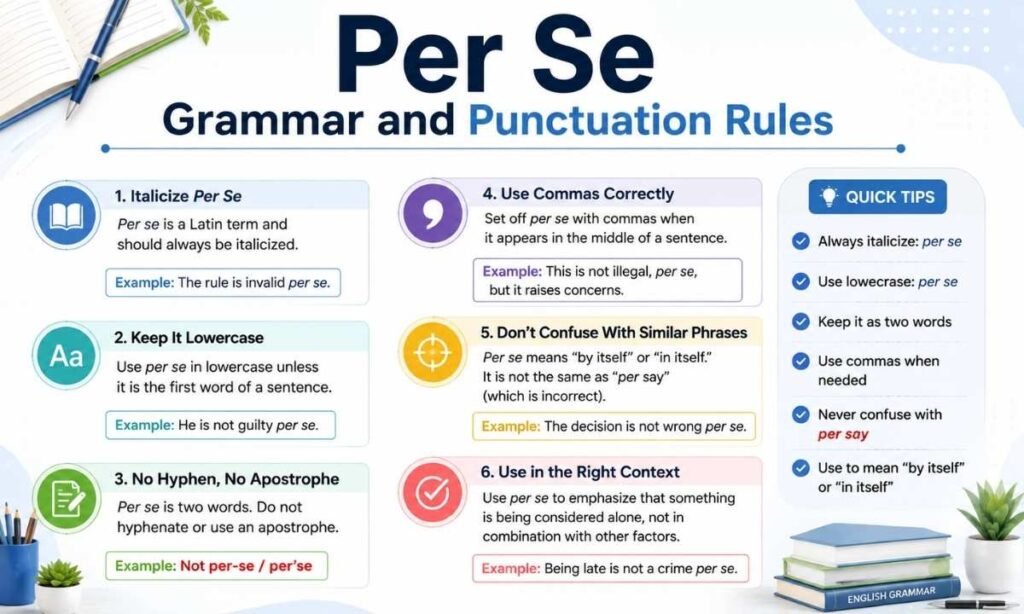
Per se functions as an adverb, and it is always written as two separate words rather than one combined term.
Is Per Se One Word?
No, it is always two words, and combining it into “perse” changes it into an unrelated term for a color.
Should Commas Surround Per Se
Commas are optional but common, especially when the phrase interrupts the natural flow of a sentence for emphasis.
Per Se Synonyms and Close Alternatives
According to Collins and Vocabulary.com, per se shares meaning with several other expressions used to isolate an idea.
- In itself
- As such
- Intrinsically
- Essentially
- In and of itself
Common Mistakes Writers Make With Per Se
- Writing “per say” instead of “per se” because of how the phrase sounds when spoken aloud.
- Merging it into “perse,” which is a completely different English word.
- Overusing the phrase in writing where a simpler word would read more naturally.
- Using per se when the intended meaning is closer to “for example” or “specifically.”
Per Se in Business and Marketing Writing
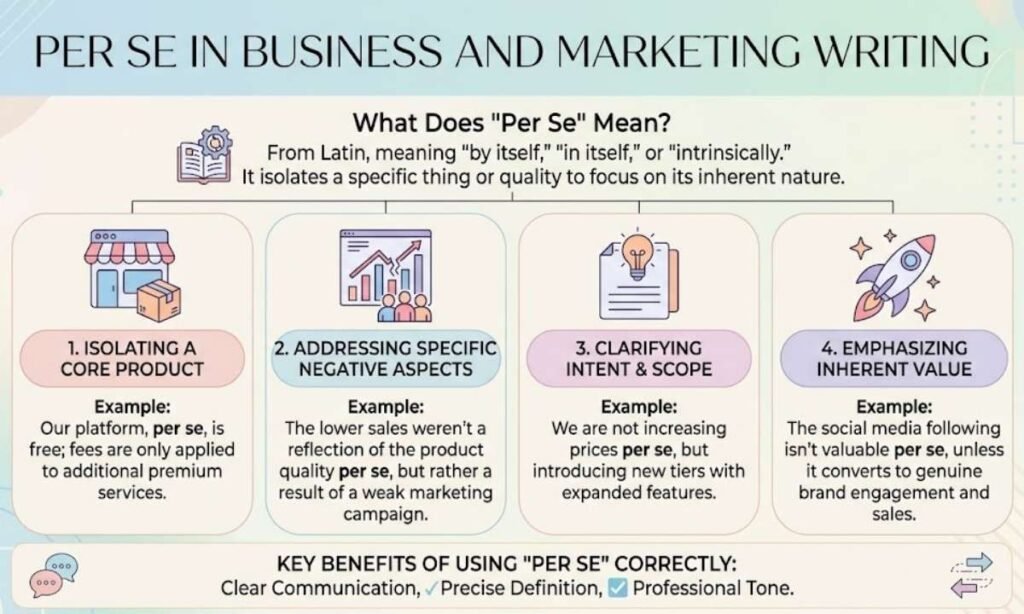
Marketing copy often leans on per se to draw a line between a product’s core feature and everything surrounding it, such as clarifying that price per se is not the deciding factor for most customers, but perceived value is.
Per Se in Legal Documents and Court Rulings
Merriam-Webster notes a distinct legal meaning, where per se describes something established automatically under a rule, without needing extra proof. Legal doctrines such as negligence per se and illegal per se rely on this exact sense, treating certain actions as violations by definition alone.
Per Se Across Different English Accents
British, American, and Australian speakers all pronounce per se in a very similar way, which explains why the per say misspelling shows up across nearly every English speaking region rather than being tied to one accent.
Digital Search Trends Around Per Se and Per Say
Search behavior consistently shows large volumes of people typing “per say” into search engines while looking for the correct spelling, which is exactly why dictionaries such as Dictionary.com and Merriam-Webster maintain dedicated pages addressing the misspelling directly.
Quick Cheat Sheet for Using Per Se
| Situation | What to Remember |
| Spelling | Always per se, never per say |
| Word count | Two separate words |
| Placement | Usually right after the noun it modifies |
| Common pattern | Not X per se, but Y |
| Formality | Works in both formal and casual writing |
Frequently Asked Questions
Is it per se or per say?
Per se is correct. Per say is a common phonetic misspelling with no dictionary support.
What does per se mean?
It means by itself, in itself, or intrinsically, isolating one idea from a larger context.
Is per se one word?
No, it is written as two separate words in every standard dictionary.
Why is per se spelled that way?
It comes directly from Latin, where per means by and se means itself.
Can per se be used in a sentence?
Yes, it is commonly used to clarify that something specific, not the whole situation, is being discussed.
Is per se formal or informal?
It fits comfortably in both casual conversation and formal academic or legal writing.
What is a good synonym for per se?
Common alternatives include in itself, as such, essentially, and intrinsically.
Conclusion
Per se is a small phrase that carries a lot of precision once you understand how to use it. Remembering its Latin origin, by itself, makes both the spelling and the meaning far easier to keep straight, so the next time you reach for it in writing, you can use it with full confidence instead of guessing at the spelling.